









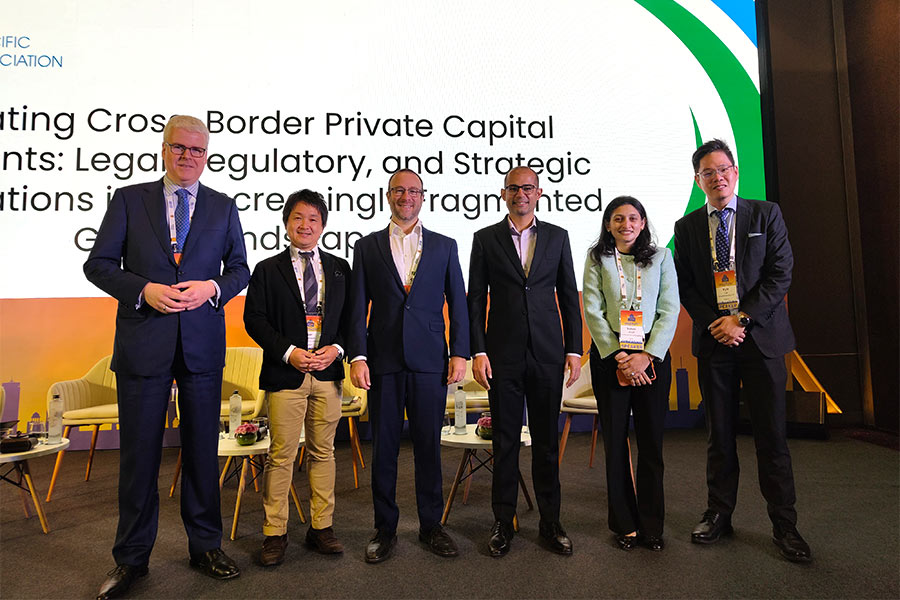
The Inter-Pacific Bar Association (IPBA) panel “Navigating cross-border private capital investments” discussed the evolving private equity (PE) landscape on 28 February, focusing on key sectors and regulatory trends, and how investors were carrying on despite headwinds.
On day three of the IPBA conference, Saloni Shroff, partner at Cyril Amarchand Mangaldas from Mumbai, discussed the hot sectors for private equity investment firms in the past year. She said large parts of the healthcare sector such as multi-speciality hospital chains and blood diagnostic centres were attracting private capital from large players such as KKR and Temasek. She added that the infrastructure sector had seen a lot of investments in terms of roads, railways and highways.
Akshat Babbar, managing director at Chrys Capital from Mumbai, agreed with Shroff’s assessment. He said that as a homegrown PE firm, Chrys Capital had “focused on a handful of core sectors – tech, financial services, consumer healthcare, life sciences”, and his firm consistently deployed investment in these sectors during the past 30 years.
“We end up looking at sectors that have very strong secular tailwinds, and are not subject to ebbs and flows of short or medium-term movements in the environment,” added Babbar.
Moderator Markus Rasner, partner at Oppenhoff based in Frankfurt, suggested continuing a discussion from the IPBA last year at Chicago as to what constituted “mid-market”. To this, Babbar said USD500 million or larger would constitute a large PE investment. Values between USD50 million and USD500 million become mid-market, and anything below that would constitute a venture capital investment.
Kyle Lee, a partner at WongPartnership from Singapore, said for Southeast Asia values between USD50 million and around USD400 million would count as a mid-market investment.
Turning to Japan, Rasner observed that Japanese investors were active both inside and outside the country and asked Gen Takahashi, a partner at Anderson Mori & Tomotsune from Singapore, as to the key drivers behind the investments.
Takahashi responded, “There has been a booming trend after the pandemic.
One, the weak yen may be a bad thing for the Japanese, but that has encouraged foreign investors to come into Japan. The other is due to low interest rates, which has been a trend for many years and it is predicted to continue in the future.”
Claudio Oksenberg, a partner at Mattos Filho from Sao Paulo, said Brazil’s focus had been on infrastructure, agribusiness, life sciences and technology. He said the country’s large population and market size made it attractive to PE investors.