









In the tussle between nature and development, the Supreme Court has come out on the side of the environment by ruling that projects cannot start until an environmental clearance has been granted. Katherine Abraham reports
In a recent Supreme Court ruling in the writ petition Vanashakti v Union of India, Justice Abhay Oka struck down the 2017 notification and the 2021 office memorandum, which allowed for retrospective ex-post facto environmental clearance for development projects, terming them illegal and contradictory to the principles of environmental jurisprudence.
The 2017 notification from the Ministry of Environment, Forest and Climate Change of India on 14 March 2017, was designed to address a category of projects that had commenced without obtaining the statutorily required prior environmental clearance under the Environmental Impact Assessment (EIA) Notification, 2006.
The 2021 office memorandum that the government issued on 7 July 2021, was a standard operating procedure (SOP) for handling “violation cases” under the EIA notification, as per directions from the National Green Tribunal. The memorandum set out a process for dealing with projects that commenced without prior clearance.
“The Vanashakti judgment is a watershed moment for Indian environmental jurisprudence,” says Varun Singh, a managing partner at Foresight Law Offices in New Delhi, who has worked on various environmental law cases.
An ex-post facto environmental clearance is granted by authorities at the state or federal level after taking into account several factors that could potentially damage the environment.
Citing that access to a clean environment falls under article 21 (right to life) of the Constitution, the court further instructed the central government to restrain itself from issuing circulars, orders, office memorandums (OMs) and/or notifications that granted ex post facto clearance “in any form or manner”, as it would be in contravention of the EIA notification. The court, however, has clarified that projects that have already received clearance under the two notifications would remain unaffected.
Ashutosh Senger, an advocate-on-record and environmental lawyer at Shardul Amarchand Mangaldas & Co (SAM) in New Delhi, says, “This judgment has established an ‘absolute doctrinal bar’ and a ‘zero-tolerance’ approach to ex-post facto environmental clearances by prospectively prohibiting any similar future mechanism, in any form or manner.”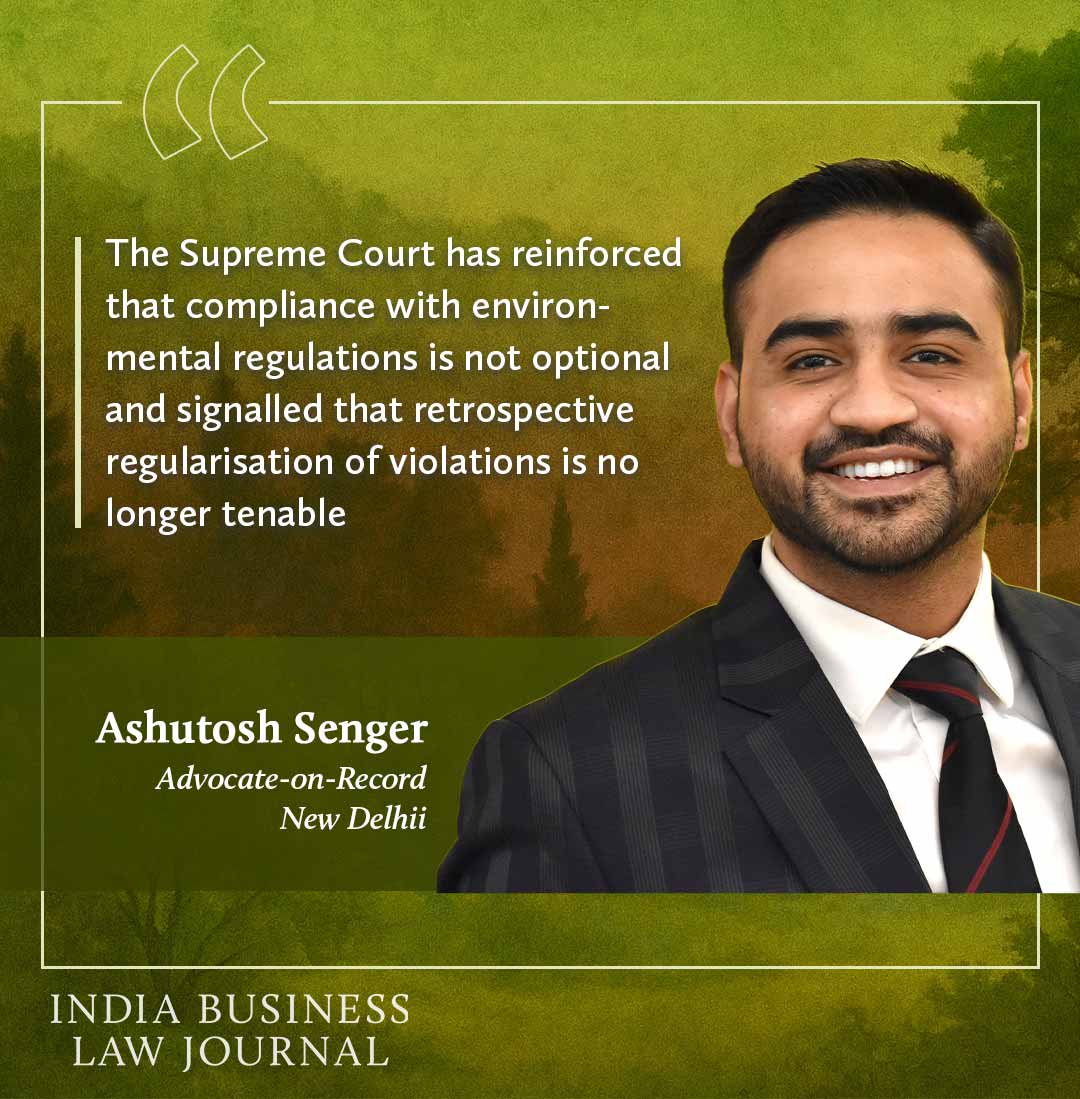
Speaking of the court’s decision to strike the previous two government notifications, Senger says, “The Supreme Court has reinforced that compliance with environmental regulations is not optional and signalled that retrospective regularisation of violations is no longer tenable. This will drive environmental stewardship and compliance to be integrated from the project’s very inception.”
You must be a
subscribersubscribersubscribersubscriber
to read this content, please
subscribesubscribesubscribesubscribe
today.
For group subscribers, please click here to access.
Interested in group subscription? Please contact us.
你需要登录去解锁本文内容。欢迎注册账号。如果想阅读月刊所有文章,欢迎成为我们的订阅会员成为我们的订阅会员。