




Will AI replace paralegals in the frontline of legal work? Chandu Gopalakrishnan reports
To kickstart her work, Samridhi Jain, a final-year law student and part-time paralegal in Bengaluru, turns to tools like ChatGPT, Claude and Perplexity.ai. These AI-powered platforms have streamlined tasks like legal research, helping her quickly sift through complex statutes and summarise case law.
“My workflow is improved with ChatGPT’s efficient research and understanding, and Claude’s outputs are effective for client-facing work, minimising the need for heavy editing while maintaining professionalism,” she explains.
“While certainly not flawless, these AI tools often provide the initial confidence to dive into a task, enabling me to ask more informed questions of seniors and grasp the broader context of the transaction I am working on.”
While Jain appreciates the efficiency these tools bring, she remains cautious about their limitations. “I still double-check everything because AI isn’t at the point where we can fully rely on it, especially when clients expect expert advice from experienced lawyers,” she observes.

According to her, AI tools and legaltech services free up lawyers from tedious and repetitive tasks, allowing them to focus on developing business-focused skills and providing strategic insights. But the question arises as AI tools and the host of new legaltech services become more sophisticated: will they replace paralegals or simply augment their roles?
To understand the issue, India Business Law Journal sought the views of various stakeholders in the legal ecosystem, from law firms, policymakers and educators to legaltech companies and, of course, paralegals.
The role of paralegals
In India, paralegals perform essential functions that are often hidden behind the scenes. They assist with legal research, draft documents and help clients navigate the complexities of the legal system. Yet, unlike the US or the UK, where paralegals are formally recognised and certified, 含羞草社区 legal framework offers them little recognition.
The Advocates Act, 1961, which governs the legal profession in India, fails to define or acknowledge paralegals as a distinct category. This regulatory oversight limits career opportunities and perpetuates the ambiguity surrounding their role. Despite their contributions, paralegals in India operate without the formal recognition or structured support systems that could help them thrive.
While paralegals in India do not need formal legal qualifications, having legal education or training significantly enhances their ability to perform effectively, especially in specialised or complex legal environments. The National Legal Services Authority (NALSA) attempted to address this training gap through its paralegal volunteer scheme in 2009. The initiative trains individuals to provide grassroots legal aid and promote awareness about citizens’ rights.
While the scheme is laudable, several respondents pointed out that it is focused primarily on community-based work, leaving paralegals operating in corporate or litigation settings without formal status or standardised training.
Where AI tools could help
While the roles performed by paralegals vary from firm to firm, below are the tasks they generally perform.
- Drafting. Prepare legal drafts, affidavits, wills and contracts.
- Court support. Organise case files, index documents and support lawyers during proceedings.
- Liaison. Facilitate client-lawyer communication and navigate procedural complexities.
- Administrative tasks. Manage records, correspondence and scheduling in legal offices.
- Dispute resolution. Mediate conflicts and support Lok Adalats (an alternate dispute resolution forum) for settlements.
- Research. Conduct legal research, and compile statutes and precedents for cases.
- Technology. Use legaltech tools for research, document review, e-litigation and compliance support.
- Legal awareness. Conduct literacy camps and educate communities about rights and welfare schemes.
- Legal aid. Assist in filing free legal aid applications under the NALSA (National Legal Services Authority) and other schemes.
According to the responses collated from four legaltech firms, at least four of these functions can be automated completely. Their assessment is divided into three categories. - High automation potential. Drafting, administrative support, research and technology-assisted services can be significantly automated with current tools.
- Partial automation potential. Legal awareness and liaison services can benefit from automation but require human involvement for cultural or emotional contexts.
- Low automation potential. Advocacy and dispute resolution remain highly human-centric due to their reliance on empathy, judgement and interpersonal skills.
The responses IBLJ garnered show concern that these technologies, designed to automate tasks traditionally performed by paralegals, might render many tasks obsolete. However, the consensus among legal professionals right now is that AI will not replace paralegals but rather redefine their roles.
Komal Gupta, chief innovation officer at Cyril Amarchand Mangaldas (CAM) in New Delhi, asserts that AI is revolutionising workflows by streamlining repetitive tasks. CAM claims to be the first Indian law firm to adopt artificial intelligence and machine learning-based legaltech in its day-to-day practice.
“AI will be instrumental in unlocking the wealth of information within the firm. Looking ahead, AI will revolutionise both internal operations and client-facing services by streamlining processes like drafting, legal research and due diligence, while offering predictive insights and personalised solutions,” says Gupta.

Paralegals themselves echo these sentiments. Shivansh Singh, a law student balancing academic and paralegal work in Bhubaneswar, emphasises the importance of adaptability. “AI is a great tool when used carefully. I come from a time when AI was practically non-existent, like in 2020 and 2021,” he says.
“Back then, I had to conduct research manually and simplify keywords myself. Now, AI simplifies keywords for me, which makes searching on platforms like SCC Online and Manupatra much easier.”
Ayush Chandra, chair of the Policy Innovation Committee at the Indian Society of Artificial Intelligence and Law in Mumbai, says the concern crops up from certain mindsets.
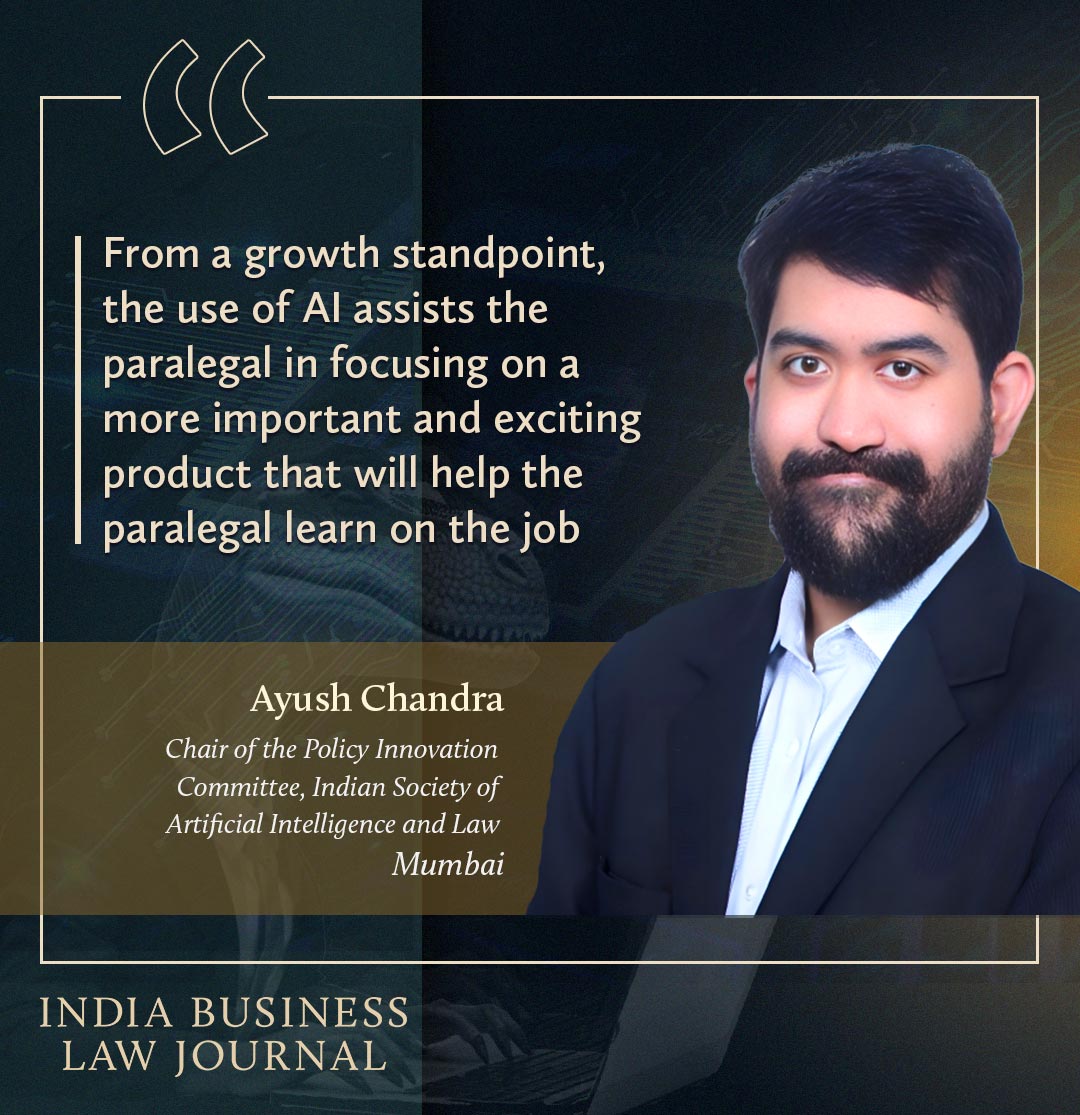
“From a growth standpoint, the use of AI assists the paralegal in focusing on a more important and exciting product that will help the paralegal learn on the job, rather than working on such aspects that would require hours of work on something mundane and cause extreme burnout,” says Chandra.
He agrees that there are some tasks that will still require paralegals to go through and interpret. “In some domains, particularly litigation and decision making, AI technologies cannot deliver the necessary outcomes; the human touch will always be required to replace a computer.”
The potential of AI use remains perfunctory as of now, according to Hera Nafis, advocate at the High Court of Calcutta, in Kolkata. “At its current level of maturity, AI remains best suited as a secondary or tertiary resource rather than a replacement for paralegals,” she says.
According to Nafis, the real survivors in this shift to increased use of technology will be the paralegals who embrace AI tools and integrate them into their work processes, leveraging technology to enhance efficiency and precision.
“Far from being replaced, these individuals are likely to redefine their roles, evolving into indispensable legal technologists who bridge the gap between traditional legal work and the modern capabilities of AI-driven tools,” she says.
According to most respondents, the potential of AI to transform legal workflows is perhaps most evident in its ability to automate repetitive tasks like due diligence, legal research and document review. These are the areas in which most legaltech firms now specialise.
You must be a
subscribersubscribersubscribersubscriber
to read this content, please
subscribesubscribesubscribesubscribe
today.
For group subscribers, please click here to access.
Interested in group subscription? Please contact us.
你需要登录去解锁本文内容。欢迎注册账号。如果想阅读月刊所有文章,欢迎成为我们的订阅会员成为我们的订阅会员。