










Following state-led litigation and lengthy court debates about games of skill versus games of chance, the Online Gaming Act, 2025, bans all such games and threatens to unplug the sector for good. Indrajit Basu reports
India’s booming real-money gaming (RMG) industry was recently jolted by a sudden and seismic shift. The Promotion and Regulation of Online Gaming Act, 2025, signed into law on 22 August, outlawed all online real-money gaming nationwide. An industry once touted to be worth about USD2.5 billion a year, employing millions and drawing an estimated USD3 billion in foreign investment, now faces an existential crisis.
This is not just another rule change. Overnight, the fight over RMG in India has suddenly shifted beyond the questions of entertainment or addiction.
Legal experts warn the new law risks straying into constitutional overreach – eroding judicial precedent, weakening federal principles, and stretching rules to their limits. The standoff has also crystallised into a clash between state and central authorities, a test of how digital economies should be regulated, and a struggle to balance citizen protection with fundamental rights.
“The act creates a profound constitutional tension by asserting central authority over a traditionally state-governed domain, [which] represents a significant federal overreach that violates article 246(3) of the constitution,” says Salman Waris, the New Delhi-based managing partner at TechLegis. Waris’ firm specialises in technology, media and telecommunications, and he counsels foreign and Indian RMG clients.
Article 246(3) of the Indian Constitution gives states exclusive power to make laws on certain subjects, including gambling. This means only state governments – not the federal government in New Delhi – can decide whether to allow or ban gambling activities, unless the constitution specifically permits central intervention.
According to Ashish Deep Verma, the New Delhi-based managing partner at Vidhisastras, “The act complicates this landscape by imposing a uniform national ban on online money games, regardless of whether they are based on skill or chance, if they involve monetary stakes.” Verma has been involved in advising RMG companies on transition strategies, product redesign and regulatory engagements following the passage of the law.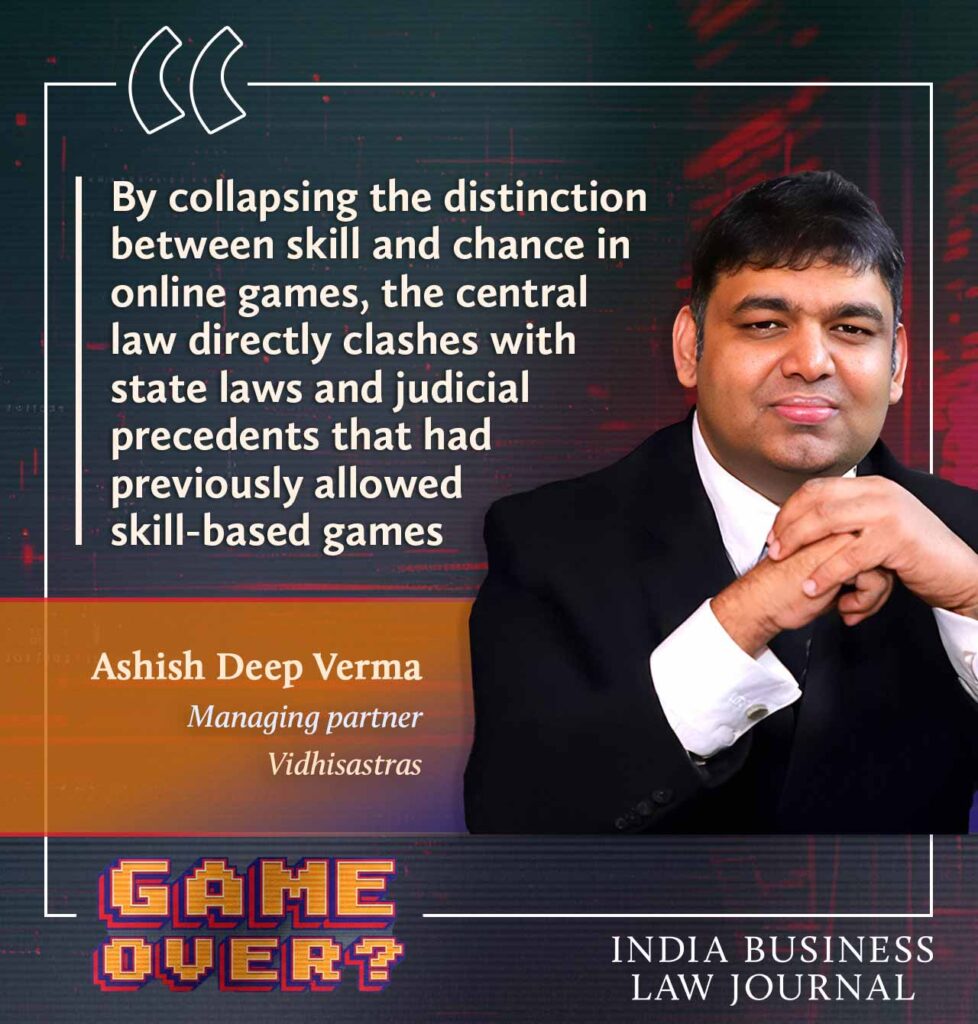
Constitutional conflict
“By collapsing the distinction between skill and chance in online games, the central law directly clashes with state laws and judicial precedents that had previously allowed skill-based games,” says Verma.
Authorities, however, cite union list entries – e.g. entries 31, 42, 51 and 97 on broadcasting, interstate trade, strategic industries and residuary powers, which empower parliament to legislate where central control serves the public interest – to justify central intervention. Legal experts doubt this argument will survive constitutional scrutiny.
You must be a
subscribersubscribersubscribersubscriber
to read this content, please
subscribesubscribesubscribesubscribe
today.
For group subscribers, please click here to access.
Interested in group subscription? Please contact us.
你需要登录去解锁本文内容。欢迎注册账号。如果想阅读月刊所有文章,欢迎成为我们的订阅会员成为我们的订阅会员。