










Can in-house counsel step up as champions of business growth amid the challenges of compliance and technology? Claire Zhao reports
As the Chinese proverb goes, the wise adapt to changing circumstances.
At the outset of China’s 15th Five-Year Plan, development resonates as the decade’s keynote, with “new quality productive forces” accelerating the transition from a broad strategy to sector-level execution.
This domestic evolution, however, is unfolding against a fractious global landscape defined by geopolitical friction and enduring conflict, where uncertainty continues to mount.
Compounding this complex picture is a potential technological inflection point. Riding the wave of last year’s agentic AI breakthrough, OpenClaw and its growing “claw” ecosystem stand to reshape the contours of the AI era.
This confluence of changes is rewriting the calculus of growth. Compliance is no longer merely a tick box but a value engine in its own right, while AI is shifting from the periphery to the core of business operations.
How is the legal sector responding to this adaptation? Top legal minds share their insights in steering a steady course through the complexity.
Anticipating uncertainties
Businesses across multiple sectors are feeling the squeeze as a raft of new legislation takes effect this year, driving up both regulatory oversight and compliance burdens.
China’s updated Cybersecurity Law, effective from January, brings AI under its purview for the first time. It requires companies to implement risk monitoring and assessment procedures for AI, and is backed by substantially increased penalties – up to RMB10 million (USD1.4 million) – delivering a clear warning to the sector.
GCL Group chief legal officer Dai Mengyang says in-house counsel must now prioritise complex legal questions from this increasingly automated world, such as the legality of data sources in AI model training, copyright ownership of generated content and the scope of platform liability.
February’s introduction of the Measures for Administration of Commitment and Conformity Certificates for Agricultural Product Quality and Safety marks a game-changing reform, according to Leon Li, legal manager for the Asia-Pacific at Driscoll’s Management. The legislation establishes a clear legal principle that producers bear primary responsibility by requiring them to issue legally enforceable conformity certificates and maintain comprehensive production records.
Li says the practical outcome is that agricultural goods cannot enter the market without this legal guarantee. In the case of quality failures, regulators can initiate traceability proceedings, and can hold agricultural material suppliers and even technical service providers jointly liable.
March brings yet another compliance milestone. The Provisions on the Supervision and Administration of Live-streaming E-commerce Operators’ Implementation of Primary Food Safety Responsibilities now require all food supply chains to interface with blockchain-based traceability systems, ensuring full provenance from origin to end consumer. For agricultural and food companies, this means that robust supplier verification and data retention capabilities are no longer optional but are an “admission ticket” to mainstream sales channels. “Without substantial investment in digital traceability, companies will find themselves locked out,” says Li.
Beyond the mounting pressure at home, overseas expansion must also navigate a labyrinth of overlapping regulations and extraterritorial enforcement. SonoScape, a Shenzhen-based medical manufacturer of ultrasound and high-definition endoscopy systems, exemplifies the challenge. Its international operations are under strain from multiple compliance fronts: full implementation of the EU’s medical device regulation and in vitro diagnostic regulation; tighter scrutiny on cybersecurity and real-world evidence from the US Food and Drug Administration; and stricter data privacy laws across jurisdictions.
Ye Yuting, SonoScape’s head of compliance, says major economies are “increasingly applying their export control and sanctions laws beyond their borders”. “This forces us to conduct multi-tiered penetration checks across our supply chains, which substantially increases both system complexity and operating costs,” she says.
While raising the entry bar, higher compliance standards also open new doors. Ye sees clear potential in emerging markets, where public health infrastructure is being upgraded and medical resources are expanding to grassroots levels. Demand is surging for clinically effective, cost-efficient imaging and minimally invasive equipment, with the key differentiator lying in local adaptability – how well a product fits local clinical practices, service capabilities and insurance frameworks.
“The winners will be those offering integrated local solutions, from registration and training to after-sales support,” she says. “That’s the structured route to deeper market access.”
This rewards virtuous players. For enterprises with mature compliance infrastructures, regulatory adherence is evolving from a cost centre into a value engine – a distinct competitive advantage in the marketplace.
Melvin Zhang, vice president and general counsel at live-streaming e-commerce operator Be Friends, sees February’s implementation of the Measures for the Supervision and Administration of Live-streaming E-commerce as a catalyst. By sharpening the boundaries of acceptable practice, the rules are accelerating a market shakeout. He says the result is a more transparent and equitable arena where compliant operators gain the upper hand.
“Consumer confidence is gravitating towards businesses that play by the rules,” says Zhang. “Deep investment in compliance translates into tangible returns of brand premium and user growth, a pathway to enduring value creation.”

Leon Li points to the reward for green credentials. As China’s carbon peaking and carbon neutrality goals gather momentum and the EU’s Farm to Fork strategy takes effect, he says the agricultural products and companies that demonstrate strong ESG alignment are winning greater attention from capital markets.
The pursuit of both compliance and commercial gain is pushing in-house counsel from the back office into the operational core to front-load legal engagement across the entire compliance value chain.
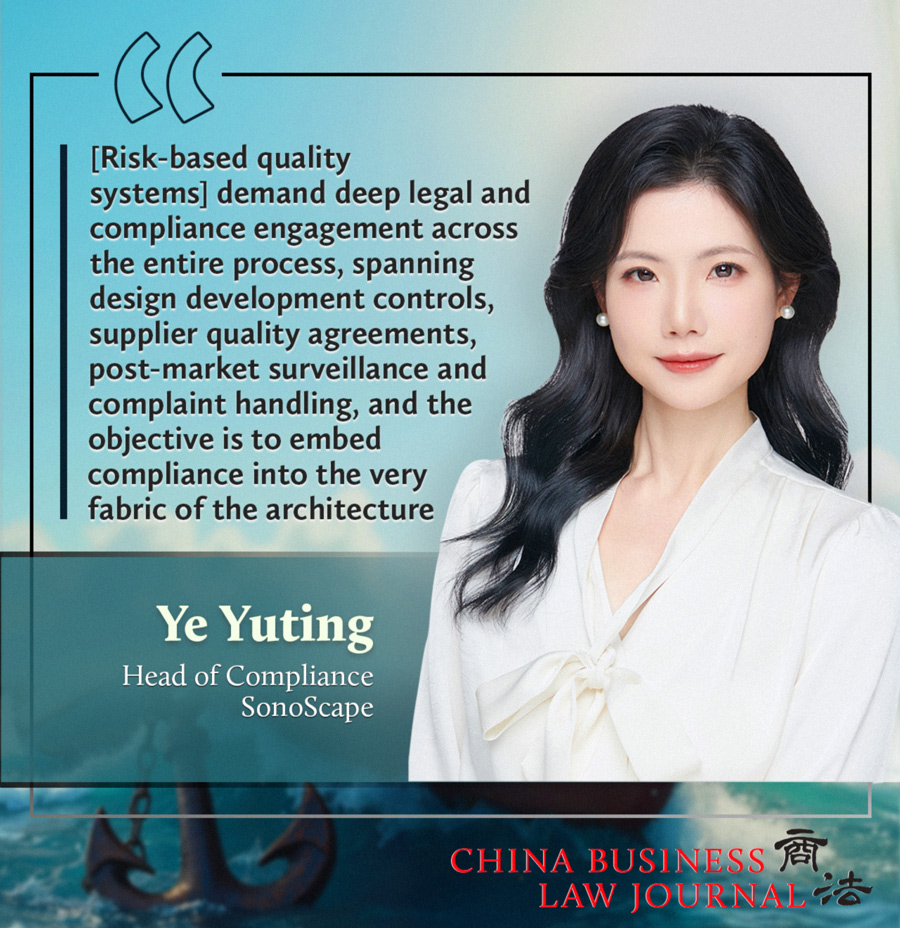
This shift can be illustrated by China’s revised Good Manufacturing Practice for Medical Devices, effective in November. Ye says the regulatory paradigm is moving away from periodic conformity inspections towards continuous assurance of system effectiveness. This requires manufacturers to establish risk-based quality systems covering full product lifecycles.
“This demands deep legal and compliance engagement across the entire process, spanning design development controls, supplier quality agreements, post-market surveillance and complaint handling,” she says, “and the objective is to embed compliance into the very fabric of the architecture.”
Similarly, in response to the shift of ESG from voluntary initiative to mandatory compliance, Eric Xie, vice president and chief legal officer at Foxconn Industrial Internet, is repositioning in-house counsel from back-office advisers to front-end architects. He suggests embedding green compliance provisions across investment and supply chain contracts, and bringing upstream and downstream suppliers into the compliance net to upskill the whole ecosystem.
The changing regulatory lens also extends to the technology sector. For data security, Kenneth Zhou, SIG Group’s head of legal and compliance for Asia-Pacific North, advocates early legal intervention in product design – contributing to development of data architecture and source protocols while maintaining oversight across the full data lifecycle.
Leon Li complements this view with a practical prescription. He recommends establishing compliance ledgers covering the entire data journey, from collection and annotation through training to model deployment, ensuring every step remains traceable.
The case is even more pressing on the investment front. Cao Shipeng, legal counsel at Harvest Investment Management, aims to turn uncertainty into certainty in response to regulatory flux in private equity. He advocates early intervention by opening dialogue with investors, collaborating with operational and financial teams, and restructuring deals pre-emptively, ensuring risks are addressed proactively before new rules take effect.
Regulatory force majeure is another critical concern. Amid geopolitical turbulence, a marked increase is observed in contract frustration triggered by non-commercial factors, including updates in export control lists and sudden changes in target market registration rules.
To bring uncertain regulatory risks within a manageable contractual framework, Ye says international trade agreements must be engineered with greater foresight, particularly for liability, suspension or modification, law application and dispute resolution.
You must be a
subscribersubscribersubscribersubscriber
to read this content, please
subscribesubscribesubscribesubscribe
today.
For group subscribers, please click here to access.
Interested in group subscription? Please contact us.
你需要登录去解锁本文内容。欢迎注册账号。如果想阅读月刊所有文章,欢迎成为我们的订阅会员成为我们的订阅会员。
Practitioner’s Perspective Article Series
Responding to legal challenges in overseas investmentBy Zhang Tianyi, Tahota Law Firm |
 |
Case study: Seeking compensation for ‘no-contract’ overseas projectBy Cindy Ge, Hiways Law Firm |
 |
Navigating mining dispute resolutionBy Zhao Yue, Bairui Law Firm |
 |
Implications of Asian source countries asserting tax rightsBy Carl Liu, Guantao Law Firm |
 |
Latest cautious steps in China’s maturing bankruptcy lawBy Nafisa Nihmat, Zhong Lun Law Firm |
 |
Using SPVs to control founder risks in VAM agreementsBy Peng Guopeng, W&H Law Firm |
 |
Corporate criminal risk: Pitfalls and course correctionsBy Wang Siwei, Bohe & Hansen |
 |
Partner compliance and trade secret protection in the AI eraBy Jolie Yan, Han Kun Law Offices |
 |
Relearning trade secret protection in the age of AI agentsBy Steve Zhao and Simon Du, GEN Law Firm |
 |
RELATED ARTICLESMORE FROM AUTHOR

Rewriting the arbitration playbook
With a new law imminent, does your dispute strategy need an overhaul?

The A-List 2025-26: Visionaries
We announce the top lawyers who have driven change and served legal society for the past year

No more wild west
Revised Anti-Unfair Competition Law steps up platforms' gatekeeping duties