











Companies that have long wrestled with cross-border disputes may find relief in a revised Law that seeks to rebrand China as a trusted resolution forum. Claire Zhao reports
Holding a binding Chinese arbitral award, yet finding it stuck in limbo abroad, blocked by procedural differences, has long been a daunting reality confronting dispute resolution leaders at Chinese companies. A pivotal change, however, has now emerged.
With the revision of the Arbitration Law, on 12 September 2024, China has for the first time written core international principles such as the “seat of arbitration” into its legal code. This marks a major institutional progress, refining its foreign-related arbitration mechanisms and strengthening systemic credibility ahead of the law’s implementation on 1 March 2026.
These steps are intended to prevent enforcement deadlocks for in-house counsel and provide a more viable legal course for Chinese firms in cross-border disputes.
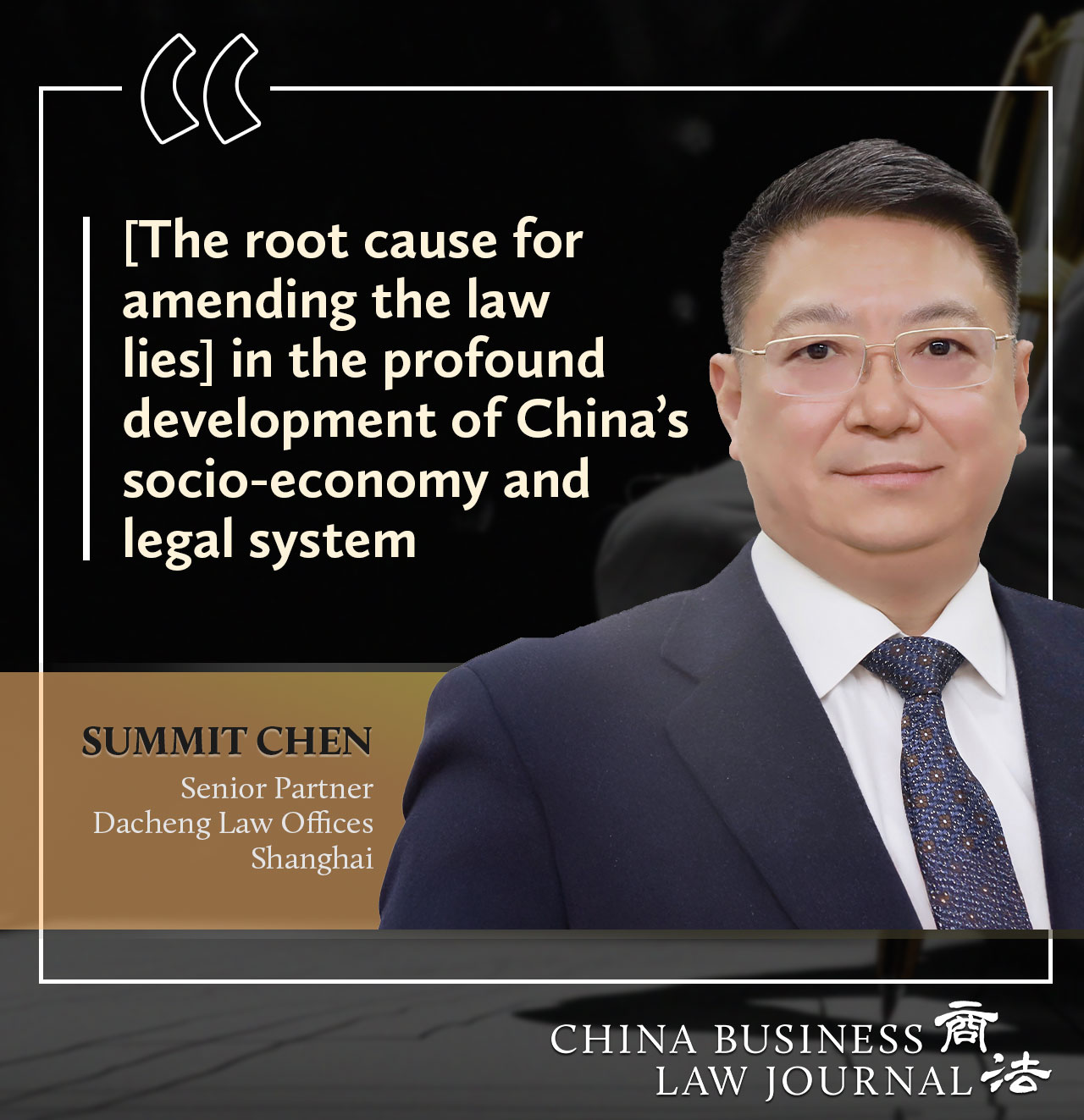
Summit Chen, a Shanghai-based senior partner at Dacheng Law Offices, points to “the profound development of China’s socio-economy and legal system” as the reason for amending the law.
He says that, after nearly 30 years in effect, the existing Arbitration Law’s structure fails to align with China’s contemporary position as the world’s second-largest economy and largest trader, with shortcomings in its international arbitration framework becoming ever more pronounced.
Parallel to this, the need to upgrade its offering to attract foreign capital and cross-border legal cases is also pushing for change. Lyu Yi, a partner at Guantao Law Firm’s Shanghai office, believes this will inevitably spur a modernisation drive of the country’s arbitration regime.
Groundbreaking transformation
Certainty and timeliness – two central demands of dispute resolution – are the precise focus of the revised Arbitration Law.
A key change is the long-awaited adoption of the “seat of arbitration” principle. The seat confers nationality upon an award and dictates the procedural law and judicial review standards, forming a cornerstone of the New York Convention. While a signatory, China’s current Arbitration Law hinges on the “arbitral institution’s location” to govern procedures, creating a disconnect from international practice.
This misalignment has previously undermined procedural control for parties and posed a significant risk to the recognition and enforcement of awards abroad.
In a foundational shift, the revised law codifies the “seat of arbitration” principle. It explicitly anchors the arbitral proceedings and the applicable judicial review to the designated seat, absent a contrary party agreement. And it legally deems awards to be made at that seat, and provides definitive rules for its identification.
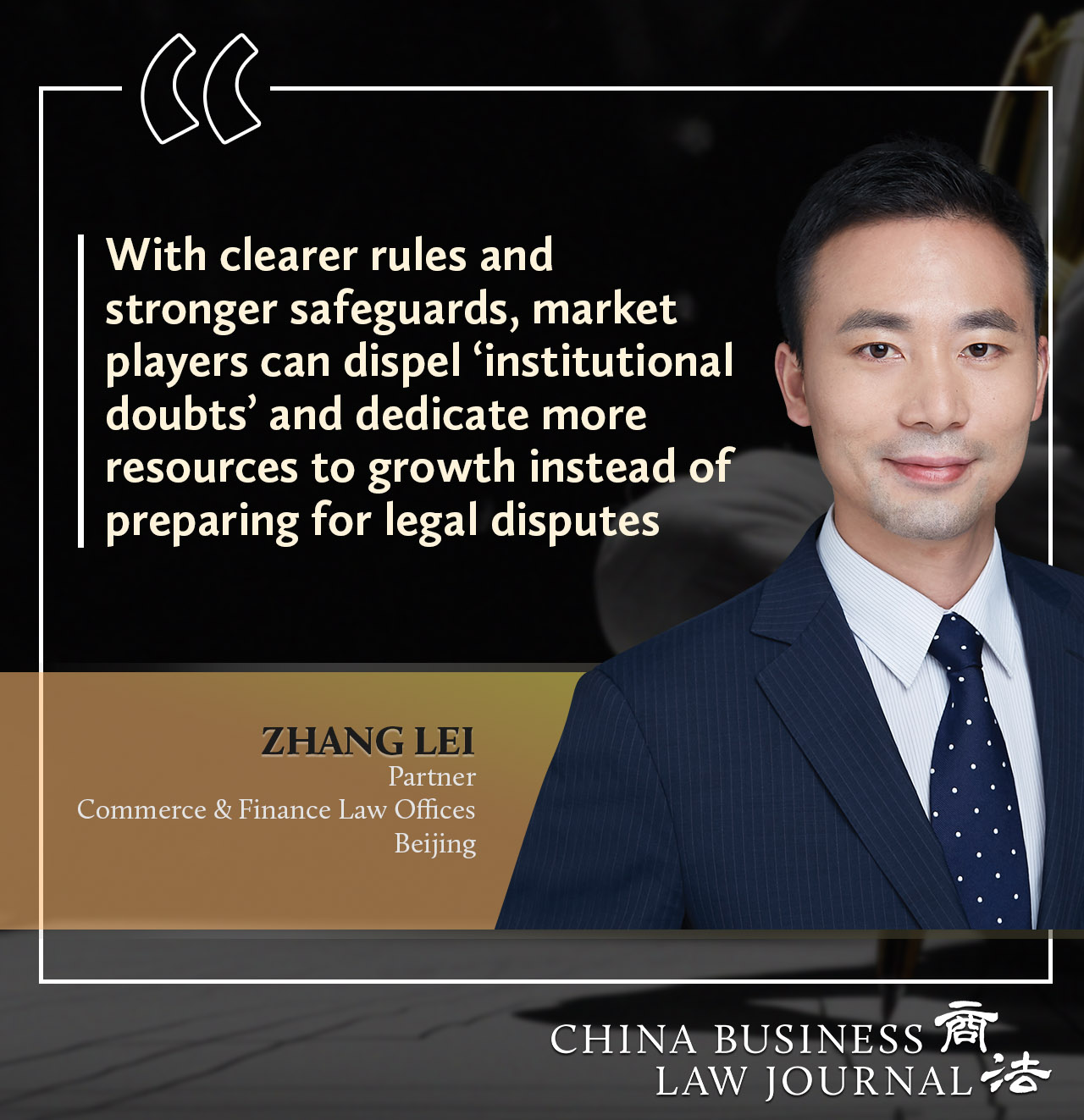
Zhang Lei, a Beijing-based partner at Commerce & Finance Law Offices, describes this as a significant step forward in consolidating an award’s nationality, procedural law and judicial review into one determinate seat. This clarity, he says, will mitigate regulatory conflicts and jurisdictional uncertainty that previously plagued cross-border cases due to divergent interpretations of the “institution’s location” versus the “seat of arbitration”.
Grounded in the New York Convention’s framework, this integration is poised to boost overseas enforceability of awards and the predictability of defences against them.
Zhang believes the innovation does more than perfect the rules. By setting clear procedural standards and solidifying rights, it establishes a crucial pillar of certainty for the business environment.
“Strengthening procedural certainty has a direct, practical value: it improves the business climate,” he says. “With clearer rules and stronger safeguards, market players can dispel ‘institutional doubts’ and dedicate more resources to growth instead of preparing for legal disputes.”
Aligned with the need for speed in business disputes, the new law also establishes ad hoc arbitration. It allows parties in free trade zones and specified areas to select arbitrators, rules and procedures, granting the resulting awards equal status to institutional ones. This returns control of the process back to the parties, enabling fast, customised resolution.
The requirement under the existing Arbitration Law to select an institution in the arbitration agreement prevents recognition of domestic ad hoc arbitration and the enforcement of its awards in New York Convention member-states.
According to David Zhou, a senior partner at the Changsha office of Kangda Law Firm, the introduction of ad hoc arbitration represents a paradigm shift from institutional monopoly to party autonomy, a critical step in aligning the regime with global standards.
The law’s push for greater efficiency is further shown by shortening the deadline to vacate an award from six to three months. Zhang points out that this, combined with harmonised grounds for challenging awards, minimises the risk of a final decision being undone, and saves companies from drawn-out procedures.
Lu Yuping, an executive deputy director of the special foreign company committee at Shanghai Corporate Counsel Association, endorses this and states: “Seemingly simple, the move is poised to profoundly shape corporate dispute resolution.”
According to Zhang, the ultimate benefit is that disputed resources can be released back into the economic bloodstream for productive use more quickly.
The law also codifies a shift to virtual proceedings by establishing online arbitration – a crucial efficiency-driven reform. This legally enshrines the remote practices that allowed arbitration to continue during the pandemic, granting online activities the same legal force as their offline counterparts.
Lynn Qi, an experienced in-house counsel and arbitrator in the automotive sector, sees the system as serving a dual purpose: it is a pragmatic solution for upholding procedural timelines in crises; and a strategic adaptation to the digital economy’s trends.
Choosing the seat
By offering a more stable and predictable dispute resolution pathway, the revised Arbitration Law aims to cut systemic transaction costs. Zhang cautions that this requires a reciprocal effort from businesses, which must now account for new procedural risks in their compliance systems.
A key example lies in the internationalised “seat of arbitration” rule. Here, the strategic calculus for enterprises shifts from mere availability to optimal selection. This necessitates a multi-dimensional strategy assessing judicial climate and global enforcement reach, far beyond simple contract clauses.
Rocky Ji, a managing partner at the Beijing office of East & Concord Partners, cites a cautionary case involving Xiamen Longking, which won an ad hoc award against an Indian entity, Bharat Heavy Electricals, only for Delhi High Court as the court of the seat to later set it aside in full.
“An expensive lesson for the Chinese company,” says Ji. “The stage was set for this scenario as early as the negotiations, when the parties settled on India as the arbitration seat, thereby portending the final outcome.”
This demonstrates the critical importance of selecting the arbitration seat. Edward Liu, a partner at Haiwen & Partners’ Hong Kong office, argues for a strategic, multi-faceted evaluation beyond simple geography.
Zhang warns against basing the decision on logistics such as travel costs, urging focus on the “hard constraints” of the enforcement framework and local judiciary. He recommends analysing how the supervising court balances support for versus intervention in arbitration.
Echoing this, Lyu suggests preferring seats with low judicial intervention, such as Hong Kong or Singapore, known for strong pro-arbitration stances and low annulment risk.

Bai Xiao, a partner at BZW Law Firm’s Beijing office, notes growing assertiveness among developing nations in supervising awards, with courts taking a broader, more liberal approach to public policy that increases the scope for review and annulment.
She advises companies to diligently study local case law and practice when choosing a seat. “The strategic goal is navigating this balance between the desired finality of a ruling and the crucial access to redress in exceptional circumstances,” she says.
Lyu advocates for a critical criterion: the global enforcement network accessible through a chosen seat, including New York Convention membership and international standing. Zhang adds that companies should align the seat’s legal pathways with the geographic spread of their assets to pre-empt enforcement hurdles.
While a Chinese seat provides solid enforceability via the New York Convention, Lyu says that traditional centres such as London or Paris integrate into a far wider enforcement ecosystem, offering superior protection for multi-jurisdictional recovery.
In specialised industries, the choice of an arbitration seat must be viewed through a sector-specific lens, evaluating its niche expertise, arbitrator diversity, and the industry-fitness of its rules.
Lyu proposes that tech entities might look to hubs such as Silicon Valley or Shenzhen for their deep-seated expertise in emerging tech disputes, while energy sector players could turn to established centres such as Houston or Beijing, recognised for their mature handling of resource-based conflicts.
For major cross-border projects, Chen recommends a single, pre-agreed framework for all linked contracts, considering their legal privity. This prevents the enforcement impasses from specifying incompatible arbitration seats in different project agreements.
In regulated deals involving areas such as critical tech, data or energy, extreme caution is required in selecting an arbitration seat, according to Leslie Zhang, the vice president and chief legal officer of United Energy Group. He advises opting for a neutral venue and including a contingency for re-selection if sanctions or trade controls intervene and make the original choice impractical.
Zhang Lei frames the objective differently, noting that clause design should follow a philosophy of risk isolation, rather than comprehensiveness. He suggests a modular design that locates the entire dispute resolution process – through the seat, governing law and enforcement route – in a self-contained offshore “loop”, effectively quarantining it from domestic regulatory exposure.

Ji says: “The choice of an optimal seat is not one size fits all.It hinges on which venue most effectively serves the particular commercial and dispute resolution context.”
Addressing this, Lyu proposes that enterprises systematically evaluate pertinent factors through a SWOT analysis, and pre-emptively integrate the findings into the contractual seat designation for robust, strategic risk control.
You must be a
subscribersubscribersubscribersubscriber
to read this content, please
subscribesubscribesubscribesubscribe
today.
For group subscribers, please click here to access.
Interested in group subscription? Please contact us.
你需要登录去解锁本文内容。欢迎注册账号。如果想阅读月刊所有文章,欢迎成为我们的订阅会员成为我们的订阅会员。