







China has been embracing a gradual increase in medical device registrations in recent years, prompting the country’s National Medical Products Administration (NMPA) to step up regulation and launch a public consultation on a draft law.
The draft medical device administrative law covers the different developmental stages, including R&D, manufacturing, distribution and sales. The public consultation closed on 28 September.

Charlene Huang, a Shanghai-based partner at Global Law Office, said currently the entire life cycle of medical devices – from R&D, registration, production and operation to its usage – was regulated by various fragmented measures and administrative regulations, and this practice easily created regulatory inconsistencies.
“Therefore, everyone is looking forward to the introduction of this medical device administrative law, as it is the first time the country has debuted a law of this kind at a top-level legal hierarchy,” she said.
One of the highlights of the draft law was permitting medical device registrants to transfer registration certificates to others, a move making it easier for costly medical devices to launch and become commercialised, said Huang. Developing a medical device takes a lot of manpower, resources and years of investment. Taking Mindray as an example, it spent RMB2.84 billion (USD397.6 million) in the first three quarters of this year alone on R&D.
“If company A lacks the funds or capability to launch a product to the market, but company B has the funds and capability to continue its development, under the existing regulatory framework, the device’s registration certificate cannot be transferred,” she said.
“Under existing circumstances, company B would typically choose to acquire company A or redo the clinical trials just to acquire a medical device,” Huang said. “The former approach complicates the entire transaction, especially if company A holds different pipeline products, while the latter will force companies to make repeated investments in clinical trials.”
Companies surveyed by Global Law Office expressed a strong demand for the transfer of registration certificates, with some even hoping they can be given a green light as early as the clinical trial stage.
When it comes to the transfer of registration certificates, the NMPA emphasises the safety and effectiveness of medical devices. It said in the draft that registration certificates for medical devices that had “expired, [were] invalid, obsolete, refurbished, and fails to pass inspection” could not be transferred.

The draft law also regulates medical devices imported to China, with the NMPA imposing heavier responsibilities on local legal deputies. It said in the draft that local legal representatives would “bear joint liability with the registrants and filers of imported medical devices”.
Katherine Wang, a Singapore-based partner at Ropes & Gray, said local legal agents are responsible for post-approval compliance of medical devices. The obligations range from annual reporting, adverse event reporting and monitoring, product recall and co-ordination with the NMPA on overseas inspections.
“It is more challenging for the NMPA to exercise long-arm jurisdictions on foreign marketing authorisation holders if they fail to fulfil the post-approval obligations,” Wang said. “Having local legal agents be jointly liable with foreign marketing authorisation holders will enable more efficient enforcement of the law.”
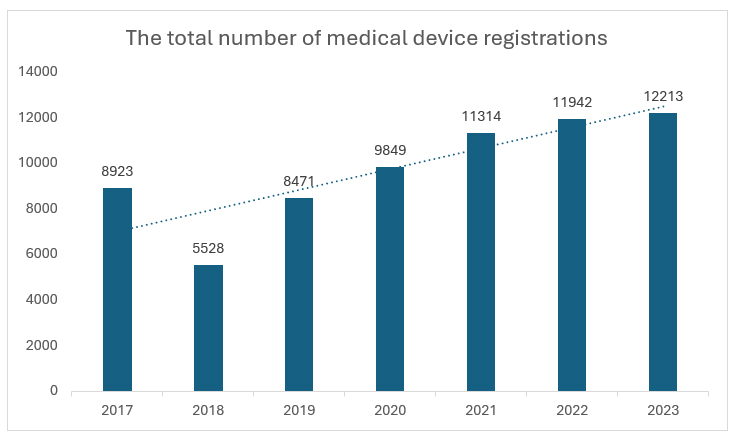
The number of medical device registrations has recorded an uptick in recent years. The NMPA received 3,559 initial medical device registration applications in 2023, a surge of 34% from the previous year, according to its data released earlier this year. The total number of registrations, including initial, renewal and registration changes, increased from 5,528 in 2018 to 12,000 in 2023. (see graphic)
While embracing this growth, the NMPA is also cracking down on malpractices that have been seeping through the vast market. The NMPA investigated 36,000 medical device cases last year, with 216 needing to be transferred to judicial authorities.
Aside from implementing the medical device administrative law, the NMPA is taking other actions to improve the business environment. In October, in a move to swiftly detect and control the risks brought by major medical device malpractices, the NMPA solicited public comments on a proposal to grant a maximum reward of RMB1 million for internal whistleblowers who helped to crack down on illegal cases.