









A series of sweeping regulations debuting in the past year has cleared roadblocks in China’s bankruptcy and restructuring regime, heralding a more refined system with clearer guidelines and quicker solutions. Maisy Mok reports
Navigating China’s corporate restructuring regime was once a daunting task, particularly in the early days after the Enterprise Bankruptcy Law was enacted, in 2007. Almost 20 years later, a series of new rules and guidelines – many launched in quick succession in the past year – has removed major legal obstacles that have long confounded bankruptcy administrators, creditors and investors, paving the way for further progress.
Since 2025, lawyers specialising in bankruptcy and restructuring have been studying and adapting to several groundbreaking documents that affect all industries.
The documents include: the far-reaching draft revision of China’s Enterprise Bankruptcy Law (the draft); a new guide for listed companies in the form of the Minutes of the Symposium on the Effective Trial of Cases concerning the Bankruptcy Reorganisation of Listed Companies (the minutes); and, watched closely by financial institutions and self-employed individuals, the Regulation on the Personal Bankruptcy Protection of the Xiamen Special Economic Zone.
These steps respond to practical needs in legal practice and lay the foundations for pre-trial restructuring procedures and the normalisation of personal bankruptcy mechanisms.
Listco comeback
Each year between 2022 and 2025, more than 20 listed companies in China applied for bankruptcy reorganisation. Many ongoing reorganisation cases have altered course in response to the promulgation, at the end of 2024, of the minutes and its complementary guidelines issued by the China Securities Regulatory Commission, i.e. Guidelines No. 11 for the Regulation of Listed Companies – Matters Relating to the Bankruptcy Reorganisation of Listed Companies (the guidelines).
In one such case, handled by Grandall Law Firm, a listed company’s reorganisation plan was turned on its head following the issue of the minutes and the guidelines. It had previously entered pre-reorganisation in July 2024. In August, investors had reached an early consensus on the proportion of reserves to be transformed into share capital and the pricing of the shares.
“In the end, there were significant adjustments to the price at which investors obtained the shares compared with the original pricing in August 2024,” says Chen Feng, a Shanghai-based partner at Grandall Law Firm and director of the firm’s bankruptcy and restructuring committee and legal research centre.
These adjustments were based on article 8(2) of the guidelines, which stated that the share subscription price for investors must not be lower than 50% of the market reference price. Companies shall take the average trading price of either 20, 60 or 120 trading days before the signing of the restructuring investment agreement as the market reference price.
Article 7 of the guidelines also sets an upper limit on the proportion of reserves that may be transformed into shares, which must not exceed 15 shares for every 10 shares held. Chen says this restriction can regulate irregular practices in the conversion of reserves into share capital during restructuring.
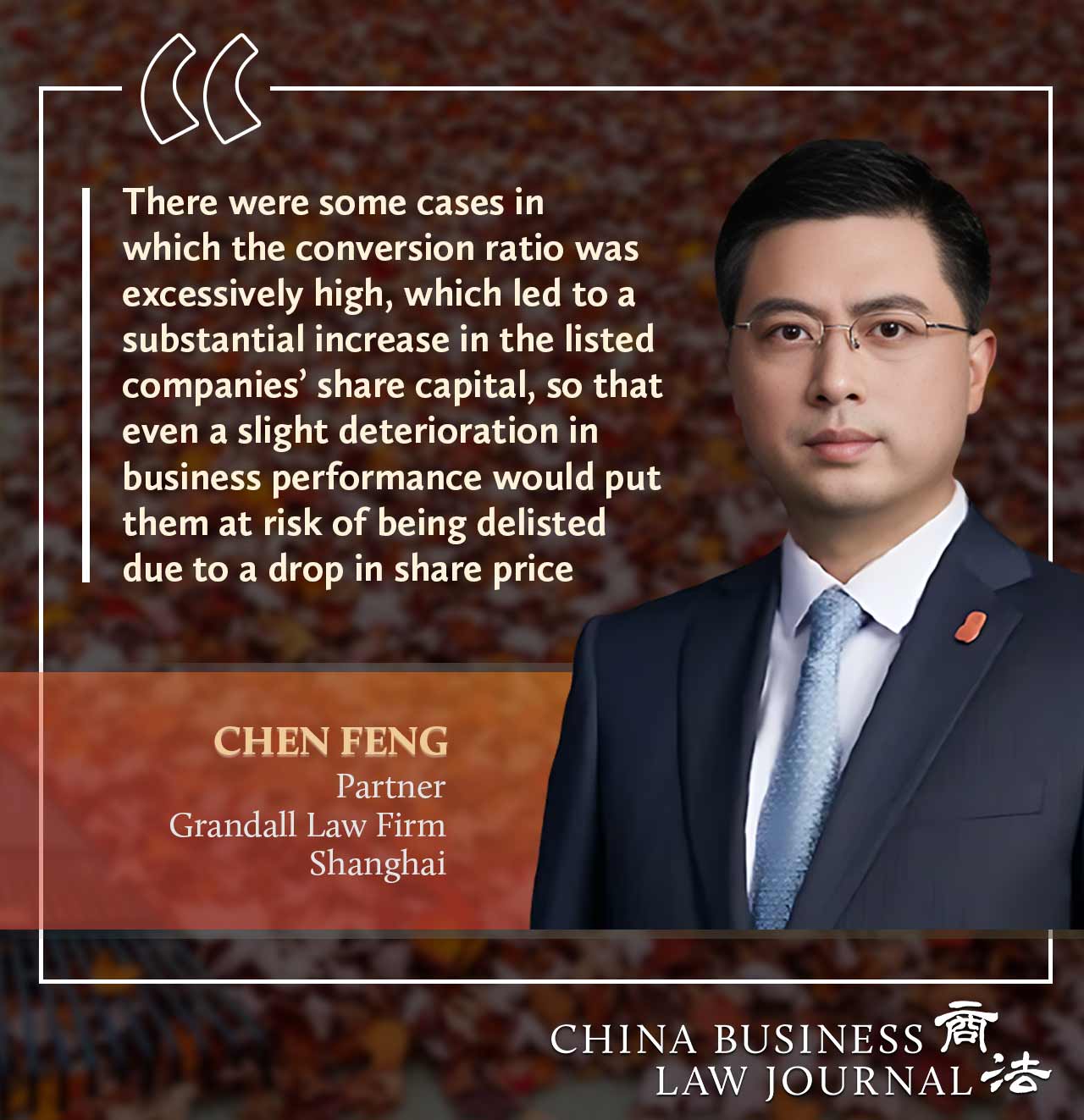
“There were some cases in which the conversion ratio was excessively high, which led to a substantial increase in the listed companies’ share capital, so that even a slight deterioration in business performance would put them at risk of being delisted due to a drop in share price,” says Chen.
“In other cases, the conversion price was extremely low, which seriously harmed the legitimate rights and interests of minority shareholders and creditors,” he adds.
Yang Li, a partner at Zhong Lun Law Firm in Beijing, says it is reasonable to set such a restriction. Creditors, existing shareholders and new investors have to strike a balance between short-term and long-term goals when deciding on the conversion. If one blindly pursues a high conversion ratio, it can easily lead to abuse of the tool, and encourage speculative behaviour.
“Using capital reserves to increase share capital in bankruptcy reorganisation proceedings is a means to achieve the goal of rescuing valuable listed companies, and should not become an end in itself,” says Yang Li.
The minutes are expected to help companies speed up their reorganisation processes. They encourage a preliminary procedure called out-of-court restructuring, which could reduce bankruptcy courts’ massive caseloads.
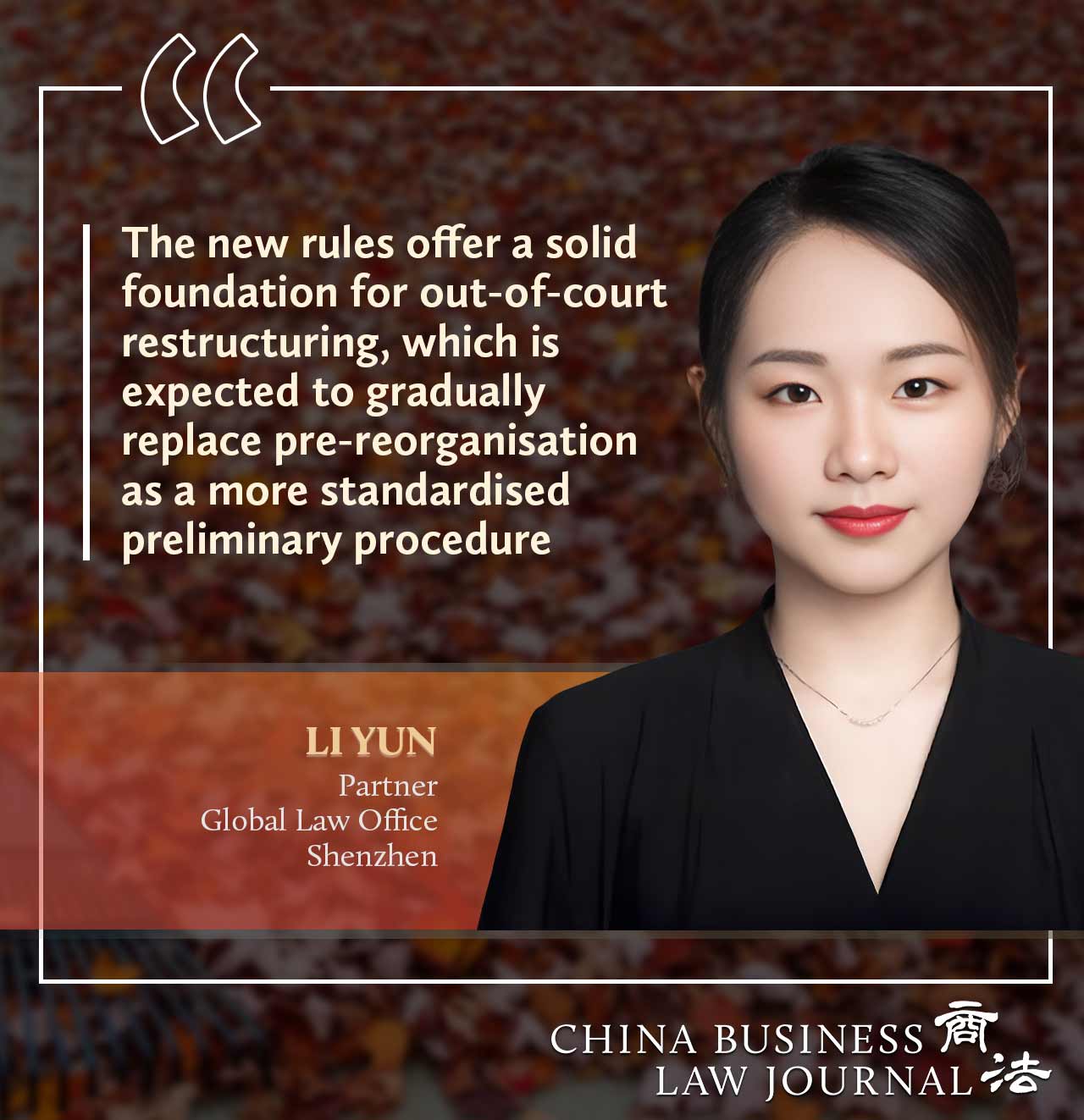
Li Yun, a partner at Global Law Office in Shenzhen, says: “Listed companies usually undergo pre-reorganisation, but there is currently no unified national standard for such a process. The new rules offer a solid foundation for out-of-court restructuring, which is expected to gradually replace pre-reorganisation as a more standardised preliminary procedure.”
Out-of-court restructuring service centres have been established in Shanghai, Shenzhen and Jilin province to facilitate debt negotiations. Yang Shuangchen, a counsel at Global Law Office in Shenzhen, says that out-of-court restructuring differs significantly from pre-reorganisation.
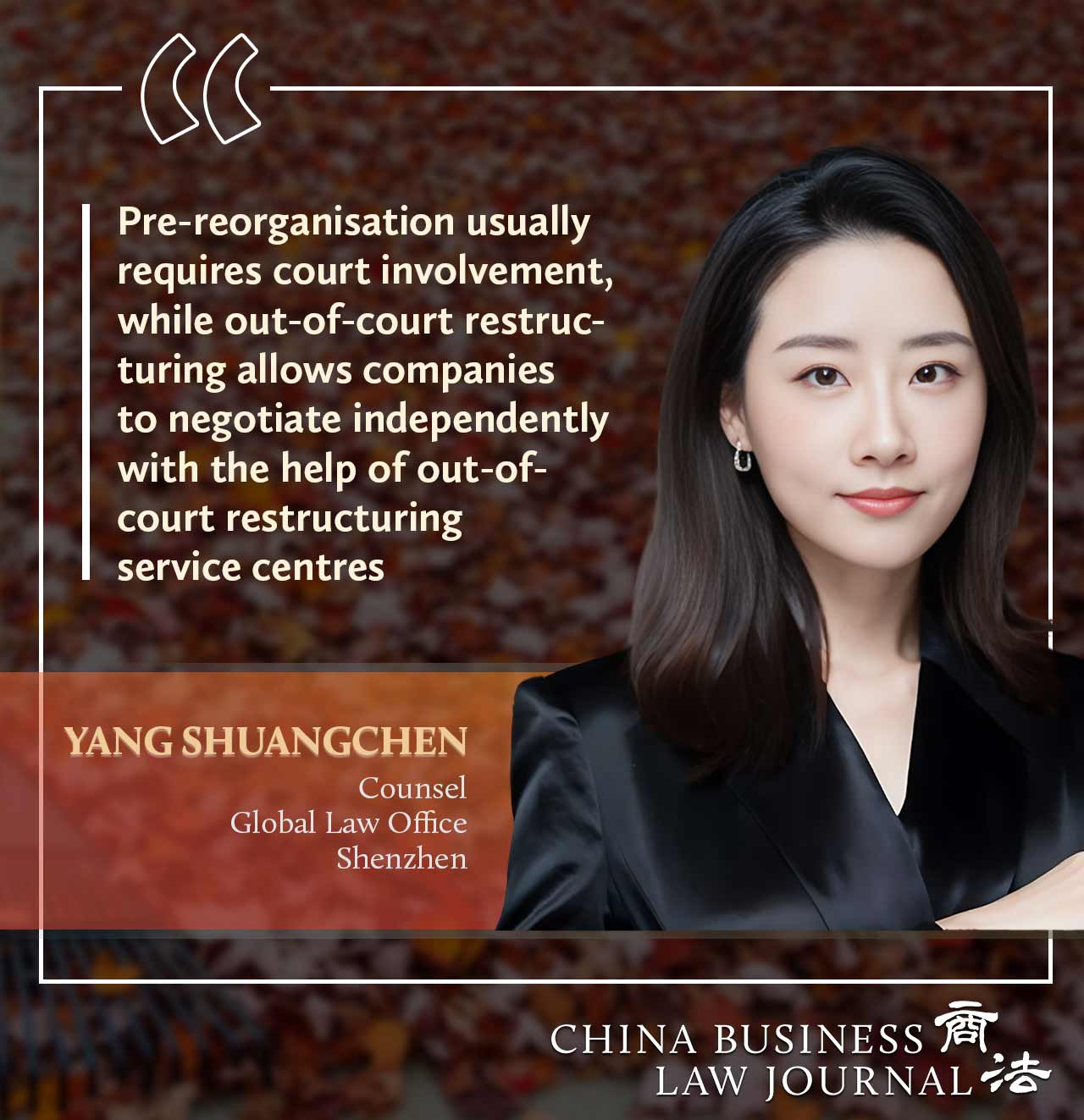
“Pre-reorganisation usually requires court involvement, while out-of-court restructuring allows companies to negotiate independently with the help of out-of-court restructuring service centres,” she says. “Both routes can connect to the formal bankruptcy reorganisation court procedure.”
Chen says out-of-court restructurings are confidential, which allows companies to avoid concerns over public disclosure that could affect their business ties with suppliers or other third parties.
Although the legal framework for out-of-court restructuring is becoming more robust, the procedure has not yet been widely adopted. Yang Shuangchen expects that more distressed listed companies will undergo out-of-court restructuring before entering judicial proceedings. “This has become a clear development trend,” she notes.
As the aim of launching the minutes is to effectively rescue distressed companies, Yang Li suggests that, moving forward, bankruptcy lawyers should put in more effort in assisting listed companies to sustain their usual operations when designing reorganisation plans.
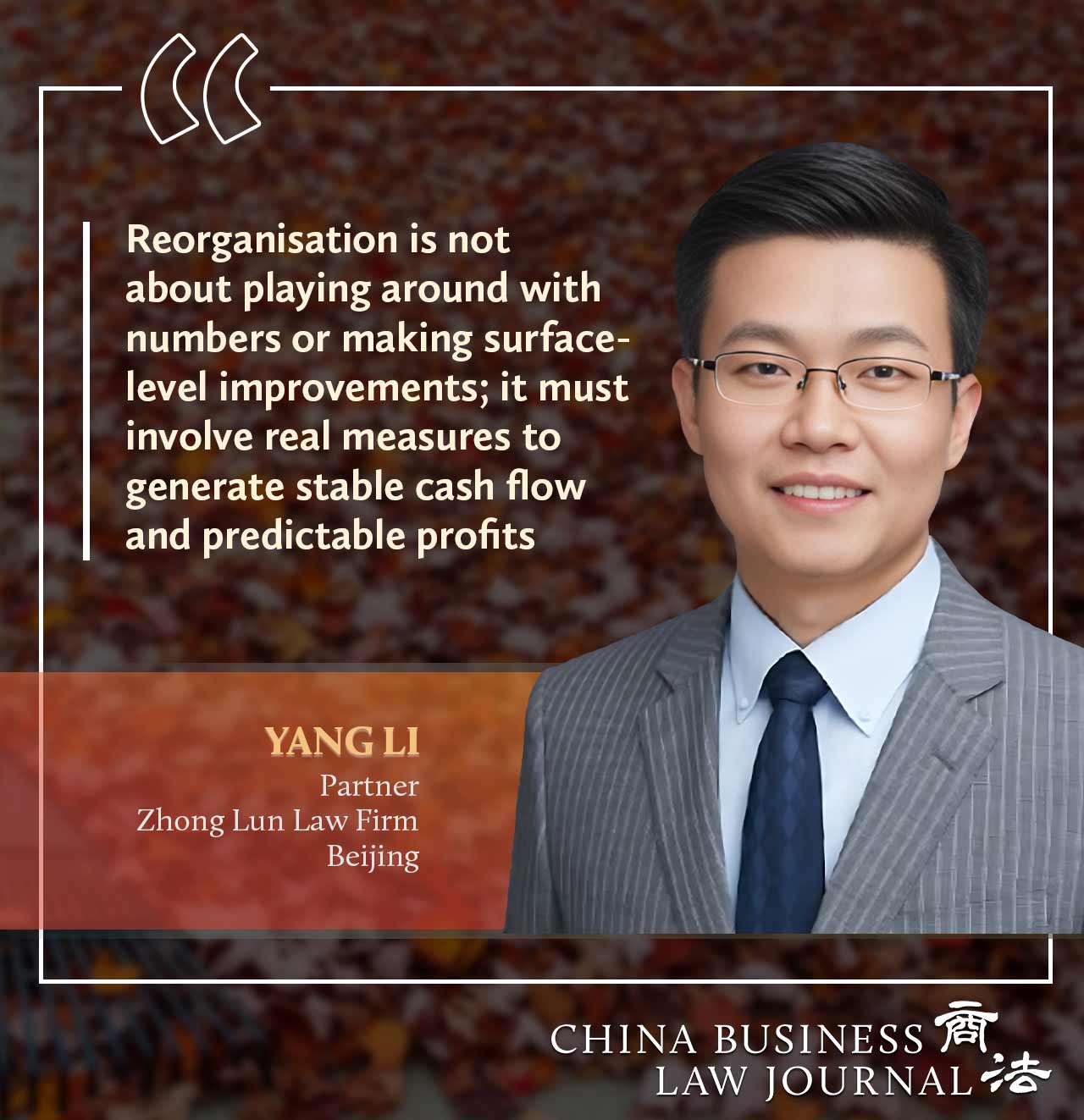
“Reorganisation is not about playing around with numbers or making surface-level improvements,” he says. “It must involve real measures to generate stable cash flow and predictable profits, thereby improving the company’s long-term viability and ensuring its continuous development, which is exactly what the minutes are going for.”
System overhaul
Listed companies make up only the tip of the bankruptcy iceberg. One of the most significant recent regulatory developments has been the draft revision of the Enterprise Bankruptcy Law, which was revealed in September 2025 and has since completed its 30-day public consultation. This marked the Enterprise Bankruptcy Law’s first revision in 18 years.
Although the public consultation period has ended, the Standing Committee of the National People’s Congress has so far not announced a timeline for the revision to take effect.
The draft added or revised more than 160 provisions, expanding the law to 16 chapters and 216 articles. It introduced four new chapters related to the bankruptcy of micro and small businesses, substantive consolidation, the bankruptcy of financial institutions, and cross-border judicial co-operation.
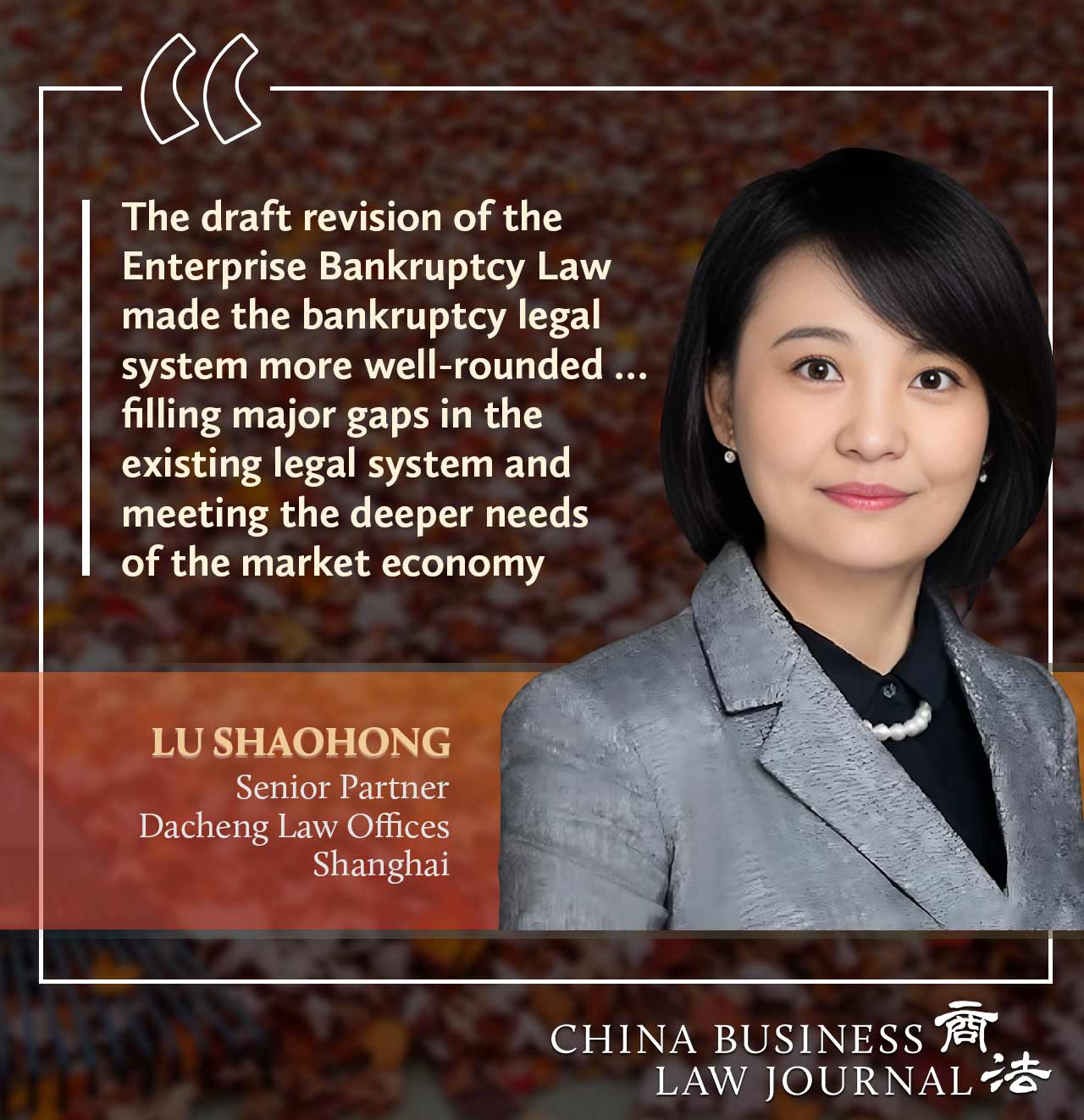
“The draft made the bankruptcy legal system more well-rounded by adding a dedicated chapter on financial institution bankruptcy, revising rules on credit repair for restructured debtors, and establishing fast-track procedures for micro and small businesses,” observes Lu Shaohong, a senior partner at Dacheng Law Offices in Shanghai. “These fill major gaps in the existing legal system and meet the deeper needs of the market economy.”
The credit repair system, cited in article 139 of the draft, allows debtors to apply for credit repair and suspend punitive measures once the court approves their reorganisation plan. Global’s Li Yun says this new addition allows reorganising companies to resume normal operations and raise funds effectively.
Previously, the Enterprise Bankruptcy Law lacked provisions on out-of-court restructuring procedures. The draft, however, adds articles 100-102, and article 120, which establish an out-of-court restructuring regime at the legislative level and create a system connecting out-of-court restructuring outcomes with in-court reorganisation proceedings.
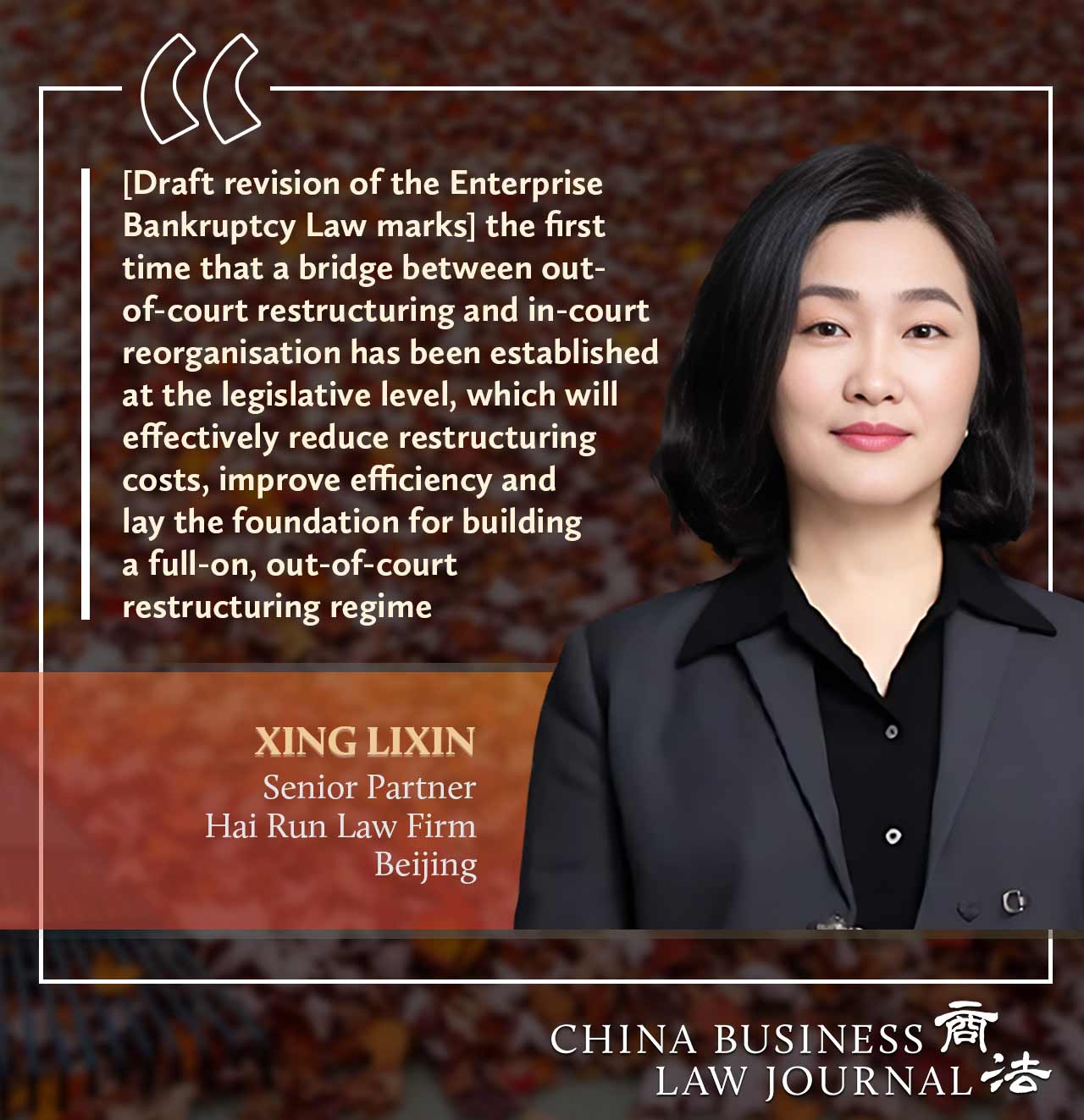
“This is the first time that a bridge between out-of-court restructuring and in-court reorganisation has been established at the legislative level, which will effectively reduce restructuring costs, improve efficiency and lay the foundation for building a full-on, out-of-court restructuring regime,” says Xing Lixin, a Beijing-based senior partner at Hai Run Law Firm.
Many lawyers see the introduction of pre-court procedures as a sign that bankruptcy practitioners need to prepare in advance.
Dacheng’s Lu says the revision allows investors to join reorganisation agreements at an earlier stage, enabling them to reach agreements in advance and take part in formulating a preliminary reorganisation plan.
You must be a
subscribersubscribersubscribersubscriber
to read this content, please
subscribesubscribesubscribesubscribe
today.
For group subscribers, please click here to access.
Interested in group subscription? Please contact us.
你需要登录去解锁本文内容。欢迎注册账号。如果想阅读月刊所有文章,欢迎成为我们的订阅会员成为我们的订阅会员。
Practitioner’s Perspective Article Series
How 2025 redefined listed company reorganisationBy Gao Meili, Dacheng Law Offices |
 |
China on course to personal debt relief in corporate bankruptciesBy Liang Qiang and Ma Jinpeng, Zhong CE Law Firm |
 |
Investment models and risk mitigation in distressed real estateBy Peng Shaohua, Tahota Law Firm |
 |
Joint and several liability for capital increase defectsBy Li Yansheng and Xu Chuanyuan, Guantao Law Firm |
 |
How protection funds compensate bankrupt financial institutionsBy Du Wenle and Pang Yadan, Han Kun Law Offices |
 |