









From property and casualty to marine cargo recovery, insurance lawyers in Asia seem to be busy as usual – but there is more to this than meets the eye, writes Brian Yap
The insurance and reinsurance space across major parts of Asia remains robust and stable, with constant activity in areas from property and casualty (P&C), and directors and officers liability insurance to financial lines and marine cargo recovery.
Nearly all senior insurance lawyers at domestic and international law firms practising in Greater China, South Korea, Japan and Southeast Asia who spoke to Asia Business Law Journal are quick to list the legal work that has been keeping them busy in recent times. Such legal work covers a range of matters from product liability and product recall claims to alternative risk transfer and reinsurance disputes arising out of fire-related losses.
This is all happening in addition to regulatory-driven legal work in individual jurisdictions, including the draft amendment to Japan’s Insurance Business Act approved by the country’s national legislature (the Diet) on 30 May.
The amendment was triggered by fraudulent insurance claims from large-scale independent agents, and misconduct regarding the sales of corporate insurance by major Japanese P&C companies with respect to inappropriate price adjustment, possibly in violation of Japan’s Anti-Monopoly Act. The amendment, which is set to take effect by the end of May next year, is expected to require establishment of an appropriate governance system and restrict the operations of large-scale independent P&C insurance agents acting on behalf of multiple insurers, rather than exclusively acting on behalf of a particular insurance company.
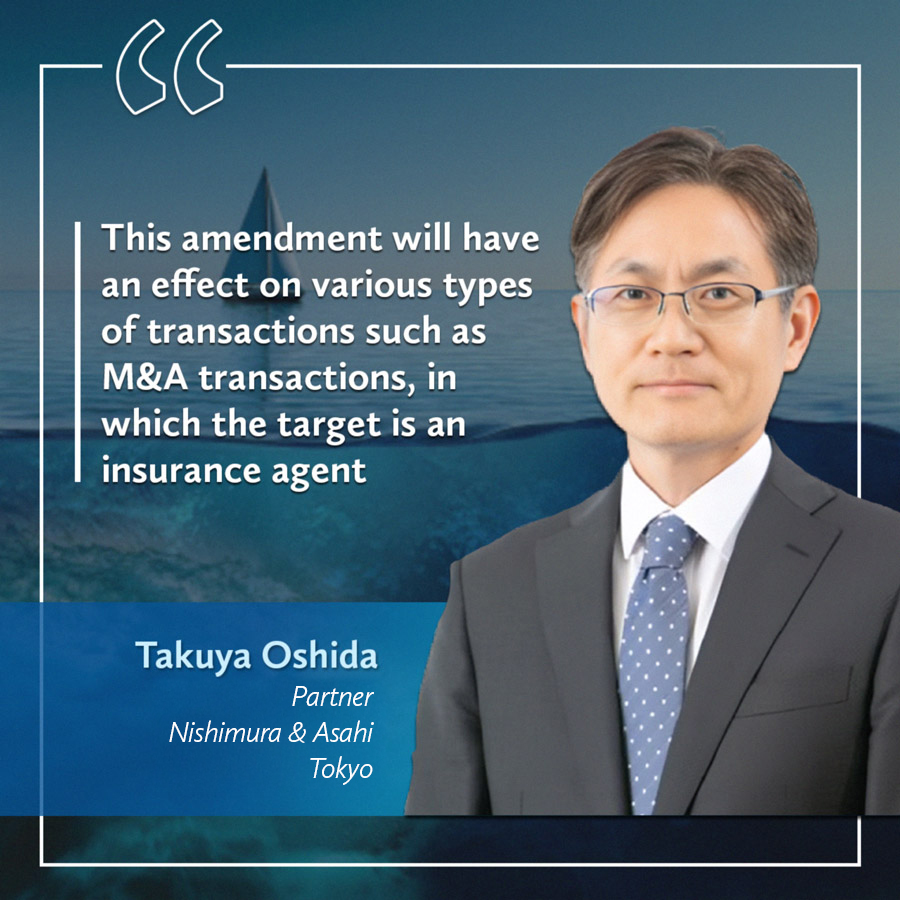
“This amendment will have an effect on various types of transactions such as M&A transactions, in which the target is an insurance agent, and parties are likely to need to take additional measures to comply with the amendment, or service transactions between an insurance company and an insurance agent, from the perspective of the prohibition on the provision of special profits,” says Takuya Oshida, a corporate partner with a particular focus on areas including insurance covering regulatory, investment and reinsurance matters at Nishimura & Asahi in Tokyo.
But that is not the only development with a wide-reaching effect. Behind the regular happenings in the insurance and reinsurance space, and the legal work generated by such occurrences, are three recent ongoing global and regional events, with their uncertain nature creating a mixed bag of challenges and opportunities for insurance lawyers in Asia.
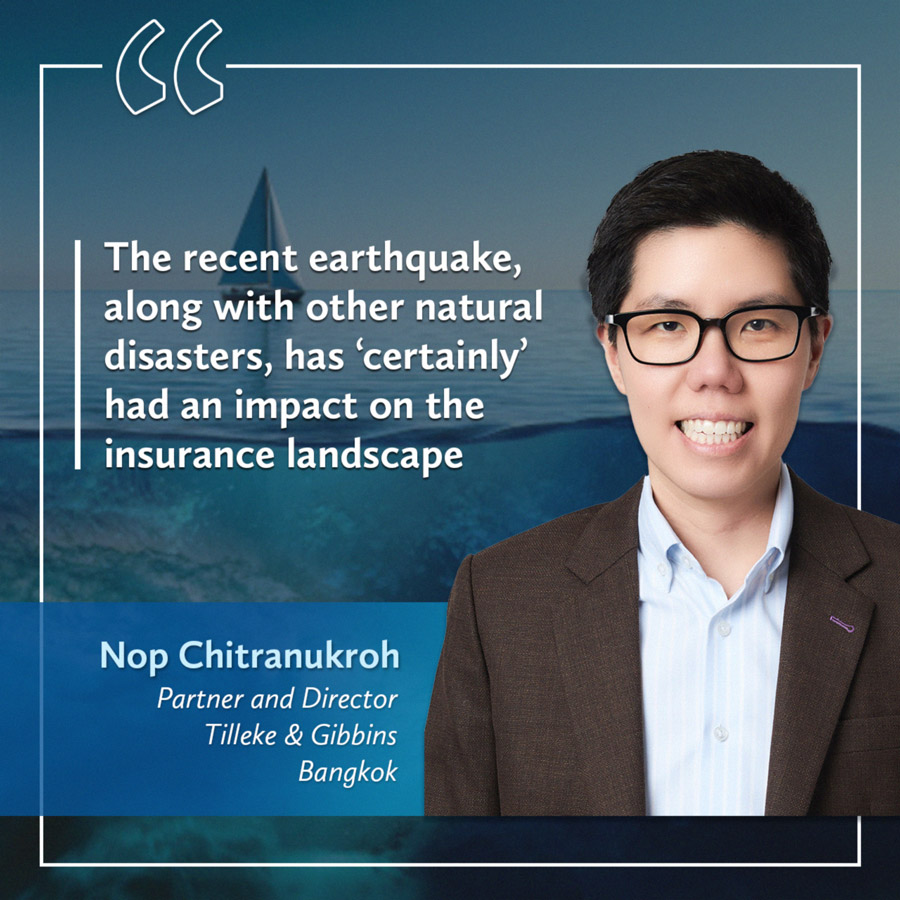
On 28 March, a 7.7 magnitude earthquake struck Myanmar and neighbouring Thailand, causing heavy human casualties and severe damage to buildings, with Reuters having reported on 4 April that the death toll in Myanmar had surpassed 3,000. Nop Chitranukroh, a partner and director of Bangkok-based Tilleke & Gibbins’ corporate and commercial group, says that the recent earthquake, along with other natural disasters, has “certainly” had an impact on the insurance landscape.
“Our firm sees an increase in contentious work surrounding denied insurance claims or disputes over coverage limits,” adds Chitranukroh, who is also one of the leaders of Tilleke & Gibbins’ technology and insurance teams and a former Thailand general counsel of US global insurance organisation AIG.
And there may be more contentious work yet to come. Ittirote Klinboon, a partner in the shipping and insurance and reinsurance practices at Rajah & Tann Thailand in Bangkok, notes that most of the more than THB1 billion (USD30.6 million) worth of insurance claims triggered by the earthquake are still in the assessment and adjustment phase. Such claims primarily involve property damage, construction, all-risk and engineering policies, as well as liability claims.
However, Klinboon says that many legal disputes have not yet surged significantly, which is likely due to reasons including many claims still being processed and larger insurers having reinsurance buffers, which reduces the need for aggressive claim denials. But he points out that structural liability issues, such as substandard design or supervision, might eventually lead to litigation, especially in high-profile cases.
“So far, law firms are monitoring rather than actively litigating a large volume of disputes,” says Klinboon.
He also observes a consistent trend of trade-related disputes involving international sales contracts. Such disputes typically involve sellers seeking payment for goods, buyers defaulting due to financial instability or currency fluctuations, and trade insurers stepping in to cover the loss and then subrogating the seller’s rights to pursue the buyer.
The impact of these trade-related disputes has seen trade credit insurance being increasingly used to mitigate non-payment risks, with legal teams being involved in subrogation litigation that is often cross-border.
Klinboon also points to such disputes being driven by macroeconomic volatility, including tariff policies and insolvency risks, with insurance being both a buffer and a trigger for legal action under a tightening global trade environment.
In April, US President Donald Trump launched a global tariff regime by imposing import taxes on most of America’s trading partners involving a 10% baseline tariff on most countries, and heavier reciprocal tariffs on certain trading partners including China, the EU and Japan.
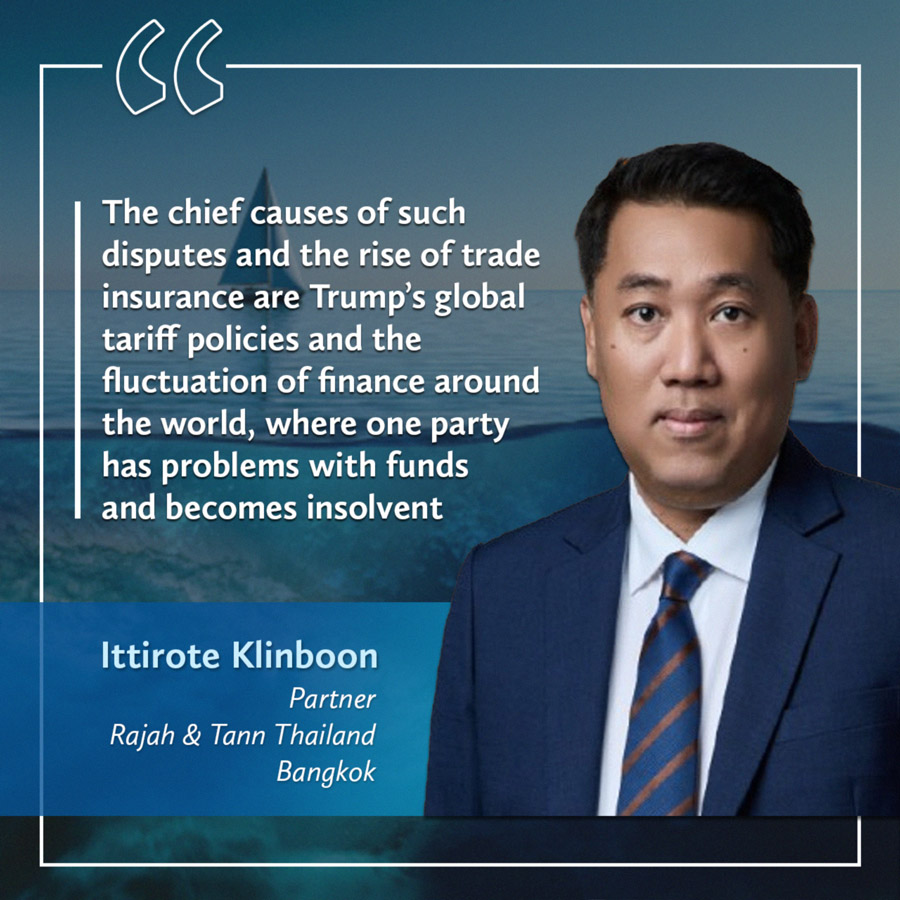
“The chief causes of such disputes and the rise of trade insurance are Trump’s global tariff policies and the fluctuation of finance around the world, where one party has problems with funds and becomes insolvent,” explains Klinboon.
In Seoul, John Kim, a US-qualified senior attorney and head and international lead of the insurance and reinsurance practice group of Dentons Lee, has also been busy preparing for supply-chain disputes.
Under Trump’s global tariff policies, Kim says that we are going to see a lot of breaches of contracts, leading to many trade credit insurance disputes going forward.
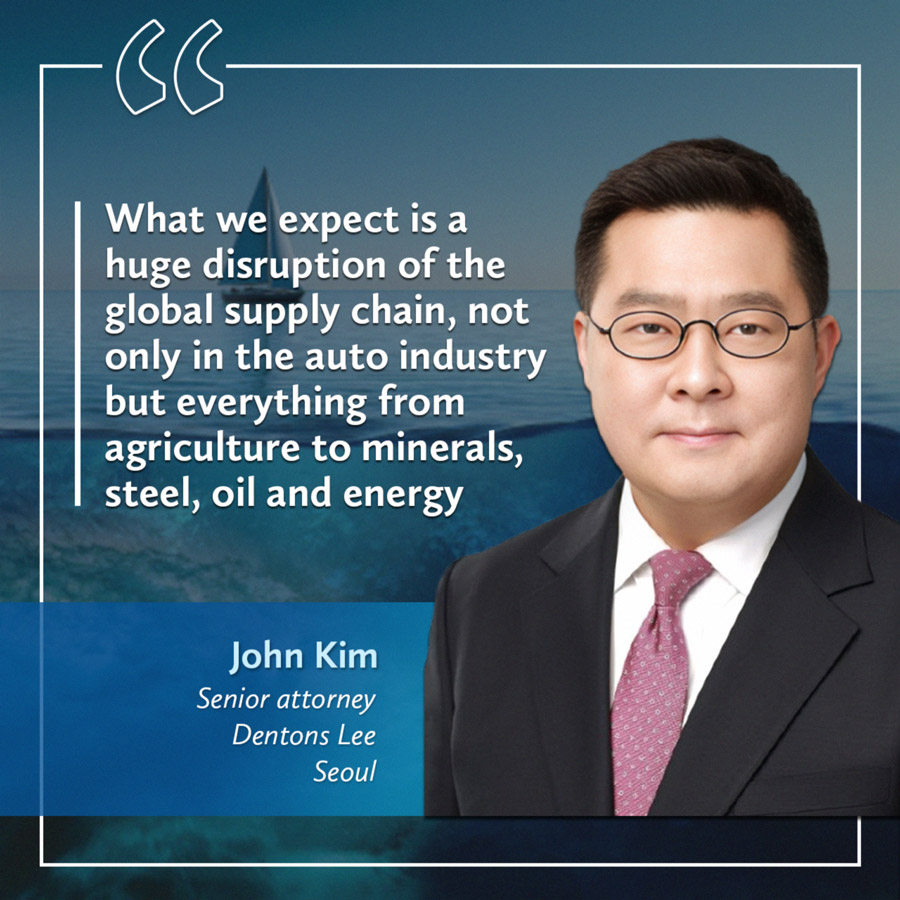
“If you are selling cars in the US and you are providing supplies and auto parts from Korea, there is a 25% tariff, and that tariff is definitely going to negatively impact the supply chain. What we expect is a huge disruption of the global supply chain, not only in the auto industry but everything from agriculture to minerals, steel, oil and energy,” says Kim.
You must be a
subscribersubscribersubscribersubscriber
to read this content, please
subscribesubscribesubscribesubscribe
today.
For group subscribers, please click here to access.
Interested in group subscription? Please contact us.
你需要登录去解锁本文内容。欢迎注册账号。如果想阅读月刊所有文章,欢迎成为我们的订阅会员成为我们的订阅会员。