









From Trump’s global tariff war to the internal machinations of law within jurisdictions that will impact business, there are both predictable and unpredictable events on the road ahead for Asia in 2025. Brian Yap gets some expert advice on being prepared
In 2025, the Asia-Pacific region is confronting a host of legal and regulatory uncertainties triggered or aggravated by political and economic factors on a regional and a global scale.
Asia Business Law Journal spoke to senior private practice and in-house lawyers either based in Asia, or heavily involved in Asian affairs, including heads of global and regional law firms. Many of these decision makers and legal industry leaders talk about Asia-based companies feeling confused about what they should do as US President Donald Trump’s second administration confounds markets with its erratic agenda, including additional tariffs on imports from China and other countries including its allies.
Aside from politics, new regulatory challenges have arisen in several Asian countries, and while these at least have outcomes that can be parried with the best legal strategies, all these developments, both certain and uncertain, have investors knocking on the doors of their domestic and international legal counsel.
Trump’s effect on Asia
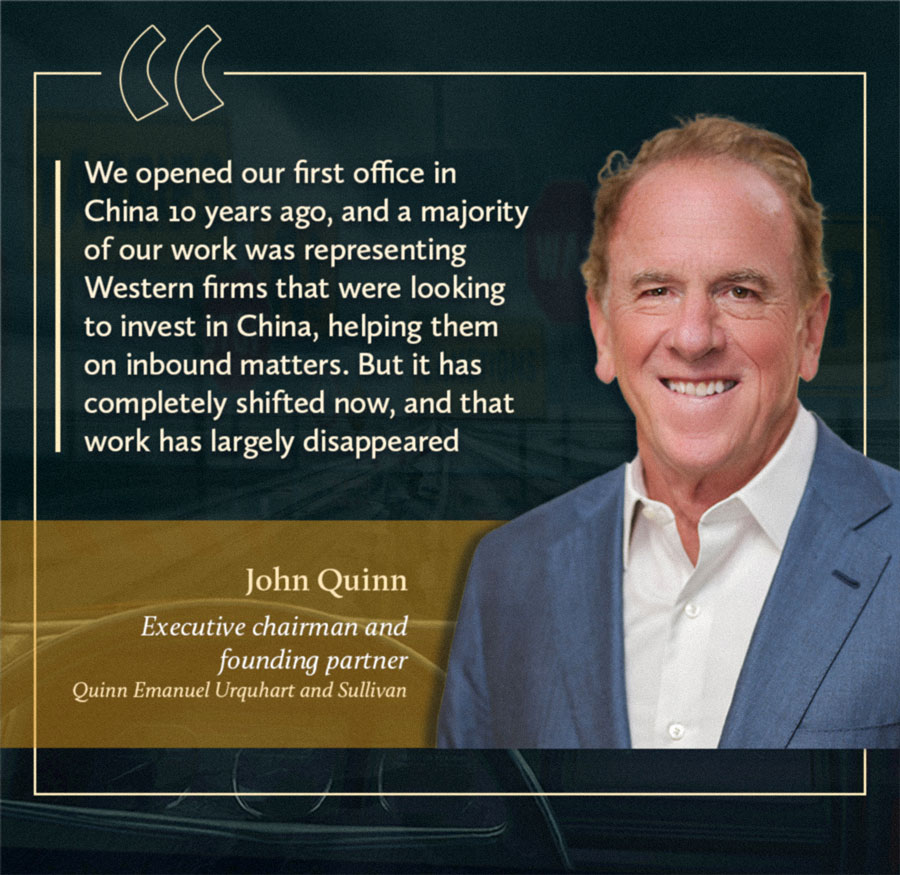
Recounting his most recent trip to China, John Quinn, executive chairman and founding partner of Quinn Emanuel Urquhart and Sullivan in Los Angeles, tells Asia Business Law Journal that there is an acknowledgement that the world’s second-largest economy’s domestic market is challenged, coupled with a lot of uncertainty about what the Trump administration is going to do, and what that would mean for business between China and the US.
“That has had a chilling effect and Chinese companies are wary about investing [in the US] because they don’t know what is going to happen,” says Quinn.
But he points to the fact that major Chinese businesses are now focused on growing their business around the world and projecting into new markets, particularly the Middle East, Southeast Asia, Latin America and Africa. He adds that most of his firm’s China-related work through its Hong Kong, Shanghai and Beijing offices now involves representing Chinese companies in issues that they have abroad from regulatory and compliance, to breach of contract and intellectual property.
“We opened our first office in China 10 years ago, and a majority of our work was representing Western firms that were looking to invest in China, helping them on inbound matters. But it has completely shifted now, and that work has largely disappeared,” says Quinn.
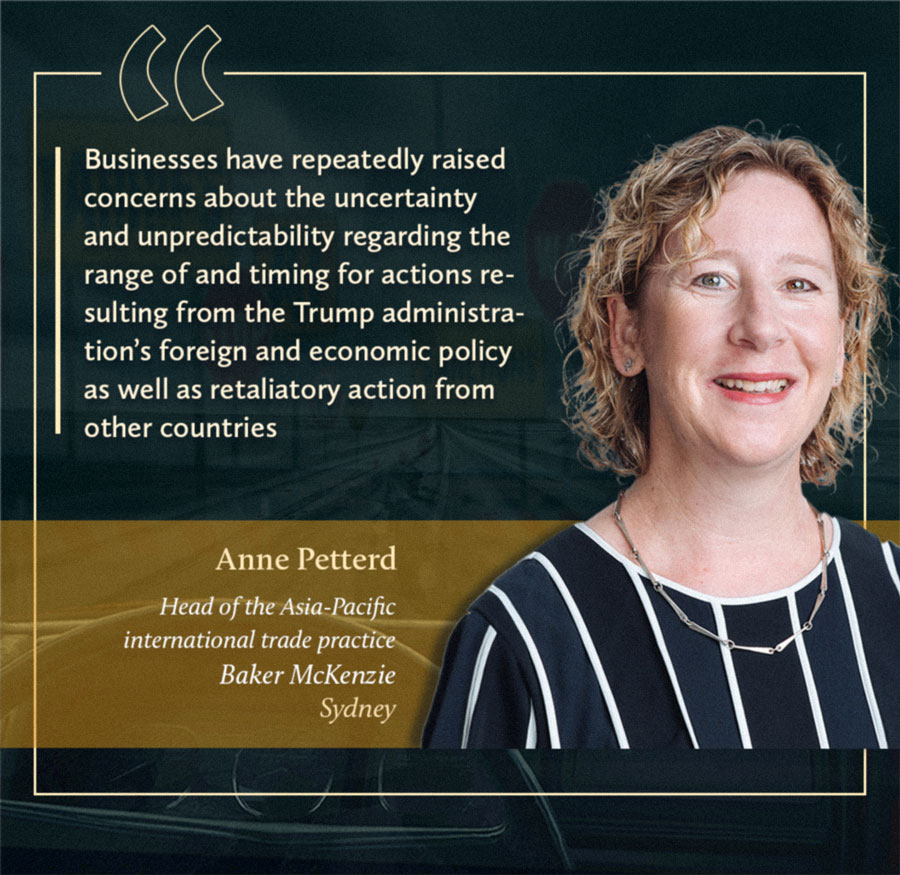
Since the inauguration of Donald Trump for his second term on 20 January, rapid shifts in his foreign and economic policies are hampering the ability of not only Chinese enterprises but companies everywhere to assess risks and recalibrate strategies to future-proof their business, Anne Petterd, partner and head of Baker McKenzie’s Asia-Pacific international trade practice in Sydney, tells Asia Business Law Journal.
“Businesses want to be able to place parameters around regulatory and tariff risk in order to plan and make decisions. Businesses have repeatedly raised concerns about the uncertainty and unpredictability regarding the range of and timing for actions resulting from the Trump administration’s foreign and economic policy as well as retaliatory action from other countries,” says Petterd.
Another member of Baker McKenzie’s international trade practice, Washington DC-based partner Kerry Contini, observes that Asia-based companies are keeping a close eye on the US Congress, particularly for the possible re-introduction of the Biosecure Act. She explains that the re-enactment of the law could have significant impacts on Chinese biotech companies by essentially forcing their US customers with US federal government contracts to choose between the Chinese company or US government contracts.
“We have been working with our clients in Asia to ensure that their trade compliance programmes are fit for purpose and appropriately address US risks as well as risks under local law,” says Contini.
This is echoed by Tai-heng Cheng , co-leader of Sidley Austin’s global arbitration, trade and advocacy practice and co-managing partner of the firm’s Singapore office. Cheng says that he is already seeing clients in Asia working to stay ahead of perceived changes in the US export control regime, to ensure compliance with existing sanction laws and export restrictions as well as those that may be introduced.
“That is a separate area from tariffs but one that is equally deserving of attention,” says Cheng.
South Korean companies in industries producing goods like steel, semiconductors and batteries used in major exports to the US from China (such as automobiles and home appliances) are also expected to be affected.
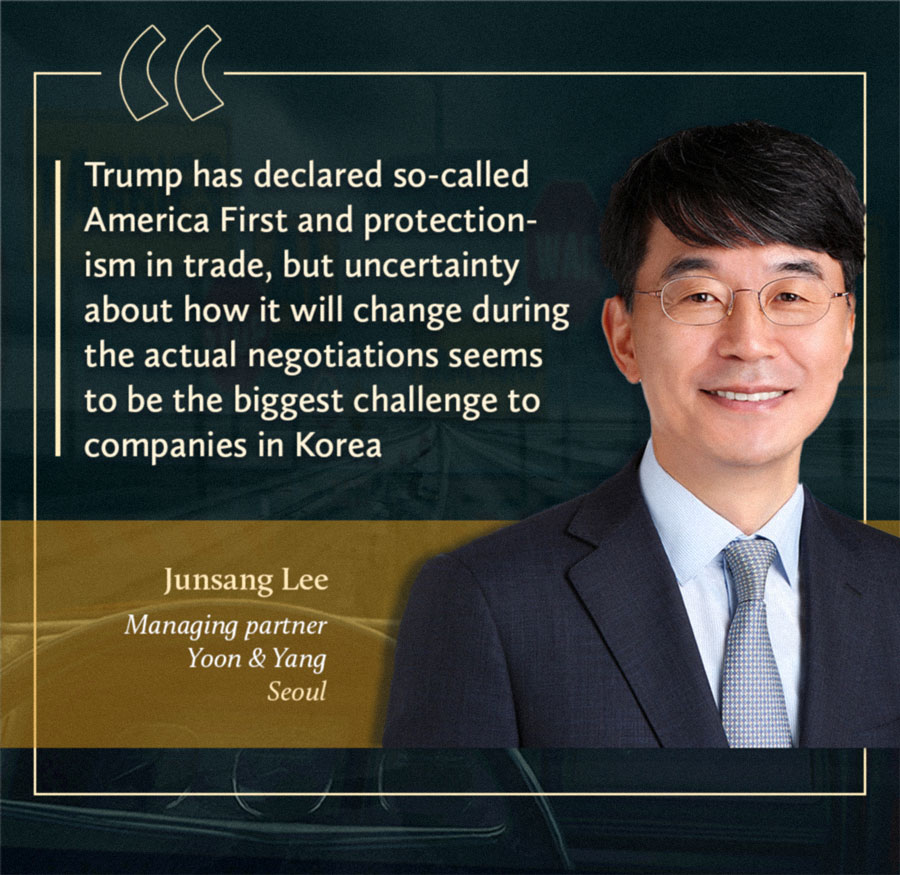
“Trump has declared so-called America First and protectionism in trade, but uncertainty about how it will change during the actual negotiations seems to be the biggest challenge to companies in Korea,” says Junsang Lee, a managing partner of Yoon & Yang in Seoul. “In particular, clients are increasingly interested in industries such as automobiles, steel, semiconductors and secondary batteries that will be affected by the imposition of export tariffs to the US.”
Lee explains that Trump’s reported plan to impose 25% tariffs on Mexican imports will hit South Korea hard, making its use of Mexico to bypass the US administration’s export restrictions on China no longer viable.
Thailand, which has emerged as a popular investment destination for Chinese companies, including those in electric vehicles and batteries, might also move to tighten procedures for issuing certificates of origin for exported goods amid an ongoing tariff war launched by the Trump administration.
Phatsawat Siwawej, a partner specialising in international trade and dispute resolution at Weerawong C&P in Bangkok, argues that when Thai exporters send goods to the US, the actual origin of their products will now be a critical point being examined by US authorities. “The Thai government may tighten consideration on issuing the certificates of origin to ensure products are genuinely manufactured in Thailand,” he says.
Regional regulatory flashpoints
Last year was marked by important general elections across the Asia-Pacific, including wins for Indonesian President Prabowo Subianto in October, and Singaporean Prime Minister Lawrence Wong in May. With this year kicking off in more chaotic fashion with the arrest of South Korean president Yoon Suk Yeol, following his sudden declaration of martial law, Asia Business Law Journal takes a look at regulatory gains and losses in train in various regional markets that investors should take heed of.
China
Five years ago, in January 2020, China’s central government introduced the Foreign Investment Law (FIL), replacing three previous laws regulating foreign investment and foreign-invested enterprises (FIEs) in the country. Under the FIL, FIEs have been subject to the same regulations as domestic companies, including the Company Law, but a five-year transition period was introduced which expired on 1 January 2025.
FIEs established under the previous governing laws, including the Sino-Foreign Joint Venture Law, have been required to align their organisational structure as well as operating rules with the Company Law during this transitional period.
Wu Dong, a senior partner and member of the national management committee at Hui Ye Law Firm in Shanghai, says that the reconfiguration of the organisational structure to comply with the Company Law will significantly impact the governance structures and decision-making processes of FIEs.
“From a structural perspective, certain arrangements previously inconsistent with the Company Law, such as the practice of designating the board of directors as the highest authority in joint ventures, need to be adjusted to establish the shareholders’ meeting as the highest authority, following a two-thirds majority voting mechanism,” says Dong.
From the in-house legal perspective, Kenneth Zhou, head of legal and compliance at Swiss carton packaging manufacturer SIG Group’s Asia-Pacific North region in Shanghai, cautions that those in legal affairs and business must pay attention to the likely passage of the draft amendment of the 2024 Anti-Unfair Competition Law this year. In particular, watch out for the introduction of personal liability in provisions related to commercial bribery, which would be similar to the dual-penalty system under the Criminal Law, with a focus on tackling both bribery and the acceptance of bribes simultaneously.
Zhou adds that another key area of focus is how unfair competition in the online domain will be addressed in this amendment to the Anti-Unfair Competition Law, such as whether it will enumerate more new types of online unfair competition behaviour, or strengthen the provisions of the dedicated internet-related articles.
“Once the amendment to the Anti-Unfair Competition Law is passed, companies will inevitably need to review their business models to ensure there are no deviations from the new law,” he says.
Japan
Similar to China, Japanese companies are facing a regulatory deadline this year and are under pressure to be compliant in time. The country’s Act on the Protection of Personal Information (APPI), significantly amended in 2022, is set to undergo a mandatory triannual review this year with the proposed introduction of administrative monetary penalties.
Ryuichi Nozaki, a senior partner at Atsumi & Sakai in Tokyo, has seen many companies seeking legal advice from Japanese law firms on how they can ensure strict adherence to the APPI regulations.
But this is not the only thing about the upcoming APPI review that domestic and foreign companies operating in Japan should be watching.
Nozaki points to another significant proposed amendment that introduces the right for qualified consumer protection groups to file damage and injunction claims in court on behalf of data subjects. This is particularly relevant in cases of data breaches or leaks of confidential information.
“So far, individuals would have to pay high legal fees, which could not be covered by damages awarded by Japanese courts. But once the new APPI amendment takes effect, Japanese corporates might be subject to potential claims to be filed by Japanese consumer protection groups,” says Nozaki.
Japanese regulators have also been cracking down on the longstanding practice of cross-shareholdings between companies in Japan’s corporate world, forcing corporations to improve efficiency in their capital allocation and usage. Japan’s Financial Services Agency (FSA) defines a cross-shareholding as “shares held by companies to maintain and strengthen relationships with business parties, rather than for pure investment purposes”.
According to Nozaki, Japanese companies have traditionally been engaging in cross-shareholdings to dilute the influence of general shareholders by reducing their voting rights.
While the Japanese stock exchange and the FSA now mandate Japanese corporations to reduce such practices, some companies have recently attempted to bypass this requirement by reclassifying cross-shareholdings as a pure investment. In response, the FSA now requires corporations to justify these changes, increasing pressure on them to sell off shares in listed companies. This aligns with the expectations of shareholders, including foreign investors, who favour such a divestment.
Vietnam
One of Asia’s fastest-growing economies, Vietnam is set to undergo significant change in its government structure from February onwards, which will be particularly important for local and foreign investors.
Intended to reduce red tape and bureaucratic redundancy to boost economic growth, the scaled reorganisation of government ministries merges the Ministry of Planning and Investment with the Ministry of Finance. Similarly, the Ministry of Transport will be folded into the Ministry of Construction, while the Ministry of Natural Resources and Environment will be combined with the Ministry of Agriculture to form a new Ministry of Agriculture and Environment.
Ngoc Anh Bui, Hanoi managing partner of VILAF, says that these changes will take place at both central and provincial levels, impacting procedures for registering new projects and incorporating new enterprises for local and foreign investors alike.
Bui adds that this reform is expected to be a positive step as the mergers will streamline operations and reduce contact points across ministries. While the restructuring may cause minor delays, Bui points to the government’s commitment to ensuring there is no transitional period that disrupts services.
“In the long term, it is hoped that licensing processes will become easier and more straightforward for investors,” says Bui.
Indonesia
As another burgeoning market in Asia seeing significant government-led efforts to liberalise its domestic market to attract foreign direct investment in recent years, Indonesia began the first quarter of 2025 with steps to strengthen its investment initiative by establishing a new state investment agency called Danantara, modelled on Singapore’s Temasek sovereign wealth fund. Approved by the parliament on 4 February, the plan is to create a new body to manage all state-owned enterprises and their revenue streams, along with other state assets and to create a more robust investment structure for the country.
Ira Andamara Eddymurthy, founding partner of SSEK Law Firm in Jakarta, says that the next step involves the issuance of government and implementing regulations to define the status and structure of the agency.
“Questions arise about whether the institution will operate as a governmental, parastatal, or private entity, to whom it will be accountable, and what level of immunity it will enjoy. For example, there is uncertainty about whether it will have the authority to allocate funds and whether its officials will be protected from anti-corruption scrutiny,” says Eddymurthy.
South Korea
South Korea’s political situation has been under the media spotlight in recent months following the unexpected martial law declaration by president Yoon in December last year. Despite political uncertainty brought by the impeachment and subsequent arrest of the president, the country has also seen a spate of activity on the legal and regulatory front.
Just five days before 2024 ended, the National Assembly passed the Act on the Development of Artificial Intelligence and Establishment of Trust AI Basic Act. Set to go into effect in 2026 following a one-year grace period, this marks the first foundational law enacted in South Korea in the field of AI and the first legislation to regulate AI-related industries, companies, products and services.
The AI Basic Act, which is the second piece of AI-specific legislation globally after the EU AI Act, needs to be further explained through subordinate legislation as it divides AI systems into high-impact and generative AI categories. Businesses that develop or use AI and provide related products and services must give users advance notice if such products and services are powered by high-impact or generative AI, with violators subject to monetary penalties of up to KRW30 million (USD20,500).
Yoon & Yang’s managing partner Junsang Lee expects that the law will have a significant impact on businesses that develop or use AI. “AI developers, IT manufacturing companies utilising AI products, and telecommunications operators using AI are expected to be affected, and demand for advisory services related to the AI Framework Act and policies is also becoming active,” says Lee.
But Lee says that companies are not worried about the AI Basic Act, as it is aimed at promoting the AI industry, while urging multinational companies to start preparing to designate local agents in advance as stipulated by the new law.
Singapore
Singapore has been a frontrunner in the adoption and use of AI, with both the legal industry and the government having invested in legal technology adoption.
The country currently does not have specific laws or regulations for AI, with the Singaporean government having promoted responsible use of AI and guiding its deployment through various frameworks and tools. Such methods include the Model AI Governance Framework, which provides guidance to companies for dealing with AI-related ethical and governance problems when deploying AI solutions.
But, with South Korea having introduced its own AI-specific legal regime aimed at promoting and regulating the use of AI, some senior lawyers in the Lion City believe that it is important for the Singaporean government to also establish an AI regulatory framework for promoting the wider adoption of AI.
Kim Beng Ng, managing partner of Rajah & Tann Singapore, says that a recurring theme in discussions with clients regarding the adoption of AI is its incorporation into our workflows and processes.
“Clients want to know what sort of software we are using and the specific use cases,” says Ng.
For law firms, he adds that we are not yet at the point where the AI tools are used to draft documents wholesale or formulate submissions, citing questions over the accuracy of or our ability to rely on the results obtained using these AI tools with hallunications being a real risk.
Ng argues that a guidance or regulatory framework would facilitate and promote the increased use and reliance on AI tools in the lawyer’s work. He illustrates this with an example of how the courts in Singapore have published guidance on the use of AI tools on court documents.
“One requirement is that the user may be required to identify the portions of the document on which AI tools were used and address how the results have been verified,” says Ng.
India
Amid all these political, economic and legal uncertainties, India appears as a bright spot in Asia for both domestic, regional and international investors.
In a move to further liberalise the market to foreign investors, India has made a significant change in its foreign direct investment policy by raising the percentage for permissible foreign ownership of insurance companies in the country from 74% to 100%.
Zia Mody, co-founder and managing partner AZB & Partners in Mumbai, comments that, while foreign insurers can increase their stakes in joint ventures and are allowed to gain full control, pricing disputes often arise in such scenarios.
“When a foreign company seeks to buy out an Indian shareholder, the latter may demand an exit premium, citing their long-term association with the business. On the other hand, the foreign insurer may argue that while a premium is justified, it should not be excessive, given their role in the company’s growth. This ongoing negotiation represents a key challenge in M&A in this sector,” says Mody.
For legal counsel, Mody stresses that it is essential to examine the terms of the shareholders’ agreements established decades ago when foreign ownership was capped at 26%. These agreements determine the rights of the parties, the mechanisms for enforcing buyouts, the possibility of involving third parties, and whether disputes will ultimately lead to arbitration.
Prompted by the high returns of 含羞草社区 buoyant IPO market, many startups and venture capital funding vehicles previously domiciled in locations such as Singapore or Delaware, have been considering redomiciling in India to list, says Mody.
Known as a reverse merger, foreign companies headquartered abroad merge with their Indian subsidiaries, with the shareholders of the foreign entity becoming shareholders of the Indian company. The subsequent listing in India is expected to yield better returns than foreign markets.
But Mody points to the adoption of a more stringent approach by the Securities and Exchange Board of India in overseeing public markets, and in scrutinising IPO filings to safeguard retail investors.
Thailand
For years, foreigners have been establishing companies in Thailand illegally by using Thai nominee shareholders to pass their operations off as Thai-owned enterprises. But authorities have recently stepped up enforcement efforts leading to the arrest of thousands of individuals caught being allegedly involved in such illegal nominee structures, with some having been sentenced to jail, including one reported case of a nine-year prison term for acting as a nominee in multiple companies.
Wayu Suthisarnsuntorn, a senior partner at Pisut & Partners in Bangkok, points to regulations prohibiting foreigners from engaging in several business activities as a driver for the use of the illegal nominee structures.
Under Thailand’s Foreign Business Act (FBA), foreigners are not allowed to engage in nine specified business activities and must obtain a foreign business licence or certificate before engaging in any of the dozens of other business activities listed in the FBA. Suthisarnsuntorn adds that the legal landscape for foreign investment in Thailand remains challenging. He says that while manufacturing is not subject to the FBA, engaging in original equipment manufacturing, where factories produce goods based on specific customer requirements, could be interpreted as a form of service, which would be subject to the FBA requiring the foreigner to apply for a foreign business licence.
“American companies benefit from a special treaty between Thailand and the US, allowing them to bypass most of these restrictions,” says Suthisarnsuntorn. “For investors from other countries, however, the Foreign Business Law remains a significant obstacle to doing business in Thailand.”
Philippines
The Philippines, which has attracted growing interest and investment from not only foreign corporations but also law firms in recent years, saw a lot of cross-border activity in the fintech, data centre and healthcare spaces in the first quarter of this year.
Perry Pe, a senior partner and head of the project development and finance group, and an executive board member at Romulo in Manila, says that European companies have been eyeing investment in the country’s fintech space, including looking at setting up digital banking or acquiring banks with fintech potential.
Investors from other Asean countries have also been showing interest in the data field in the Philippines, looking to acquire or expand data centres, whereas US investors are setting their sights on the country’s healthcare sector.