










Alternative legal service providers are racing to grab a share of the market, but does this mean that law firms will lose traditional work? Manokamana reports
In the age of technology, it is not uncommon for the discovery of newer methods to perform previously mundane, difficult or tedious tasks. This is true across sectors and is not limited to any single industry. Where law is concerned, we see technology being integrated into our everyday lives in multiple ways.
Routine and tedious tasks like maintaining records of all cases, events and meetings; managing physical files, papers and other related documents; rushing from one case hearing to another, or to a meeting; preparing different versions of the same document over and over again, and so on, were all items soaking up a lawyer’s time.
“Traditional legal services rely heavily on manual interventions, leading to inefficiencies and delays,” says Mumbai-based Sapan Parekh, head of business at Leegality, a software company providing a document automation and management tool.
It is no wonder, then, that lawyers welcomed evolutions in technology to their everyday legal practices. Now, there are online hearings and meetings, cloud databases for all documents, electronic signatures, electronic stamping and more, all made possible through the integration of technological innovations in the legal industry. Lately, one of the bigger stars of this integration is the rise of alternative legal service providers (ALSPs).
The concept of ALSPs is that instead of going to a traditional lawyer or law firm service for a particular task or opinion, a corporate client or individual can go to a service provider who meets the same requirements and performs the same task, but in a non-traditional manner, making them an alternative to traditional legal services. This is done for various reasons including lower costs, quicker turnaround time, or self-curated processes, among others.
However, it also raises questions about authenticity and reliability. And it piques interest in what goes on behind the scenes at these alternatives, such as how they manage these services; and what brought about their emergence in the first place. To answer these questions India Business Law Journal talks to service providers, customers and supporters for insight.
Gaps identified
A product or service can only flourish if there is a demand for it. Often, the identification of such demands and missing elements can be a eureka moment for innovators.
For Shashank Bijapur, CEO and co-founder of SpotDraft in Bengaluru, his own predicament as an active lawyer led him to start his contract management venture. “I remember one late night, [I was] painstakingly reviewing a contract, and it hit me – while the world was advancing toward driverless cars, lawyers were still manually copying and pasting contract text,” he says.
Later and coincidentally, he met his co-founder and chief technology officer Madhav Bhagat at a party, and they started their venture into changing contract management with SpotDraft.
The combination of large volumes of work, repetitive tasks, limited resources and the need to complete all of it in record time is another gap that ALSPs fill. “Sometimes, the ‘all hands-on deck’ mantra is simply not enough,” says Bijapur. “Legal teams bring in external counsel for support, increasing costs.”
Sanjit Kaur Batra, group vice president of legal and legal head of India at Cummins India in Mumbai, agrees with this sentiment. She says that in-house counsel face shrinking budgets, limited headcounts, a complex business and legal ecosystem, along with the expectation to become business enablers, in addition to their traditional roles. In this context, ALSPs provide an attractive cost proposition.
Lower cost is always alluring. Delhi-based Ashok Sharma, founder and CEO of the Federation of Indian Corporate Lawyers (FICL), shares: “ALSPs are significantly more cost-effective than engaging traditional legal counsel for routine tasks.”
And with lower costs, multiple other possibilities also appear for ALSPs. “For startups or smaller companies that do not have big legal teams yet, ALSPs give them a way to stay on top of legal needs without breaking the bank,” says Noida-based independent arbitrator, conciliator and legal adviser, Subir Bikas Mitra.
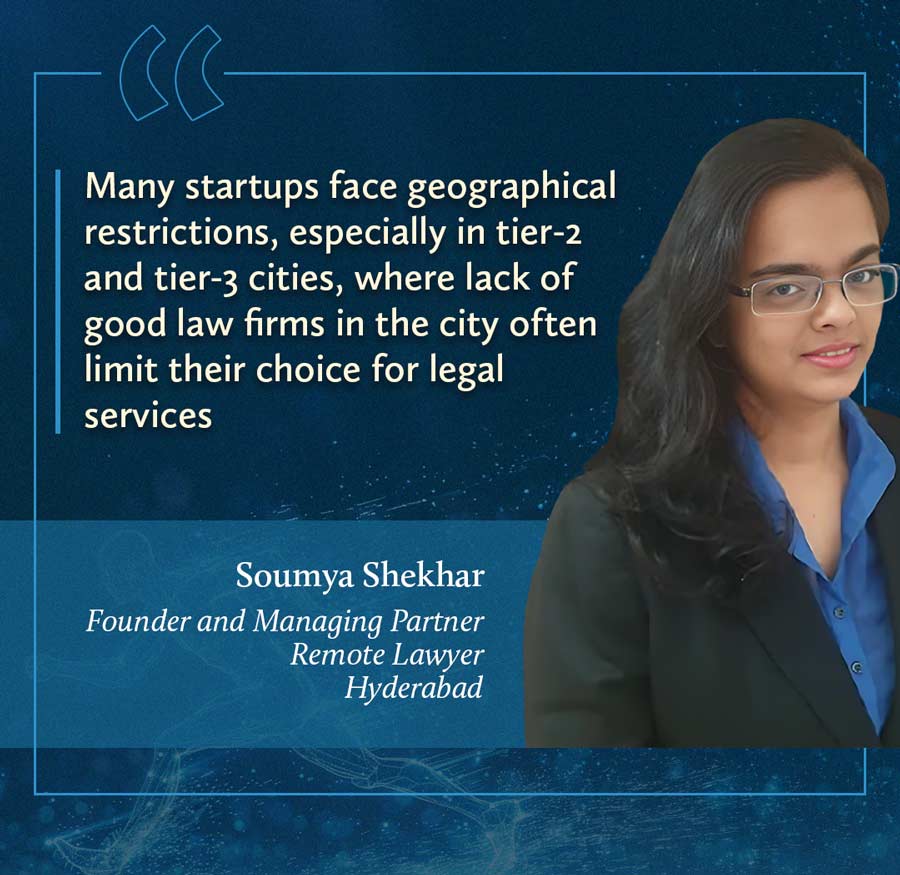
Cost was not the only element identified by lawyers as a hurdle for startups. “The lacunae I observed … was the geographical restrictions faced by many startups, especially in tier-2 and tier-3 cities, [where] the lack of good law firms in the city often made the choices of legal services limited,” notes Soumya Shekhar, founder and managing partner of a completely virtual law firm, Remote Lawyer in Hyderabad.
Law firms as legal service providers pose certain limitations that ALSPs do not. Santosh Mane, general counsel of Zydus Wellness in Ahmedabad, says: “Support is also sought where the conventional law firm might be reluctant to provide paralegal support.”
He goes on to list multiple tasks that for him make ALSPs a crucial part of the modern legal ecosystem – contract negotiations, commercial discussions for property or asset purchases, legal documentation digitisation, and repository management, among others.
Mitra points out: “Not every legal issue needs to go straight to a high-priced law firm, or even the in-house counsel.” This makes the quick and mostly reliable solutions provided by ALSPs a game-changer.
Addressing suspicions
The alluring factors of ALSPs collectively face criticism over possible security, privacy, cyber and accuracy risks related to the services. However, service providers are well aware of these points of criticism and already have multiple measures in place.
At SpotDraft, Bijapur addresses criticism over the lack of accuracy and authenticity for legal solutions by ensuring that lawyers are included in the process every step of the way. “We have lawyers embedded across our leadership and product teams, enabling us to build a platform that truly resonates with legal professionals and delivers an exceptional experience,” he says.
This approach is also adopted by the team behind Jurisphere, an AI assistance tool for legal professionals. Mumbai-based Sankalp S, co-founder of Jurisphere, shares that they “actively collaborate with lawyers to train the tool, validate outputs and shape product features to suit real-world use cases”.
For cyber risks, ALSPs ensure that they maintain the best and latest security certifications, practices and continuous monitoring. “Leegality adheres to both global and domestic encryption and data security standards and undergoes regular audits by independent information security experts,” says Parekh.
To ensure that the service itself remains free from potential risks, both Jurisphere and Remote Lawyer adopt different measures. Varun Khandelwal, CEO of Jurisphere in Mumbai, says that they “deploy enterprise-grade encryption, role-based access, audit trails and private cloud options”.
Shekhar, on the other hand, has adopted the simple but effective measure of executing NDAs with all the personnel and consultants at Remote Lawyer, ensuring legal safety for the data they deal with.
All these measures come in addition to continual improvement and updates for the services provided, as the competition is very tough. So then, why do companies not build their own legal software? That would be a “perfect fit”, without any risks, as it would be completely in-house. Mane answers simply: “Developing such dedicated [solutions] will cost more as compared to the work outsourced to ALSPs.”
You must be a
subscribersubscribersubscribersubscriber
to read this content, please
subscribesubscribesubscribesubscribe
today.
For group subscribers, please click here to access.
Interested in group subscription? Please contact us.
你需要登录去解锁本文内容。欢迎注册账号。如果想阅读月刊所有文章,欢迎成为我们的订阅会员成为我们的订阅会员。