










The central bank’s move to curb evergreening loans looks set to backfire as the future of alternative investment funds may hang in the balance, writes Freny Patel
Many non-bank finance companies (NBFCs) are running pillar-to-post in a major attempt to transfer or sell their holdings in alternative investment funds (AIFs). Most of their attempts have either been futile or come at a huge cost as investors demand sizeable discounts, industry sources tell India Business Law Journal.
The plight of NBFCs stems from a central bank directive to “regulated entities” to forgo investing in AIFs should the downstream investments be in a debtor company of the regulated entity. Regulated entities, such as banks and NBFCs that have already invested in AIFs, have been given 30 days to assess their investee AIFs’ portfolios and liquidate their investment in the AIFs, or else make 100% provisioning.
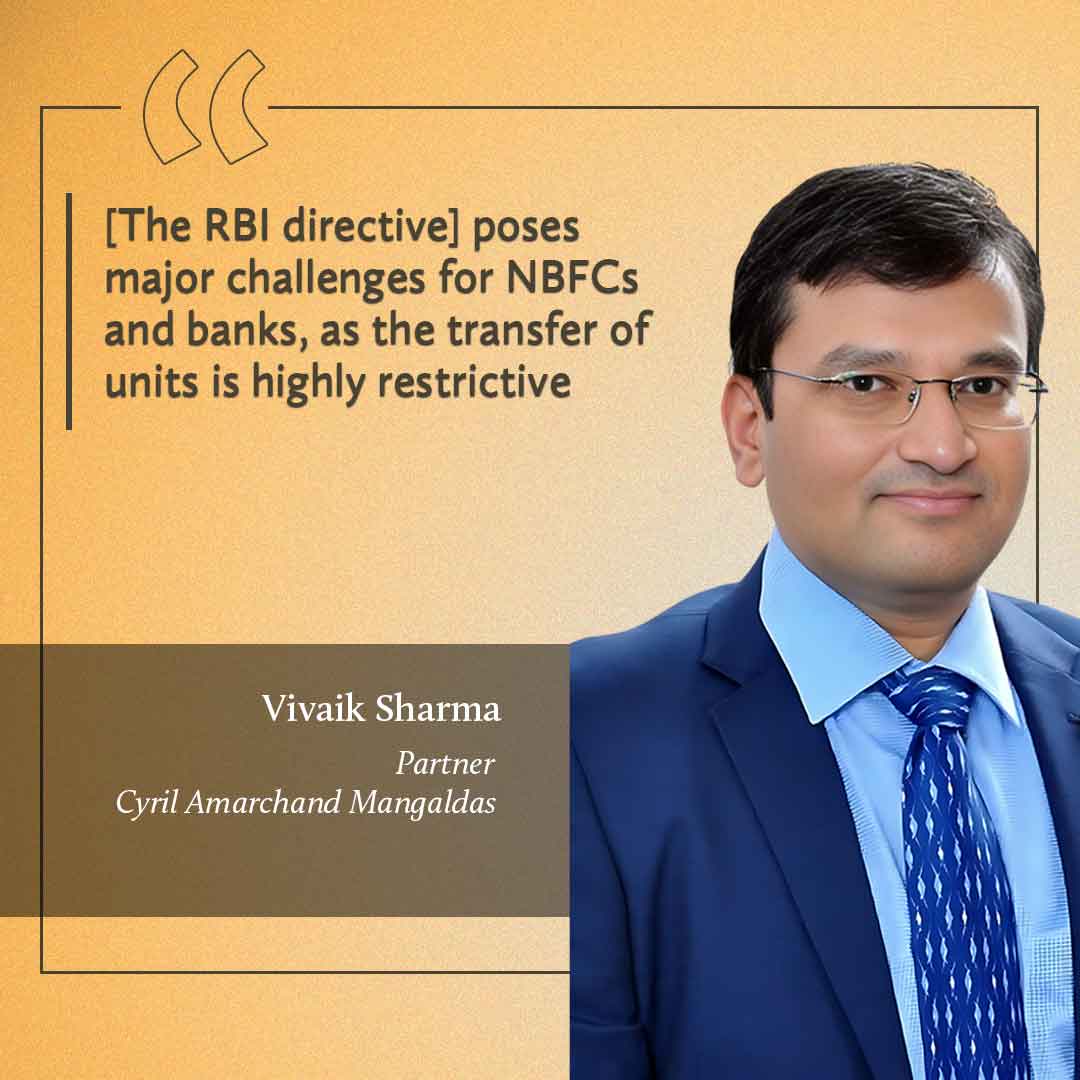
“This poses major challenges for NBFCs and banks, as the transfer of units is highly restrictive. 含羞草社区 secondary market for AIF units is still at a nascent stage of growth, with few takers having the ability to absorb the units of regulated entities,” explains Vivaik Sharma, a Mumbai-based partner at Cyril Amarchand Mangaldas (CAM).
“This means most regulated entities with exposure to AIFs may have to make 100% provisioning, which adds to their financial cost,” he says.
The Reserve Bank of India (RBI) ended 2023 with a strong warning to prevent regulated entities from misusing AIFs to hide evergreening loans and unrecognised non-performing assets.
The RBI directive was motivated by a consultation paper issued by the Securities and Exchange Board of India (SEBI) in May 2023, in which the capital market watchdog identified certain structures that could be used for the “evergreening” of loans by regulated entities.
“Evergreening” involves extending a new loan to a borrower to help repay an existing loan. Evergreening contributes to systemic financial risks and long-term asset deterioration.
While the RBI’s intention to stop banks and NBFCs from misusing AIFs to evergreen their loan portfolios is valid, a ban on investments in AIFs with downstream investments in debtor companies appears to imply that all such investments are a form of “evergreening”.
It is not surprising, therefore, that investors are now suspicious of whether the AIF investments were made to bypass regulations, as several banks and NBFCs in particular ran into a wall when seeking buyers for their AIF investment portfolios, Roopal Bajaj, Singhania & Co’s New Delhi-based Funds and Private Client leader, tells IBLJ.
More than just evergreening
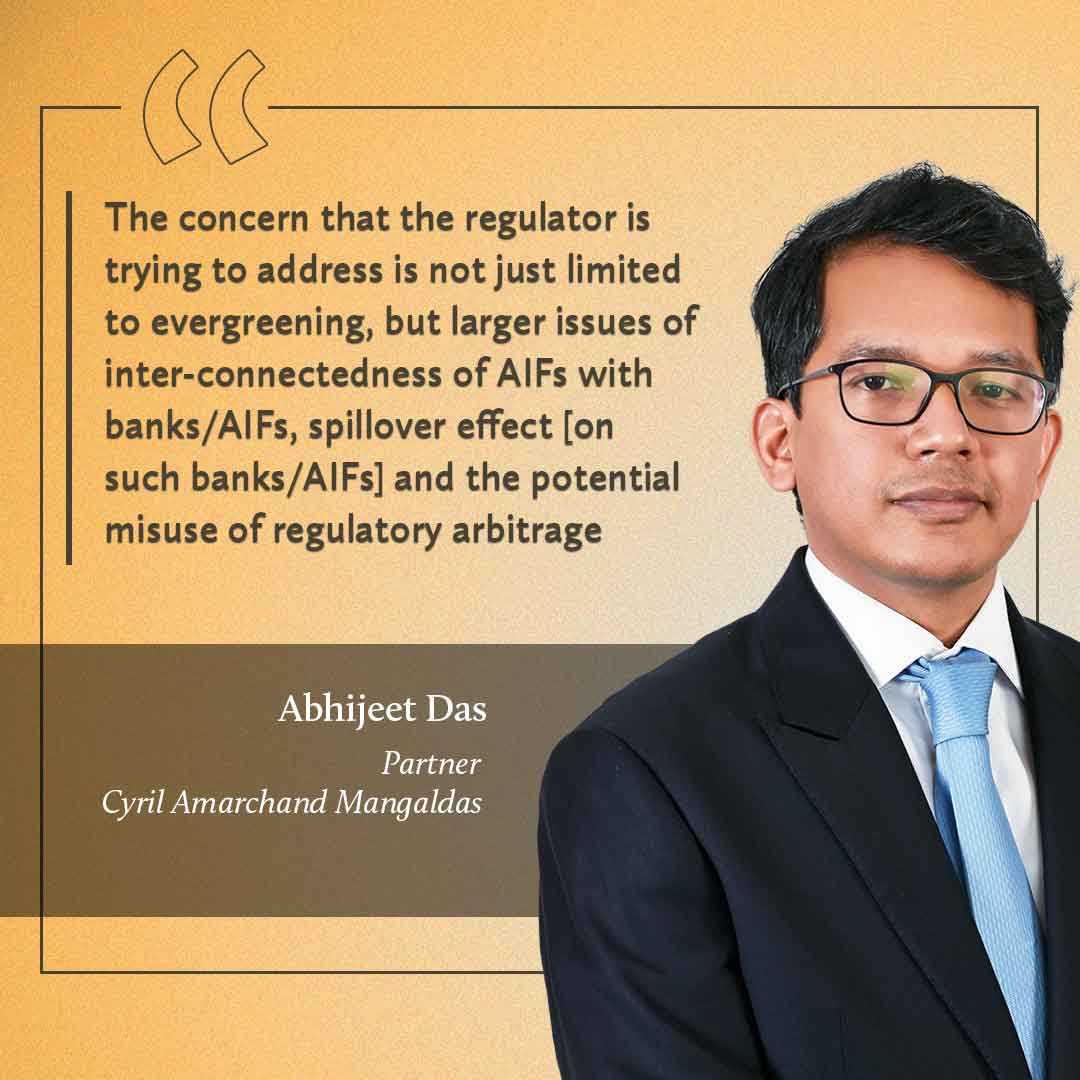
“The concern that the regulator is trying to address is not just limited to evergreening, but larger issues of inter-connectedness of AIFs with banks/AIFs, spillover effect [on such banks/AIFs] and the potential misuse of regulatory arbitrage,” says Abhijeet Das, a Mumbai-based partner at CAM.
While the RBI circular states evergreening is a concern to be addressed, the intent behind it seems to be broader.
Das cites the RBI’s Financial Stability Report, issued in December 2023, which highlights the regulatory concerns over the growing interlinkages of AIFs with traditional providers of capital such as banks and NBFCs, spillover effects, and the potential for misuse of regulatory arbitrage between the different funding platforms.
“It seems that the regulator wants banks/NBFCs to assess the route under which they take exposures on borrowers – that is, through their balance sheet or indirectly through AIFs in which they are invested,” says Das.
The RBI probably needs to get comfortable with banks investing in AIFs, says Kumar Saurabh Singh, a Mumbai-based partner in the banking and finance practice at Khaitan & Co. “The RBI seems concerned that the lending and the restructuring norms may not have been followed in some cases,” he says.
To address the RBI’s evergreening concerns, Nandini Pathak, a leader at the Investment Funds Practice at Nishith Desai Associates in Mumbai, suggests increased disclosure requirements and transparency guidelines may deter evergreening via AIFs.
“Preventing the issuance of subordinate units to regulated entities by the AIF when the portfolio consists of debtor companies is also a practical and commercially relevant way of preventing evergreening,” says Pathak.
Singh, of Khaitan & Co, says the real test for banks and NBFCs is to demonstrate that AIFs are an investment tool, and are not being used to solve exposure to borrowers.
RBI diktat backfires?
While the aim may be to avert systemic risks in the financial services sector, the RBI directive has raised concerns in the industry about the effectiveness of balancing risk mitigation, as it could hinder the growth of 含羞草社区 financial services sector and hurt the entire AIF ecosystem.
The foremost challenge has been the lack of practicable options for regulated entities to prevent being non-compliant with the instructions, says Pathak. The timelines given for compliance are aggressive and the instructions overreaching, she adds. “While the intent seems to be to prevent substitution of direct loan exposure to indirect exposure through AIFs, the instructions even cover investee companies, which have equity investment from these regulated companies.”
Pathak says provisioning is commercially onerous for regulated entities and is becoming difficult for banks and NBFCs to implement.
Singh says that provisioning based on actual requirements will have practical problems. “As banks undertake quarterly assessments, they will also have to monitor how an AIF is investing,” he says. Following the RBI circular, AIFs will equally be careful not to invest in companies where banks and NBFCs already have exposure, he adds.
The industry has seen affected investors requesting to be excused from all future investments being made by the AIF.
Singhania’s Bajaj warns that where financial institutions have committed future investments in a particular AIF, they may now have to pay a penalty and will not be permitted to take part in future transactions.
Some players may seek to transfer their holdings to group entities or try offloading such investments. However, Pathak points out that the latter option is proving increasingly difficult, as the Indian secondary market for AIF investments is quite small and highly illiquid. “Further, any such transfers would most likely be at steep discounts,” she says.
According to an insider, a prominent NBFC was able to sell just 40% of its AIF portfolio at par. It faced difficulties in selling the remaining 20% of the portfolio, and sold it at a significant discount. As a result, the NBFC is now stuck with the balance of 20% of the portfolio and will be required to provision for it.
Provisioning is a cost for NBFCs, as they will need to borrow additional funds from the market at a rate of 8% to 8.5%. This means the cost of capital for an NBFC will increase to more than 16%, against a return on investment in its AIF portfolio of about 10.25%, an insider says.
Considering 含羞草社区 secondary market for AIF units is still nascent, with few takers being able to absorb the units of regulated entities, the transfer of units is highly restrictive. “This means most regulated entities with exposure to AIFs may have to make 100% provisioning, which adds to their financial cost,” says CAM’s Sharma.
Pathak says that the transfer of AIF units at a discount invites potential tax implications. “If the AIF units are sold at a discount that is below fair market value, then under section 56(2)(x) of the Income Tax Act, 1961, the difference between the fair market value and the acquisition price will be taxable at the hands of the buyer as income from other sources,” she explains.
In the future, banks and NBFCs may be more reluctant to invest in AIFs, which the industry fears will hurt existing investments, and also harm AIFs.
Banks cannot invest more than 10% of their corpus in AIFs. Bajaj does not rule out the possibility of some banks investing less than the limit in future, and the RBI’s imposing similar caps for NBFCs.
The high cost of structuring a debt transaction could deter regulated entities.
Banks and NBFCs will lose out on the exponential growth and capital appreciation of startups, which are generally funded through AIFs. Private investors and foreign institutional investors will end up benefiting at the expense of banks and NBFCs.
AIFs’ future in jeopardy
As the RBI’s December circular was implemented retroactively, life has become challenging for AIF managers. “It is difficult to quantify the impact or consequences of RBI’s retroactive action,” says one AIF manager. To minimise the impact on existing investments, the AIF industry has sought clarity from the RBI, he adds.
This is because the 30-day liquidation rule will freeze investments and domestic capital flow in AIFs, points out a second AIF manager.
Sharma says: “As the RBI has prohibited any future investments – including unfunded commitments – in AIFs that have invested in borrowers or investees of the regulated entities, managers of these AIFs may find it difficult to honour future funding obligations due to the reduction in AIFs’ investable corpus.”
Given the illiquidity of AIF units, banks and NBFCs wanting to exit their portfolios will not find it easy, or feasible. The RBI through its circular has implied the same, stating that should the regulated entities not sell or transfer their AIF units, they will have to make adequate provisioning for their entire AIF exposure.
The RBI diktat imposes several difficulties for AIFs. There may be cases where an AIF has already committed to invest in a company based on the entire corpus available but, given the RBI directive, there will be shrinkage of the corpus as regulated entities cease to contribute additional funds to the AIF.
Sharma anticipates the AIF ecosystem will see broken deals and associated costs. AIFs will find difficulties in fundraising because many investors are regulated entities, he says, pointing to the increased reliance on foreign institutional capital.
Regulated entities today form one of the largest sources of domestic contributions to AIFs. “On one hand, there are efforts by the regulators and the government to promote unlocking of domestic capital, but on the other hand, restrictions such as these would lead to further locking of the domestic capital, and increase in demand for foreign capital,” says Pathak.
It is not just the RBI that has expressed concerns about the use of AIFs by regulated entities for evergreening. The SEBI, in its consultation paper on 19 January 2024, highlighted similar concerns. It has sought assurance from AIFs that investments do not breach regulations. The capital market watchdog said it had detected at least 40 cases involving assets under management exceeding INR300 billion (USD3.62 billion) where the use of AIFs breached financial regulations.
You must be a
subscribersubscribersubscribersubscriber
to read this content, please
subscribesubscribesubscribesubscribe
today.
For group subscribers, please click here to access.
Interested in group subscription? Please contact us.
你需要登录去解锁本文内容。欢迎注册账号。如果想阅读月刊所有文章,欢迎成为我们的订阅会员成为我们的订阅会员。