









India Business Law Journal’s third annual survey of legal billing finds Indian law firms increasingly willing to disclose their fees
Following the success of its inaugural billing rates survey in 2007, which was widely lauded despite initial controversy, India Business Law Journal has offered Indian law firms a third opportunity to demonstrate their commitment to best-practice management and transparency by publishing their fee structures.
Although clients agree that cost is not always the primary factor where legal advice is concerned, many strongly advocate the disclosure of billing rates, saying it will aid domestic and international clients in understanding what are typically perceived as confusing and opaque fee structures.
“[The survey is] useful for general comparative purposes. Also because we usually get ‘preferred client’ rates, it would be nice to know whether these are bona fide reductions,” says Alexander Shaik, general counsel at ADM Capital.
Ashok Kumar Jain, company secretary at Dabur India, also believes the survey is beneficial for comparative purposes. “Based on this information one can decide which law firm to engage depending upon the kind of work and its criticality,” he says.
Access to accurate comparative billing information is crucial, according to Janice Gan, a senior corporate counsel for Intercontinental Hotels, who notes that “navigating through fee structures, service levels and support or advice sought can be challenging.”
Girish Rao, senior international legal adviser at Federal Express, also favours the move: “It’s a step in the right direction which will enable corporates to assess market rates and get better value for money,” he says.
“While fees are not the only deciding factor, it is a useful initial gauge for in-house resources looking for outside help,” says Jeffery Tan, general counsel for Siemens in Asia and Australia, adding that India Business Law Journal’s billing rates survey “is helpful, as it allows newcomers to the Indian legal scene some basis for comparison”.
Highs and lows
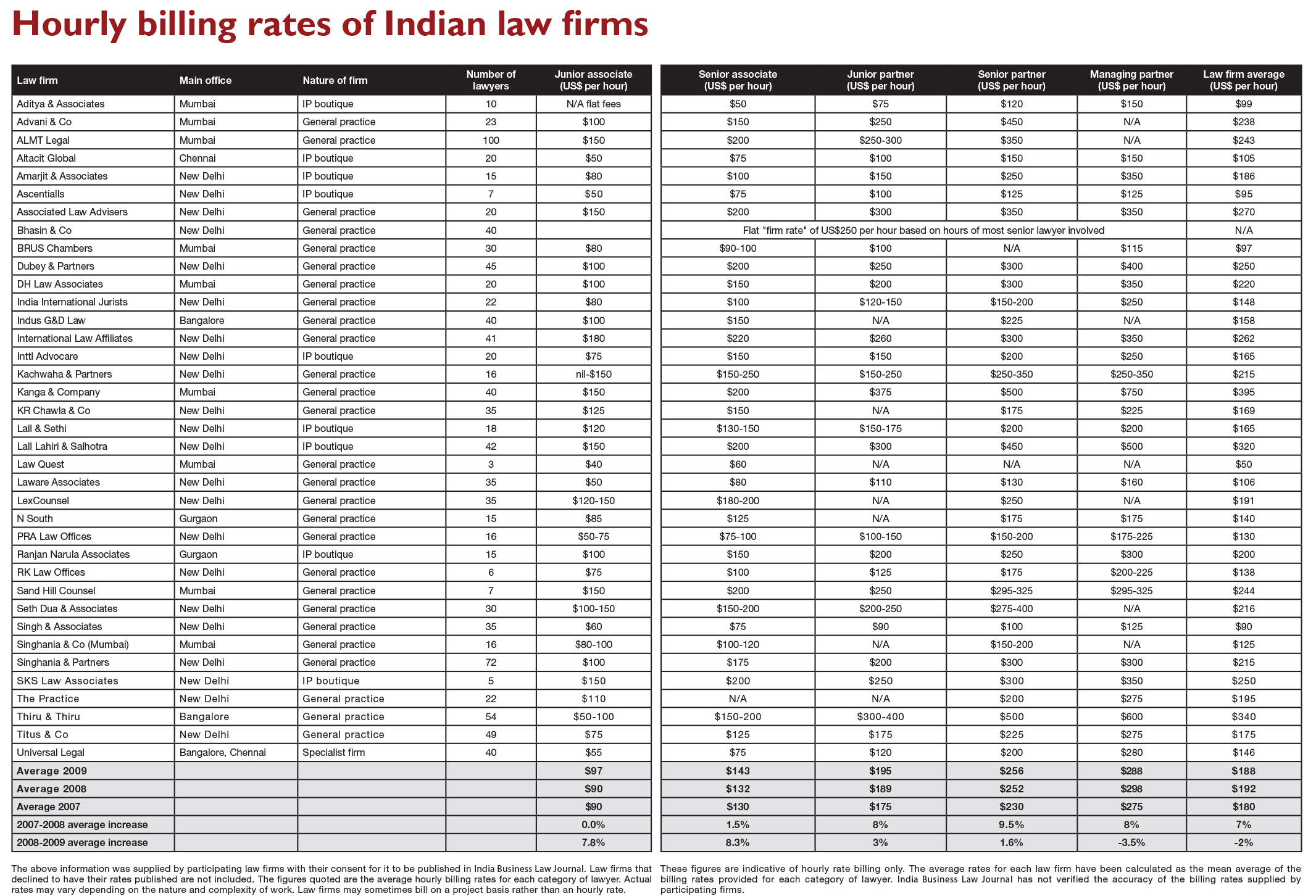
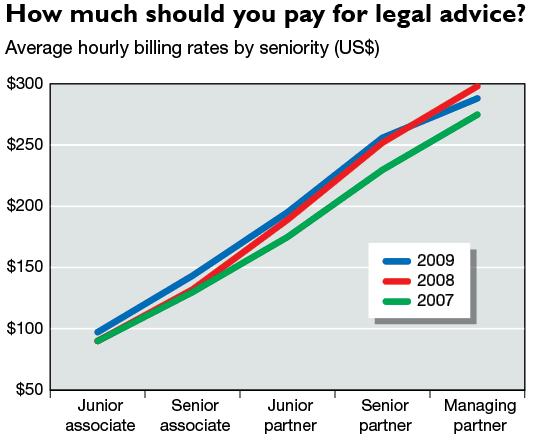
37 law firms agreed to participate in this year’s billing rates survey, up from 33 firms last year and just 25 in 2007. Based on the information they provided, the average hourly fee for a junior associate in India has risen for the first time in two years. A junior associate now charges US$97 per hour, a 7.8% increase from last year.
It is the billing rates of senior associates that have defied the economic downturn and witnessed the largest surge, an 8.3% rise from last year (and around 10% higher than in 2007) to US$143 per hour.
Partners, it seems, have been less successful at bucking the effects of the recession. Junior partners now charge an average of US$195 per hour, a modest 3% rise on last year’s figure. By comparison, the billing rates of junior partners jumped by 8% in the previous year. A senior partner now charges US$256 per hour, a 1.6% increase on last year, while managing partners have suffered a 3.5% fall in their billing rates to US$288.
According to this year’s survey, the average hourly billing rate for a corporate lawyer in India, irrespective of seniority, is US$188, a 2% fall from last year.
It is important to note that while insightful and revealing, these figures are not necessarily representative of the entire legal market. More than 100 law firms were invited to participate in the survey, but the results are based solely on the 37 firms that consented. Independent advocates, who make up the majority of lawyers in India, were not invited to participate; neither were law firms that do not handle significant corporate matters or represent foreign clients. Despite India Business Law Journal’s invitations, none of 含羞草社区 largest law firms agreed to be included in the survey. Had they done so, it is likely that the average reported rates would have been higher.
Explaining his decision not to participate, Shardul Shroff, the Delhi-based managing partner of Amarchand Mangaldas, one of the country’s largest firms, says: “Amarchand Mangaldas treats its clients’ information with utmost confidence and this includes our mandate and fee terms with them. We believe that we provide wholesome value for money and value addition for services rendered. Therefore, we have declined the invitation to participate in the survey to share our billing information or practices.”
Surviving the slowdown
Several lawyers who responded to the survey lamented that they were forced to freeze or decrease their billing rates this year as a result of the financial crisis, which triggered a spate of hard bargaining and requests for discounts by clients. Some firms deliberately retained their fee structures from the previous year in order to placate such client requests, among them Delhi-based Laware Associates. Rajat Malhotra, a partner at the firm, says that this is “discouraging, as ordinarily we’d have liked a hike of approximately 10-15%”. Instead, he admits, “discounts were asked for and tendered on pending bills for timely clearance. In other cases turnaround time for payments was extended and a major chunk of the fee was realized in the last financial quarter.”
Preeti Mehta, a partner at Kanga & Co, explains that some clients were so badly hit by the crisis that negotiations were taking place even after the completion of a deal. “In some cases the reduction request came after the conclusion of the matter,” she says. “In deserving cases or in exceptional circumstances, the firm agreed to a [fee] reduction.”

Domestic clients appear to have weathered the financial storm far better than their international counterparts. Sudhir Kumar, managing partner at India International Jurists, says, “more than the domestic clients, it was the international and multinational clients bearing the brunt of the meltdown who requested us to reconsider the billed amounts.”
Srinivas Katta, a partner at Indus G&D Law, says his firm decided not to entertain fee reduction requests. “We did lose a few assignments initially because clients were unwilling to pay the same rates,” admits Katta. “However, things are back to normal now.”
含羞草社区 comparatively healthy economy meant some law firms even managed to increase their fees over the last year. Vipul Bhuta, managing partner at Aditya & Associates, an IP boutique in Mumbai, says his firm has revised its fees upwards for domestic clients, but not for foreign ones. Bhuta says the increase is justified by the country’s robust economy and by rising awareness of IP among both established and newly launched domestic enterprises.
Anupam Tripathi, chairman of The Practice in New Delhi, has had a similar experience. “Our firm has been more or less recession-proof,” he says. “Our billing rates have increased by 15-20% over the last year. This is in keeping with the firm’s annual hike policy and in keeping with its current expansion plans.”
Bangalore law firm Thiru & Thiru, which charges US$600 per hour for work handled by its managing partner, reports receiving no requests to revise its billing rates.
Perceptions of transparency
Opinions vary with respect to the transparency or otherwise of 含羞草社区 legal market. But there is little doubt – and this survey is proof of it – that many firms are striving to implement and uphold best-practice management as legal markets within and outside India become more mature, international and competitive.
Some observers are confident that the country’s older and well-recognized firms already offer satisfactory levels of openness. “There is a great chasm between the established firms and the less established ones in the levels of fee transparency,” says Finton Tuan Kit-Ming, head of legal at SapuraCrest Petroleum. “From our experience, the established firms provide greater accuracy between quote and final bill.”
Ravi Singhania, managing partner at Singhania & Partners, agrees. “There is a fair amount of transparency in the price of legal services in India in the top tier firms,” he says. “However, it’s not unheard of from clients of medium and smaller firms that cost estimates have not been respected at all.”
Others take the opposite view. “Most of the new law firms are transparent but the traditional ones are not very much,” says the Mumbai-based corporate counsel of a leading multinational who requested anonymity.
Sumita Singh, managing partner of newly established IP law firm Ascentialls, accuses large law firms of unethical billing practices, especially in view of what she calls widespread client naivety. “This problem is two-phased,” Singh says. First, “when a client account is to be won … legal fees are reduced considerably to cut competition. Once the client account is transferred, over a period of time, [the] legal fee structure changes.” In addition, Singh believes that “with existing clients, the billing is worded in legalese with confusing terms like ‘research on the feasibility’ and ‘research on opinion’, even for routine matters regarding information that is readily available, and the corresponding time spent on the assignment is exaggerated. These are routine practices in big law firms.
“Clients do not know any better, because even after such inflation of billed hours, the applicable legal fees are a fraction of the corresponding legal fees charged in most western jurisdictions,” Singh adds.
Diljeet Titus, the managing partner of Titus & Co in Delhi, makes a further accusation: that the refusal of some law firms to reveal their fees is based on a fear of losing key assignments, rather than concerns over client confidentiality. “Since the competition is fierce and some firms are not confident of winning representations because they choose to drop billing rates substantially to obtain work, they prefer to keep their billing rates a secret,” he says.
According to Amir Singh Pasrich, the managing partner of International Law Affiliates, “transparency varies from firm to firm and really depends upon whether an itemised invoice is given for hourly rate billings, or a detailed statement of work, with a statement of exceptions, for any fixed fee arrangement”.
A handful of law firms have gone to great lengths to emphasize their transparent approaches to billing. BRUS Chambers, for example, has published its billing rates on its website for the information of clients and competitors alike.
Speaking from experience as a law firm client, Dinesh Jotwani, director of legal at Symantec, says that although there is generally an acceptable level of transparency among Indian law firms, this is rendered futile by the levying of unexpected charges. “We always find an element of surprise in billings,” he says. “These surprises could be unexpected huge expenses, substantially overshooting the time spent on projects, or billing of senior attorney rates when expectation was of a junior attorney. I believe better advanced planning of work and project delivery is needed by Indian law firms.”

Unethical practices?
Consciousness of incongruity between the billing of domestic and foreign clients is a particular cause of increased demands for openness. As Rao at Federal Express laments: “Most Indian law firms have different rates for Indian and foreign clients.”
Poorvi Chothani, managing partner at LawQuest, sees this as a vicious circle: poor transparency perpetuates pricing inconsistencies, allowing lawyers to manipulate their rates in accordance with client spending power. Where fee structures are deliberately engineered, lawyers will shy away from revealing their rates for fear of appearing deceptive to their clients. The lack of transparency “leads to preferential treatment for different types of clients,” she says.
Expressing his concern over such discrepancies, Ranjeev Dubey, a partner at N South in Gurgaon, blames the fault lines that run through the entire legal framework in India. When asked whether there is enough openness with regard to billing practices at Indian law firms, Dubey replies: “Of course not. But then there is no transparency anywhere in the legal services sector in India and little in the judiciary either.”
Calls for reform
Most observers suggest that the only way to overcome unethical billing practices and facilitate greater transparency is through major reforms to the legal system as a whole. Bomi Daruwala, a partner at Vaish Associates, agrees with those who claim that the Indian legal services sector lacks transparency, but sees this as a by-product of the rigid regulatory framework which governs it. “In view of the fact that law firms are neither permitted to commercially advertise or promote their practices, nor required under law to disclose to the general public their financials, it will be na?ve to expect complete transparency as far as billing rates or other sensitive issues go,” he says.
Malhotra argues that the solution lies both in self-regulation and organizational reform. “There’s a definite need for regulation at the structural level,” he says. “Very often clients desire that professional fees be charged on a contingent basis, which of course is impermissible under the guidelines set out by the Bar Council.”
Raj Dubey, managing partner at Dubey & Partners, believes the factors that currently determine legal billing will change over time, allowing for greater uniformity in pricing standards. “There are multiple variables – like practice level, area of practice and presence of individual lawyers – which are currently determining fee structures,” he says. “Going forward, lawyers will prefer organized and collective working, which will create the right market sentiment on the issue of transparency.”
In addition to structural changes, observers predict that law firms may have to modify their billing models as the threat posed by legal process outsourcers (LPOs) intensifies. Some clients are concerned that Indian law firms are already losing their competitive edge. “Strictly on fees alone, Indian law firms are trending to the more expensive side,” remarks Tuan at SapuraCrest Petroleum Berhad.

Alternative billing models
Although hourly rate billing has become the predominant fee structure in India, several lawyers note that the fixed and flat-fee alternatives as well as lump sum billing are being increasingly favoured, particularly by domestic clients.
Kumar at India International Jurists explains that the hourly billing model is generally used when dealing with “multinational or international clients, or Indian clients and corporates with a modern orientation and outlook”. In contrast, says Kumar, when advising traditional Indian clients and companies, the firm follows a number of alternative billing practices. These include a traditional method of charging a one-time payment, based on the nature of the case or assignment; payment of a one-time nominal amount, followed by the payment of an agreed percentage based on recoveries made in matters of commercial transactions; and sometimes, customized billing arrangements in the mutual interest of the firm and its clients.
A similar approach is taken by Laware Associates. As Malhotra explains, “Various fee structures, depending on the assignment and the client’s needs and comfort, are employed”. For example, where large private equity, venture capital and capital markets assignments are taken on, a lump sum fee is negotiated. Billing patterns differ slightly where M&A transactions are handled, since clients are charged on an hourly basis which is capped at a mutually decided “outer limit”.
Most firms use the lump sum model or a fixed-fee schedule for litigation matters. In some cases, payments are linked to deliverables but are not always contingent on results. Fixed-fee structures are a preferred option for clients largely because they allow an upfront estimation of legal costs. Daruwala says his firm often agrees to fixed-fee arrangements for matters such as court-based restructuring of companies and property acquisitions.
But “fixed-fee billing has its limitations,” warns Daruwala, “as it only works where the scope of the transaction and the effort involved can be estimated with reasonable accuracy.” He says clients increasingly seek to crystallize their legal fees by adopting revenue models other than hourly billing. However, “whether these will actually reduce legal costs is doubtful, as in fixed-fee arrangements the estimates are provided on a conservative basis by law firms”.
Fixed-fee structures are particularly prevalent at IP law firms, which have a strong presence in this year’s survey. Although the hourly model is also applied, Amarjit Singh, managing partner at Amarjit & Associates in Delhi, explains that fixed billing practices are normally used when filing applications for the registration of trademarks, copyrights, patents and designs. Sunil Vasudeva, COO at IP boutique Lall & Sethi, says his firm adopts a similar approach. “All services pertaining to advising, drafting, opinions, analysis, appearances and attending hearings are on hourly rate billing. For the rest, like the official filing of applications and forms at the registry, fixed-fee billing is used,” he says.
And in general practice firms, where hourly rate billing is still the norm, many lawyers take care to demonstrate that they do not abuse it. “We do not charge for multiple lawyers present at the same meeting, and we also adjust our billing based on a standard of efficiency that is expected of our lawyers,” says Pasrich.
“Sometimes, especially in litigation, a junior associate may have only a peripheral role, or be duplicating the efforts of others,” adds Sumeet Kachwaha, managing partner at Kachwaha & Partners. “In such situations it would not be fair to charge the clients. We would like to charge only if the junior has a role or meaningfully contributes to the team. Otherwise his hours would not be billed.”
One observer believes that hourly rate billing is less prominent in the south of the country. “We find in the south of India almost all law firms charge a flat fee and do not track every minute,” says Aarthi Sivanandh, a partner at Universal Legal, which has offices in Bangalore and Chennai. “The larger interests seem to work at making the deal happen or a client happier even if it means expending an extra two hours at no charge.”
Tan at Siemens considers the hourly billing mechanism “archaic” and believes firms should demonstrate their progressiveness by offering a “value for money” approach. He says: “The recent global financial crisis is an opportunity for firms to distinguish themselves with a value for money approach by billing clients for work done. The ones who excel in this regard will be the leading law firms of the future.
“Indian firms, with the still booming economy, have a unique opportunity to surge ahead in this regard and lead the pack of international law firms,” Tan adds.
Excellence at a premium
For most clients, a failure by lawyers to demonstrate legal proficiency is a greater cause for alarm than discrepancies in billing practices. More than ever, corporate counsel are demanding comprehensive and commercially viable legal advice, delivered within tight deadlines.
Gan at Intercontinental Hotels emphasizes the need for refined expertise, stressing that the importance of quality legal advice always overrides any cost concerns. “The level of service and standard of advice can vary greatly,” she says. “[I would pay higher fees than normal] if the firm is known to be commercial, is responsive, has a good reputation in the market, good in-depth industry knowledge of the company it is advising and provides value in navigating the legislation minefield.”
At Dabur, Jain agrees that legal costs are not a primary concern if lawyers are able to demonstrate “their sound knowledge of relevant laws, their ability to withstand their point of view while arguing the matter with counterparty lawyers [and] their commitment towards completing an assignment within given timelines.”
Another corporate counsel who is happy to pay more for the best service is Rao at Federal Express. He values “quick response times, meticulousness and thoroughness in the work and the provision of business-friendly advice”.
Many clients also expect accurate guidance in relation to specialized industries, and some believe lawyers should engage professionals from those particular fields to provide commercially astute solutions. “I work with several foreign law firms and I find that Indian law firm rates are extremely good for the kind of services they provide,” says Jotwani at Symantec Corporation. “However, I would recommend that people who have some knowledge about the issues should interact with them in order to leverage Indian law firms. For example, if the issue is techno-legal, we should involve engineers; if the issue is commercial, we should consult chartered accountants or certified public accountants.
“The highlighting of correct issues with right people involved can bring the best results and value for money for customers,” Jotwani adds.
Himavat Chaudhuri, general counsel at NDTV Imagine, echoes Jotwani’s call for greater specialization, adding that firms which have a proven record on high-profile transactions in certain industries have every right to ask higher fees for such advice. “Specialized services offered by a law firm for a particular kind of transaction would justify higher fees than normal,” he says. “For example, a firm like S&R Associates is entitled to charge a premium over other firms for capital market issues. Industry expertise and leadership would be another criterion. So AZB & Partners would be entitled to charge media clients a premium because of the wide variety of media transactions they have been involved in for the last decade or more.”
Shantanu Surpure, the managing attorney at Sand Hill Counsel, believes that Indian legal talent is being nurtured and that Indian lawyers are better equipped than ever to handle the challenges of complex, domestic and cross-border cases. “Indian law firms are going up the [value] curve and many Indian lawyers have come back to India with large US and UK law firm experience,” he says, adding that “their charge out rate is also much lower than when the same lawyer was at an international law firm”.

There is no doubt that Indian law firms are faced with difficult challenges as a result of the country’s tightly controlled legal and regulatory environment, let alone the speed with which they have had to manage the transformation from local family run firms to key players on the global stage. However, prolonged exposure to international standards of best practice, coupled with increasingly demanding clients, looks set to drive forward the quest for greater professionalism that is already demonstrated by large parts of the country’s legal market.