









Thailand’s proposed reforms to its foreign business act promise a long-desired open investment climate, but questions of clarity, enforcement and fairness remain. Sheryl Ubana reports
On 22 April 2025, Thailand’s cabinet approved in principle a proposal to amend the Foreign Business Act (1999) (FBA), signalling a shift from protecting local industries to building long-term economic competitiveness. The move has prompted a wave of questions from clients eager to understand the scope, direction and implications of the reforms, particularly whether the longstanding 49% foreign ownership ceiling in many sectors will be raised or eliminated.
However, lawyers caution that past amendments to the FBA have often removed limitations only to place them under other regulators who maintain similar restrictions, leaving investors wary of whether real liberalisation will follow. Still, many legal experts view this moment as a genuine opportunity to modernise Thailand’s investment framework, boost competitiveness and attract foreign capital. Asia Business Law Journal spoke with senior lawyers on what the proposed changes mean for businesses. Their advice is clear: prepare early.
Decades-old rules
Thailand’s government has taken a long-anticipated step towards reforming its FBA, which has restricted foreign participation in key sectors for 25 years.
Kraisorn Rueangkul, a partner at DFDL, notes that the existing framework has lagged behind Thailand’s economic transformation. “The FBA has remained largely unchanged since its enactment 25 years ago,” he says, “despite major shifts in regional and global dynamics.”
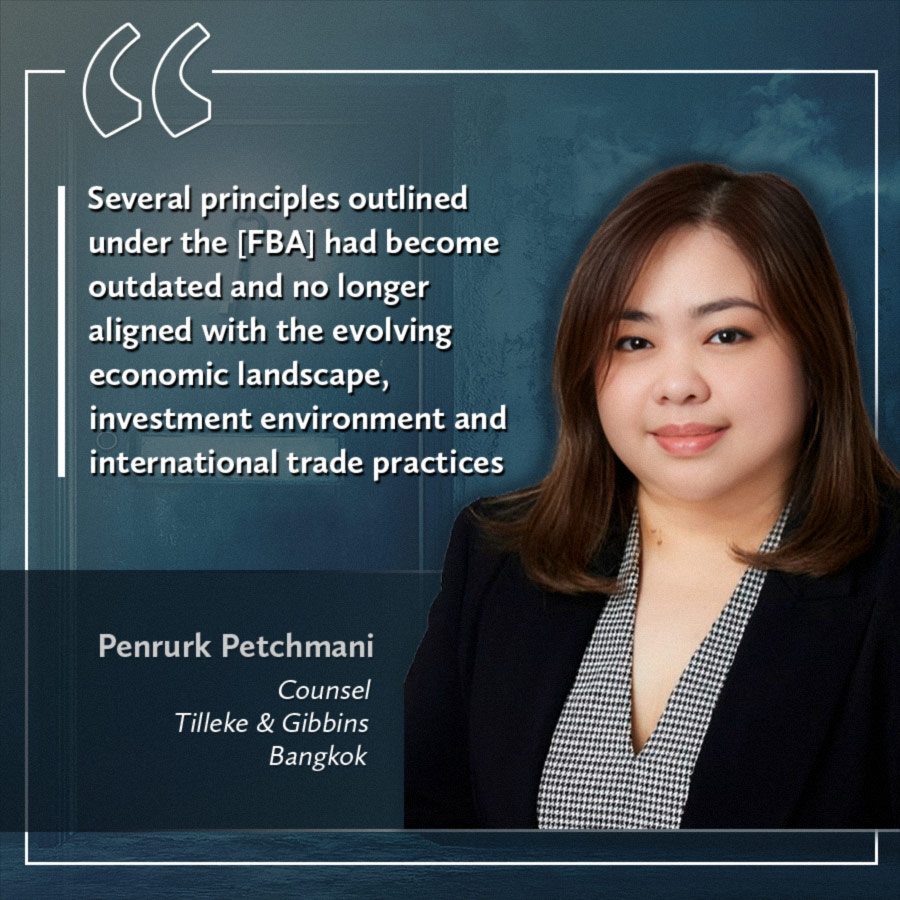
For Penrurk Petchmani, counsel at Tilleke & Gibbins, “several principles outlined under the [FBA] had become outdated and no longer aligned with the evolving economic landscape, investment environment and international trade practices”. She says that one of the barriers under the FBA is the “requirement for a foreign investor to obtain a foreign business licence (FBL)”.
Meanwhile, for Siripen Kulworakulpitak, a co-founding partner at IAS Advisory, “one of the key challenges foreign investors face under the FBA is the broad scope of restricted business categories, especially in the service sector”. The FBA divides businesses into three lists:
-
- List 1: Completely closed to foreign investors;
- List 2: Foreign investors need cabinet approval; and
- List 3: Broadly includes service businesses where foreigners need an FBL if owning more than 49%.
Experts say list 3 is especially problematic due to its vague “other service businesses” category. This broad catch-all has restricted many industries, from consulting and logistics to digital platforms and fintech. “As Thailand moves towards becoming a service-driven economy, such restrictions are becoming more and more burdensome,” says Rueangkul.
Kudun Sukhumananda, a founding partner of Kudun and Partners, warns: “Unless these legal obstacles are addressed, Thailand risks falling behind its regional peers in securing strategic foreign investment.”
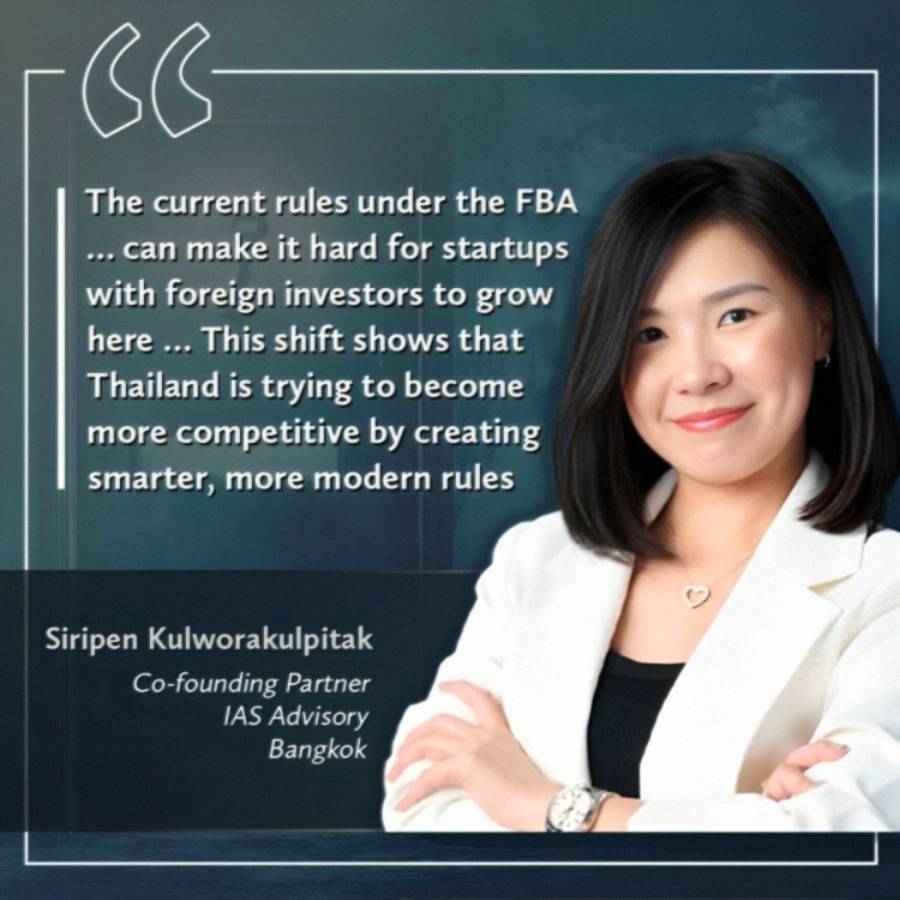
Kulworakulpitak points out that these rules also hurt startups. “The current rules under the FBA … can make it hard for startups with foreign investors to grow here … This shift shows that Thailand is trying to become more competitive by creating smarter, more modern rules.”
The shift
To get around foreign ownership limits, some companies have used Thai nominees to hold shares on paper while foreigners retain control. Christopher Osborne, a partner at SCL Nishimura & Asahi, explains that foreign investors generally fall into two broad categories when it comes to risk under the FBA.
The first group of foreign investors relies on service providers who actively encourage or facilitate nominee shareholding structures. Osborne notes that these investors may not even realise their arrangements are unlawful.
The second group takes a lawful approach, either by forming a genuine joint venture with a Thai partner of substance or by applying for formal approval under the FBA. But this path is neither simple nor cheap. Osborne points out that navigating these requirements typically takes several months and involves significant legal costs.
In April, the Ministry of Commerce launched inspections in relation to nominee shareholding structures, targeting more than 46,000 businesses.
According to Kudun, the ministry has been asked to focus the draft amendments on three main goals:
-
- Shifting the law’s purpose from merely protecting Thai businesses to boosting Thailand’s overall competitiveness;
- Removing outdated rules that hinder sectors such as tech and startups; and
- Revisiting strict foreign ownership limits, often capped at 49%.
“This initiative is not merely regulatory housekeeping,” says Kudun. “It reflects Thailand’s strategic intent to position itself as an attractive destination for high-quality foreign direct investment (FDI).”
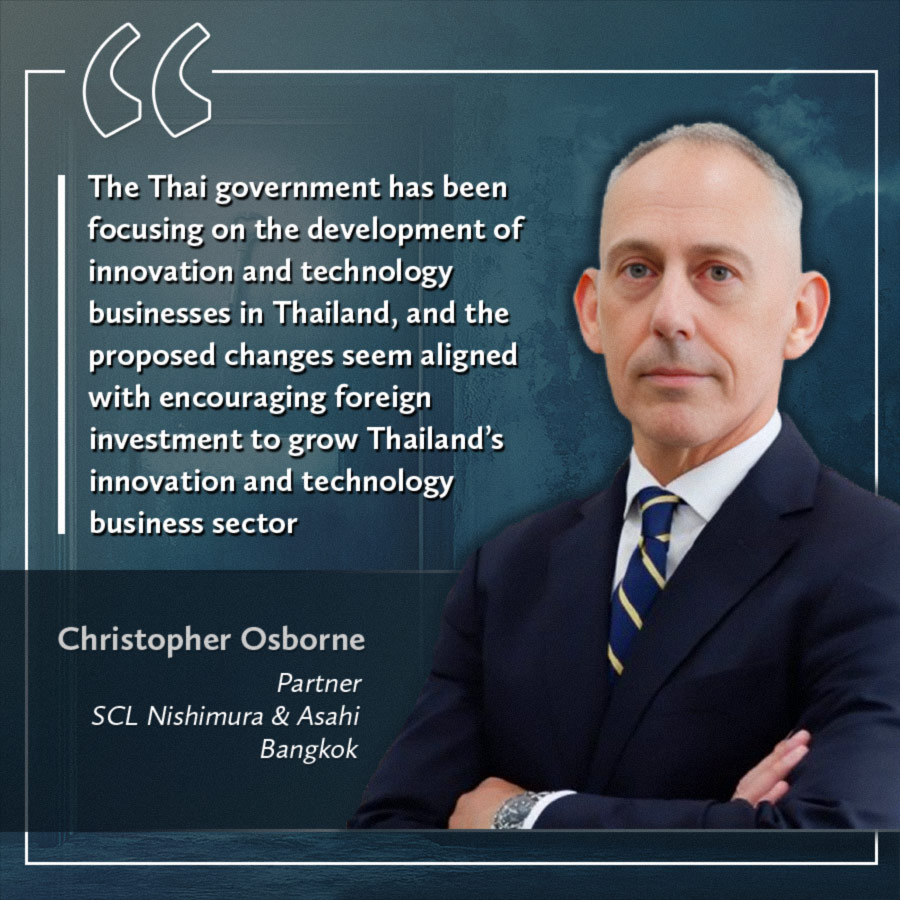
Osborne adds: “The Thai government has been focusing on the development of innovation and technology businesses in Thailand, and the proposed changes seem aligned with encouraging foreign investment to grow Thailand’s innovation and technology business sector.”
Reform or rhetoric?
Despite promises of reform, some legal experts remain sceptical about how much will truly change.
Maprang Sombatthai, a co-founder of Thailand’s corporate counsel community Thai-CCA, says that even with the proposed changes, several key areas of the FBA remain unclear.
First, the scope of restricted activities is still vague. Categories such as digital platforms, data hosting, logistics and fintech fall under the above-mentioned list 3, but the exact boundaries of these definitions remain ambiguous.
She also points to persistent nominee issues. Despite ongoing discussions about tightening rules on nominee structures, the interpretation of “Thai control” may ultimately remain subject to official discretion.
Finally, Sombatthai notes that while the proposed reforms mention relaxing restrictions in some sectors, they do not specify what precise conditions or thresholds would apply. Without clear criteria, she warns, there is a danger of inconsistent enforcement and uneven benefits across industries.
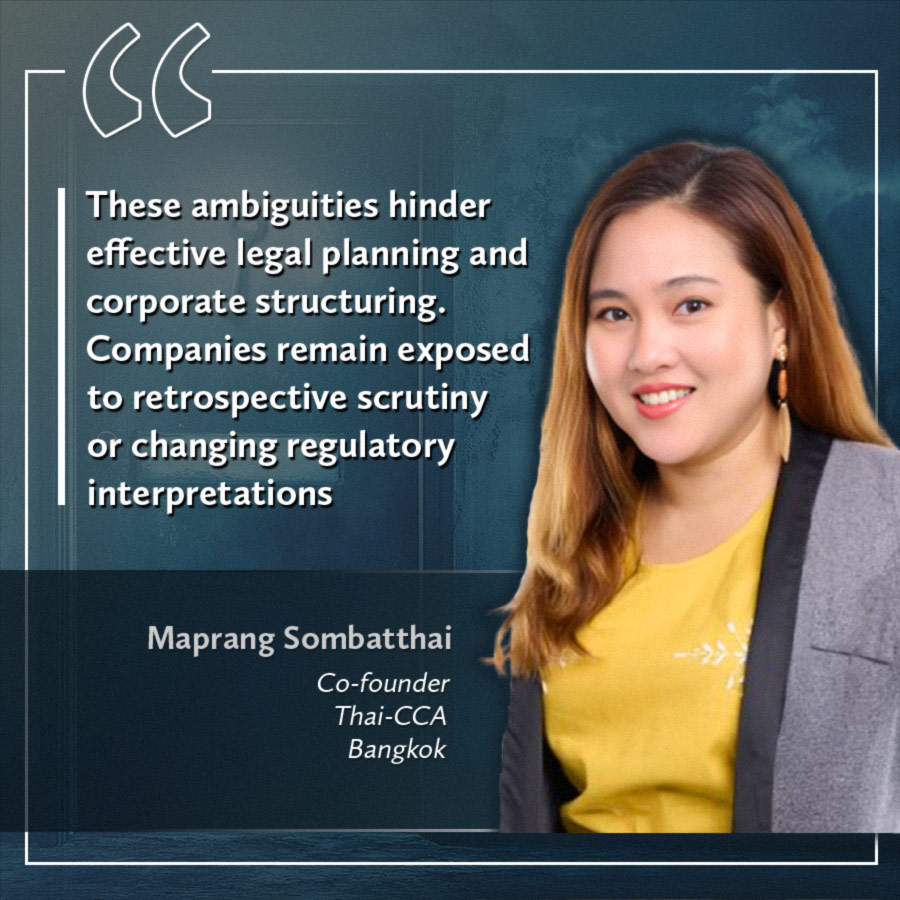
“These ambiguities hinder effective legal planning and corporate structuring. Companies remain exposed to retrospective scrutiny or changing regulatory interpretations,” says Sombatthai.
Wayu Suthisarnsuntorn, a senior partner at Pisut & Partners, says that there is already a simpler, faster way to ease Thailand’s foreign ownership restrictions: issuing more exemptions through ministerial regulations. “However, it appears that the Thai government simply does not want to do so,” he observes.
He explains that the FBA includes a catch-all clause that effectively restricts “any other service businesses” unless exempted by ministerial regulations. In theory, this allows the government to liberalise specific service sectors at any time by issuing new regulations. But, in practice, this path has seen little use.
“Many proposals have been made over the years to relax the restrictions in various sectors,” says Suthisarnsuntorn, but only a few have been issued in the past 25 years. Even then, many of those exemptions focused on highly regulated industries such as banking, insurance and securities, while proposals to exempt other service businesses have largely stalled.

“Many other service businesses have been proposed to the Foreign Business Committee [a government-appointed body that advises the Ministry of Commerce on foreign investment policy, consisting of representatives from government agencies] to be further exempted in the past, but most of them failed to materialise,” he adds.
Nonetheless, if the reforms take effect soon, companies should be prepared to act.
Prepare early
While some remain cautious until the government publishes an actual draft, law firms are already advising clients to prepare early. “Our advice has been straightforward,” says Kudun. “Conduct compliance audits now … and engage early with regulators.”
Kudun says that general counsel from sectors such as tech, energy and finance are already evaluating the implications. “It is a moment of both risk and opportunity, and legal teams understand the need for early, careful preparation.”
Kulworakulpitak says foreign businesses eyeing Thailand should adopt a long-term, strategic mindset, but begin preparing now. She advises companies to stay closely informed as the proposed changes to the FBA take shape, carefully tracking which sectors are likely to open. Timing will be critical and those who plan early will be best positioned to act quickly when new rules are finalised.
Kudun explains that acting early gives foreign investors a genuine head start. “It allows them to explore partnerships, assess acquisition targets and shape market entry strategies before the reforms are finalised.” He adds that building relationships with key regulators is one of the advantages that may be difficult to replicate later.
“Act early – those who prepare and move quickly will gain the greatest advantage, as waiting for full regulatory clarity risks missing this pivotal opportunity. Thailand is open for business, but the competitive edge will go to those who plan ahead and execute decisively,” says Kudun.
A pivotal test
Most experts agree that this is a pivotal juncture for Thailand’s investment climate. As legal experts caution, the real impact of the FBA amendments will depend on the details yet to emerge. While the cabinet has signalled a bold shift towards openness, no official draft has been released, and there remains a risk that reforms could simply move restrictions from one regulator to another.
Still, there is a clear recognition at the highest levels that the old rules no longer serve Thailand’s ambitions. “Thailand knows it cannot rely on a framework drafted over two decades ago if it wants to stay competitive,” says Kudun, citing global competition and the country’s Organisation for Economic Co-operation and Development membership bid as drivers of change.

Petchmani of Tilleke & Gibbins says that the cabinet’s move reflects a desire to modernise the law to better support innovation, startups and a more competitive investment environment. For now, businesses, investors and lawyers are watching closely, waiting for the details that will determine whether this historic effort truly unlocks Thailand’s potential, or falls short of its promise. “For too long, we have relied heavily on tourism, but that model alone will not sustain long-term growth,” says Kudun. These amendments – if executed well – can drive the next wave of economic development.”
Read the related article here:
Doing business in Thailand
Thailand can be a regulatory conundrum when it comes to foreign investors considering setting up shop here

For more stories about Thailand, visit law.asia.