





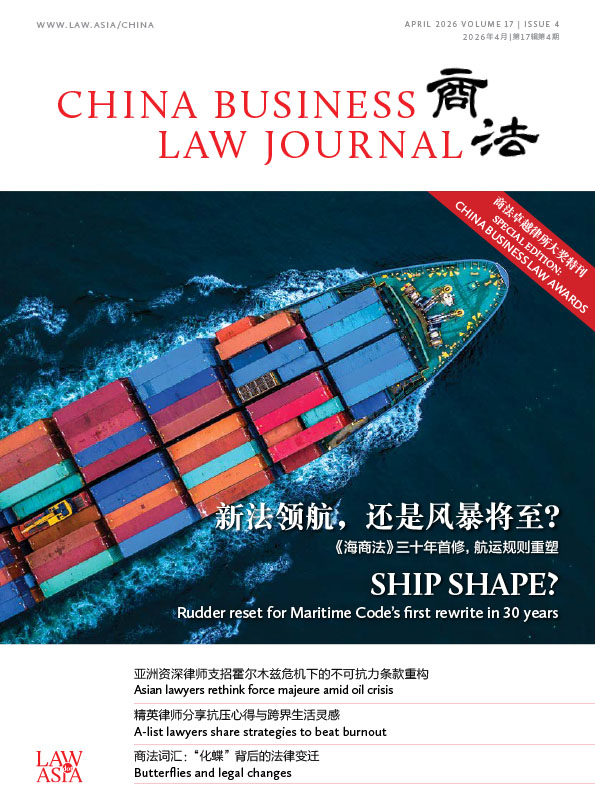




China’s revised Maritime Code came into force on 1 May 2026. Changes to the rules on cargo left uncollected at the port of discharge have drawn particularly wide attention from both the legal fraternity and shipping industry. This article examines the recovery and allocation of liability for losses arising from uncollected cargo under the revised law.
Old article 86
Under article 86 of the pre-amendment Maritime Code, where cargo is not collected or the consignee delays or refuses to take delivery, the master may discharge it at an appropriate place, with the resulting costs and risks borne by the consignee.

Senior Partner
Kangda Law Firm
Tel: +86 136 0000 0197
E-mail: leiming.chen@kangdalawyers.com
Before the revised law took effect, this provision was the main legal basis for carriers seeking to recover losses caused by uncollected cargo at destination, and it established the basic rule of consignee-first liability. In practice, however, the consignee is often difficult to identify under order bills of lading and blank bills of lading, while pursuing overseas consignees is costly and difficult to enforce.
Carriers often turned instead to the shipper with which they concluded the contract of carriage. In such cases, courts generally had to move beyond article 86 and rely on general law or fundamental legal principles to hold the shipper liable for losses arising from uncollected cargo.
But after reviewing Chinese court experience in foreign-related commercial and maritime cases since 2018, with a view to harmonising judicial standards, the Fourth Civil Division of the Supreme People’s Court issued the Minutes of the National Courts’ Symposium on Foreign-Related Commercial and Maritime Trials on 31 December 2021.
Article 61 provides that where the holder of the bill of lading does not claim delivery or exercise other rights at the port of discharge, the resulting costs and risks shall be borne by the shipper. Where the carrier claims freight, storage charges, container detention charges and other costs from the shipper on the basis of the contract of carriage, the people’s court shall uphold such claims.
In substance, this provision supplemented article 86 and expressly endorsed recovery by the carrier against the shipper on a contractual basis. In this context, “shipper” should be understood as the contractual shipper.
New article 93

Partner
Kangda Law Firm
Tel: +86 186 2054 3775
E-mail: yuan.yuan@kangdalawyers.com
Article 93 of the revised Maritime Code provides that where cargo is not collected at the port of discharge, the master may discharge it into a warehouse or other appropriate place, with the resulting costs and risks borne by the shipper, provided the shipper is notified in a timely manner.
Where the consignee has exercised rights under the contract for the carriage of goods by sea but delays or refuses to take delivery, the resulting costs and risks shall be borne by the consignee. Compared with article 86, the new provision makes three changes.
First, the default liable party shifts from the consignee to the shipper. Second, it introduces the carrier’s duty of timely notice. Third, it makes clear that where the consignee has exercised contractual rights but still delays or refuses to take delivery, the consignee bears the resulting costs and risks.
The new rule is best understood as: “Shipper first, consignee by exception.”
Article 93 of the revised Maritime Code therefore recasts the liability regime for uncollected cargo at the port of discharge. It builds on and refines prior judicial practice, while confirming that taking delivery is a right, not an obligation, of the consignee, who is treated as a third-party beneficiary of the contract for the carriage of goods by sea.
New rules on recovery, liability
Identifying the proper target of recovery. Under article 61 of the minutes, and as confirmed in Guiding Case No.230 of the Supreme People’s Court, where the consignee has not claimed delivery or exercised other rights, the costs and risks arising from uncollected cargo at destination are borne by the contractual shipper, not the actual shipper.
Accordingly, the “shipper” in article 93 should be understood as the contractual shipper who concluded the contract of carriage with the carrier. As a bill of lading or other transport document is evidence of the contract of carriage by sea, the shipper named in it may ordinarily be identified as the contractual shipper.
But that is not automatic. Where the named shipper differs from the party that actually booked the shipment with the carrier or its agent, the carrier must identify the contractual shipper by reference to the conclusion and performance of the contract. This is made clear by article 51 of the minutes.
Under FOB (free on board) terms, the foreign buyer usually books the shipment and acts as the contractual shipper. In practice, however, the domestic seller, as the actual shipper, is often named as shipper on the bill of lading or other transport document.
Where the court finds that the domestic seller did not participate in booking and did not control the cargo, it will not hold the seller liable for costs arising from uncollected cargo at the port of discharge.
Timely notice. Article 93 also adds the carrier’s statutory duty to give timely notice. If the carrier fails to do so and the loss is increased, the shipper has the right to refuse to bear that part of the loss.
The consignee’s exercise of rights. The consignee exercises rights under the contract by taking affirmative steps such as: presenting the original bill of lading to take delivery; requesting delivery; exercising control rights; seeking a change of destination or disposal of the goods; or bringing a contractual claim.
Mere possession of the bill of lading, checking arrival information, or preliminary delivery steps without claiming delivery do not amount to an exercise of contractual rights.
Takeaway
The revised rules on uncollected cargo codify and refine prior judicial practice. The rule of “shipper first, consignee by exception”, together with the carrier’s statutory duty of timely notice, reflects a more balanced allocation of rights and responsibilities between shipper and carrier.
Chen Leiming is a senior partner at Kangda Law Firm. He can be reached by phone at +86 136 0000 0197and by email at leiming.chen@kangdalawyers.com
Yuan Yuan is a partner at Kangda Law Firm. She can be reached by phone at +86 186 2054 3775 and by email at yuan.yuan@kangdalawyers.com