










In-house teams are redefining legal partnerships when selecting their best-fit law firms. Claire Zhao reports
Established business norms are undergoing profound transformation around the globe. While accelerating domestic regulatory changes demand corporate agility, geopolitical realignments are redrawing the risk parameters of cross-border trade. At the same time, technological innovation is dissolving traditional boundaries between legal and commercial domains. In this environment, where risk and opportunity increasingly converge, an organisation’s choice of external legal counsel has become a make-or-break decision for operational resilience.
General counsel across industries report a fundamental evolution in corporate-lawyer relationships. The conventional service provider model has given way to strategic partnerships characterised by mutual value creation. Contemporary enterprises require more than reactive risk assessments – they demand legal advisers capable of proactive strategic navigation. Outstanding firms are no longer merely interpreting regulations, but co-creating business value, representing a paradigm shift in how legal services are valued and delivered.
All about business needs
To pick out the most suitable law firm to work with, companies must first clarify the relationship between in-house legal teams and external law firms, define the organisation’s role within this dynamic and understand corporate expectations of legal service providers.
Aaron Shao, area counsel (Asia-Pacific) at Abbott, regards it as an essentially “business-driven” consideration. Both in-house legal teams and external counsel ultimately serve business objectives, with their core value lying in delivering commercial solutions.
Kenneth Zhou, head of legal and compliance for the North Asia-Pacific region at SIG Group, states: “In-house legal teams and external law firms share identical objectives – it’s merely a matter of division of labour.”
External counsel, he explains, provide a critical third-party perspective to identify knowledge gaps and operational pain points that may elude internal teams, while in-house legal teams can effectively co-ordinate these external resources to rapidly implement industry best practices through standardised frameworks.
This synergy creates what Zhou describes as “exponential rather than additive value when optimally managed”.
Mah Soon Sin, head of legal for product compliance, IP rights and marketing for the US and Latin America at AliExpress, identifies two critical dimensions where external firms augment corporate capabilities: objective assessment unconstrained by internal biases; and tangible workload reduction. Law firms’ involvement spans workforce augmentation and specialist intervention – from untangling internal co-ordination challenges to designing comprehensive solutions. By handling preliminary structuring and holistic analysis, law firms facilitate enterprises in developing implementation frameworks tailored to specific operational contexts.
At CBC Group, managing director Oak Ma emphasises business acumen as the primary criterion when selecting law firms. This means not only identifying risks but delivering “innovative solutions that comply with local regulations while being practically comprehensible to Chinese entrepreneurs”. Ma also expects external counsel to facilitate corporate communications with local regulators, particularly in highly regulated sectors like pharmaceuticals.
In this sense, Ma views law firms as specialist risk identifiers that should collaborate with in-house legal teams to manage risks. “We are essentially strategic partners,” he stresses, “working towards shared objectives, rather than maintaining a traditional client-vendor relationship.”
Driven by business needs, corporate legal teams principally evaluate law firms against three key criteria, namely, professional competence, proven track records, and established working relationships.
Proya’s legal director, Lyu Qing, reveals that private companies employ a two-tier selection process, leveraging existing firm relationships while matching specialist capabilities to discrete legal matters. “Listed companies prioritise different metrics,” says Lyu, “particularly for transaction work – niche expertise, partner calibre and demonstrated results become paramount.”
Successful engagements deliver dual benefits: immediate client satisfaction and long-term trust accumulation. “My first choice is always lawyers with whom we have had productive, professional collaborations,” says Panda Sun, former general manager of the legal department of Feilo Acoustics. “Their recommendations of other lawyers also serve as a valuable secondary reference.”
Guan Zhengrong, a legal expert at Lotus Tech, shares this perspective. “Law firms with existing working relationships demonstrate greater understanding of corporate needs and deliver more responsive service compared to new providers,” she says.
Although brand reputation remains a significant indicator of capability and professionalism for service providers, law firms operate on a fundamentally bespoke basis, which requires individual assessment and tailored solutions to each case. Zhao Peng, a general legal manager at Rsun Group, prioritises service quality, results delivery and consistency of lead partner involvement. “The reliability of legal services directly shapes our outcome expectations,” he says.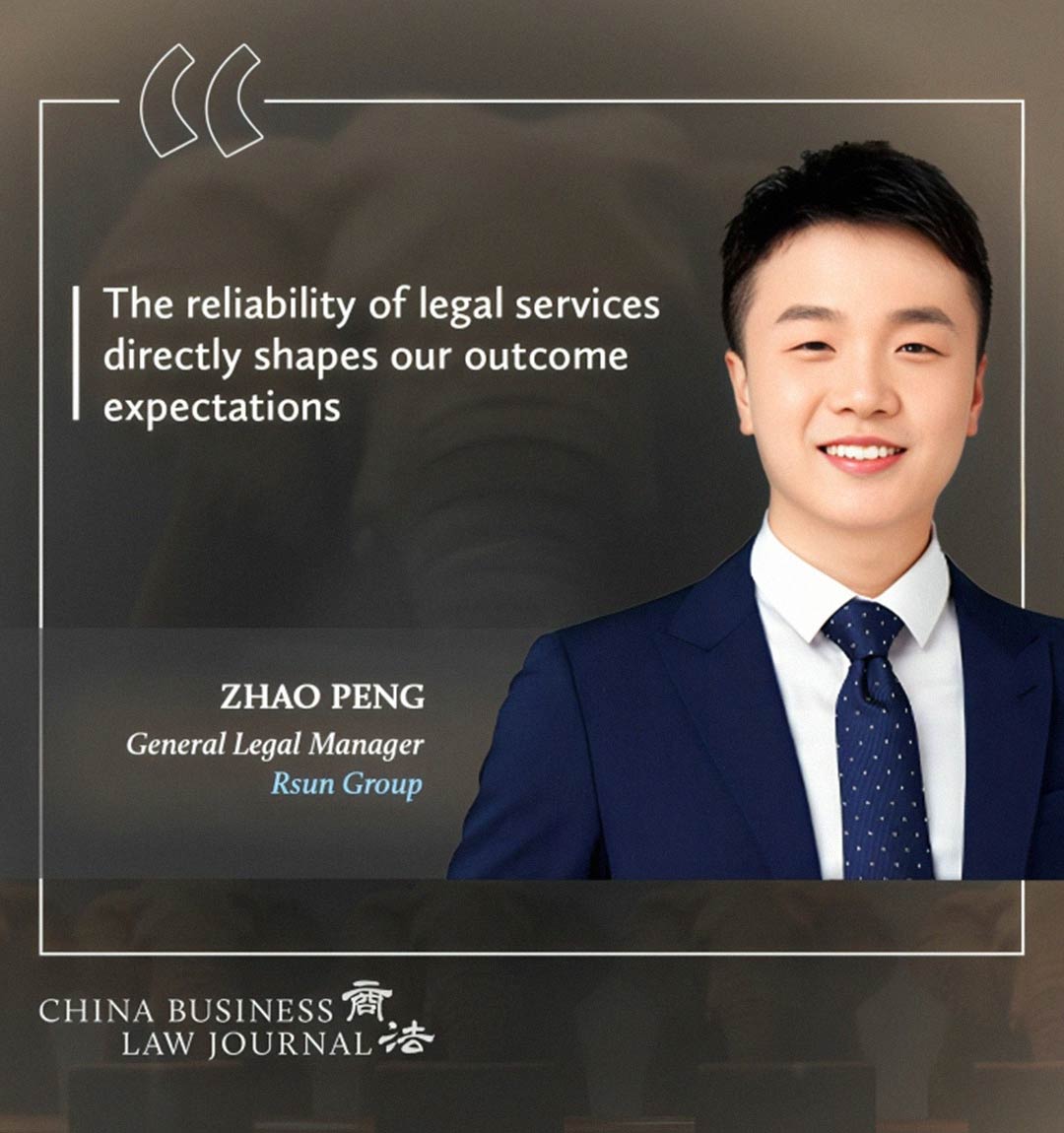
This sentiment is shared by Lyu Qing, who acknowledges brand value but focuses on team capabilities: “The expertise and service level of lead partners prove decisive, particularly their attention to detail and commitment to client relationships.”
Notably, the legal market is recognising an underutilised resource – in-house counsel’s prior practising firms. Guan notes these former employers may become viable options, provided any conflict of interest issues are properly addressed.
Aptiv’s Asia-Pacific vice president and general counsel, Shawn Zhao, expands on this point, recommending conflict checks across a firm’s nationwide practice to ensure comprehensive compliance.
You must be a
subscribersubscribersubscribersubscriber
to read this content, please
subscribesubscribesubscribesubscribe
today.
For group subscribers, please click here to access.
Interested in group subscription? Please contact us.
你需要登录去解锁本文内容。欢迎注册账号。如果想阅读月刊所有文章,欢迎成为我们的订阅会员成为我们的订阅会员。