










With uncertainty now the norm, how should general counsel navigate between risk and growth? Pan Xinyi reports
CONFRONTED WITH escalating US trade controls and sanctions lists, the in-house team at SIG Group has reassessed its compliance pathways. The company is accelerating supplier localisation and tightening both contract and data review processes to mitigate the risk of trade disruption.
Elsewhere, pressure takes a different form. An international fast-food chain, weighed down by losses, has cut a third of its legal staff in the past two years. Its general counsel acknowledges the strain: “The team is fully occupied just keeping up with daily operations. There is no room left to think about anything else.”
Sweeping changes in the business environment have pushed legal departments to the forefront of corporate survival. Global supply chains are stretched and fractured by geopolitical rivalries. Regulatory frameworks are splintering under competing jurisdictions, and AI is rapidly redrawing the logic of business itself. Legal departments are no longer managing isolated risks, but confronting a structural storm.
This environment is redefining the role of in-house counsel. Once regarded as risk controllers, they are now expected to serve as strategic partners, engaged in business decisions and developing new models. Their responsibilities extend from navigating geopolitical, technological and regulatory uncertainty to balancing growth with caution, and deciding how best to allocate scarce resources, investing in expert talent, new technologies or external partners. Legal teams have moved from the margins of operations to the centre of strategic planning.
For companies facing volatile markets and rising internal demands, forward-looking general counsel are reshaping their place within the enterprise. By combining flexible management with a long-term perspective, they are building compliance into growth strategies and helping leadership prepare for a future where uncertainty is not an exception but the rule.
Pressures mounting
Geopolitical upheaval, regulatory fragmentation, and technological change are pushing in-house teams from the back office into the core of corporate strategy. “Change is the norm in continuous development, and we have always seen it as a chance to advance,” says Doris Liu, the China legal head at Ninja Van. That sentiment has become a defining note for in-house counsel in 2025.

As global tariffs shift, Southeast Asian governments are tightening rules on cross-border e-commerce, eroding the earlier advantages of small-parcel trade. Ninja Van is responding by reinforcing its traditional B2C operations, while accelerating into B2B logistics and cold-chain services to spread risk and capture new opportunities. Its legal team has been deeply involved in compliance for these new business lines, playing what Liu calls a “critical enabling role”.
For multinational carmakers, the pressure comes from heightened domestic competition and rising trade barriers in the US and Europe. Guan Zhengrong, a legal expert at one such automaker, says: “The company has had to abandon certain markets and accelerate the shift of R&D into independent profit centres.”
He notes that these moves have raised the bar for in-house counsel. “Simply outsourcing policy analysis to external advisers can no longer meet demands for timeliness and foresight.” Building cross-border in-house networks for collaboration and resource sharing, he adds, has become an urgent task.
Semiconductor maker Naura Technology Group began restructuring its supply chain as early as 2020 to manage geopolitical risk. Song Qiaoli, vice president and the head of legal and compliance, says that when the company was added to the US entity list in 2024, “our actual operations were not significantly affected”, demonstrating that anticipation has become a core survival skill for in-house counsel.
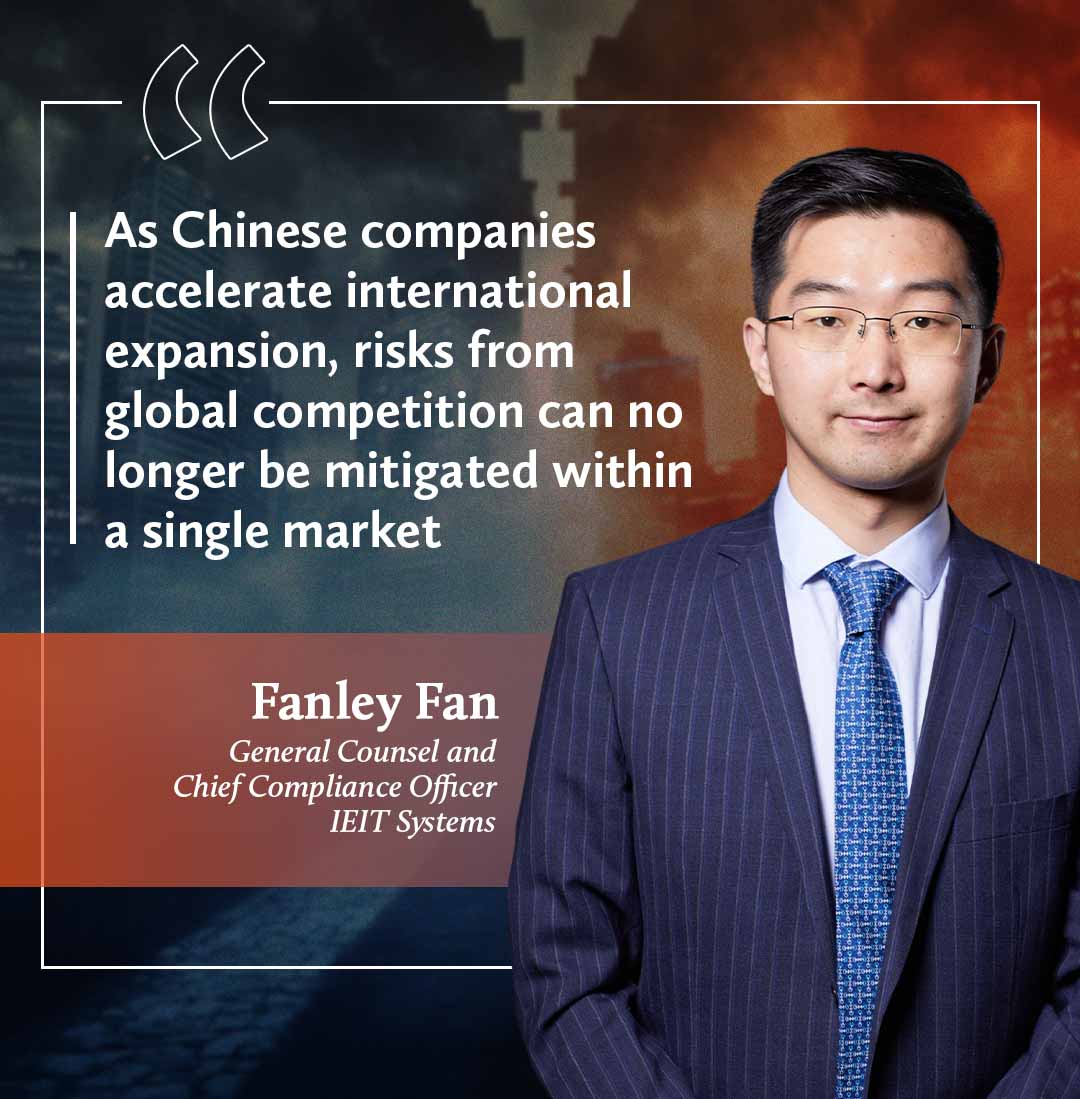
“As Chinese companies accelerate international expansion, risks from global competition can no longer be mitigated within a single market,” says Fanley Fan, the general counsel and chief compliance officer at IEIT Systems. Legal departments, he argues, are undergoing a fundamental shift from routine problem solving to creating dual value.
On the one hand, they generate revenue directly through patent operations and compliance tools. On the other hand, they provide top-level legal frameworks for overseas strategies by analysing regulatory environments and mapping legal risks.
This transition has elevated in-house counsel from tactical support to strategic partners. In today’s multi-layered risk environment, the ability to design robust legal architecture is becoming a core competitive asset for companies going global.
In-house teams are also contending with structural changes in regulation. The regulatory paradigm is moving from after-the-fact punishment towards process control, while new legislation is expanding beyond data compliance into areas such as AI ethics, supply chain security, and ESG (environmental, social and governance) disclosure.
The objectives of regulation extend from personal data protection to strategic concerns such as digital sovereignty and influence over technical standards.
Hou Yiqing, a legal manager at global retailer Miniso (Guangzhou), says her team faces a double compliance squeeze. Recently, US Executive Order 14117 designated China a priority country for data controls, forcing a complete overhaul of data flows between Chinese companies and their US subsidiaries.
At the same time, the EU’s General Data Protection Regulation and other established regimes, combined with new laws in emerging markets such as Vietnam and India, are fragmenting the global compliance map. Hou says companies must now track legal changes in real time and constantly adjust compliance strategies. “This creates significant challenges for daily management.” Data transfers between headquarters and overseas subsidiaries have become a constant focus of compliance scrutiny.
Faye Xu, general counsel at Chenqi Technology, a smart mobility platform, says that during the company’s strategic transformation, the development of autonomous driving technology has run up against a mismatch between regulation and industry progress. The company must “stay ahead of regulators” in its technology planning, yet finds itself squeezed by compliance hurdles around geographic information collection and sensitive data processing.
As local cyberspace authorities roll out catalogues defining “important data” to better promote data security management and protection, even routine operational or R&D information may be reclassified. Once labelled, such data can face restrictions not only in cross-border technology exports, but also in domestic sharing between enterprises, creating practical hurdles for innovation. As a result, legal teams are compelled to map out compliant business models in advance.
Add in economic cycle pressures, and companies have less tolerance for regulatory risks, so data compliance and information security weigh more heavily in evaluating new business models. Alongside this, rising risks in co-operation and the need to streamline teams push labour compliance to the forefront. The result, says Xu, is a dual squeeze: technological breakthroughs on one side and regulatory constraints on the other.
Amid these overlapping pressures, the rise of AI is emerging as a quiet force reshaping legal work.
“The business environment is growing more complex, and traditional legal models can no longer match business needs for efficiency and precision,” says Joe Zhou, chief compliance officer and head of the legal and compliance department at China International Capital Corporation. “Upgrading technology has become the key.”

He notes that smart contract review, risk monitoring, and data integration tools are expected to boost efficiency and strengthen risk control. Although the upfront investment is significant, in the long run technological upgrades are the key pathway for in-house teams to shift from reactive response to proactive prevention.
Yet as procedural tasks such as contract review and document drafting have already seen broad efficiency gains, new challenges are beginning to surface: Data sovereignty and professional reliability are emerging as hidden obstacles to the deeper use of AI in core legal functions. As a result, the industry’s attitude towards technology has split, with some eager to embrace it, and others choosing to wait and see.
Most companies are already reaping AI dividends in routine tasks. At commercial real estate operator Redsun Group, an AI legal system has cut the time needed to prepare documents for 30 disputes from three days to just two hours, while speeding up non-standard contract review by 60%.
Candy Sun, a senior legal director at Zhaopin.com, an integrated human resources solutions provider, tells China Business Law Journal that the company’s self-developed “I-Enjoy Law” AI chatbot has been online for more than a year and now independently handles 40% of routine internal queries, freeing staff to focus on complex projects.
Li Ning (China) Sports Goods has also built an AI-driven contract management system that automates the entire chain from approval to archiving to review, reshaping the value flow of contract management. “Since the system went live last year, we’ve found that AI-enabled review has greatly improved the efficiency of external counsel, while also boosting the timeliness of in-house review and overall business execution by 30% to 40%,” says Eva Tong, a general counsel at Li Ning.
This leap in efficiency shares a common trait: Companies are breaking through in closed, highly tailored settings. China Information Technology Development Group, for example, uses proprietary AI-powered predictive analytics to anticipate regulatory trends, while Alibaba’s legal team has built a customised AI assistant to triage repetitive day-to-day queries.
But when it comes to core business, trust remains a barrier. Costs of verification, the risk of AI hallucinations, and the limits of model capability all come into play. Drafting contracts, translating documents and other routine tasks are already commonly assigned to AI, but outputs still require human checking. The effort involved varies with project complexity, scale and compliance requirements, yet it is never trivial.
At Ninja Van, AI is used only as an auxiliary tool. Accuracy checks increase with legal complexity. At EEO Group, a global provider of professional online education live streaming services, verifying AI-retrieved legal information adds to workloads, while manual redaction of trade secrets offsets efficiency gains.
AI hallucination remains the most frequently cited concern. Iris Li, Alibaba’s head of dispute resolution, cross checked research reports produced by mainstream large models in emerging areas of law and discovered fabricated content. Zhou Benqiang, general counsel of Sinohydro Engineering Bureau 8, sums it up: “AI sometimes delivers wrong answers with absolute confidence, which can be misleading.”
Most lawyers remain unconvinced that AI could ever replace in-house counsel. They see its value in routine tasks but say it hits a wall with complex cases.
Zhao Peng, the head of corporate legal affairs at Redsun Group, recalls a RMB50 million (USD7 million) damages case in which the in-house team, together with engineering and finance colleagues, rebuilt the chain of evidence through 12 rounds before persuading the court to accept their loss quantification analysis. He says such disputes, where judicial discretion intersects with industry practice, remain beyond the reach of algorithms.
Zhang Bing, a legal director at Xiaomi Auto, adds that while AI can score “80 or 90 out of 100” on basic contract review, it still falls short in understanding complex legal issues.
These risks and cost considerations are leading companies to more carefully delineate the scope of AI use. Data security is the first red line: As Xu says, “We generally avoid using AI when internal company information is involved.”
Core judgments remain off limits. At United Energy, the in-house team insists on retaining human control over key decisions in complex disputes. At Ninja Van, uncertainty over IP ownership is a primary factor behind the team’s reluctance to adopt AI tools.
Between efficiency gains and the costs of mistrust, companies are taking different paths: Leading players are developing proprietary systems to limit risk, while others restrict use to avoid compliance pitfalls.
Cost is another hurdle. Zhong Xueyin, a general counsel and joint company secretary at ride-hailing platform Caocao Inc, says Microsoft 365’s AI suite is “effective, but far too expensive”, underscoring again that cost benefit remains a central factor in the legal profession’s adoption of AI.
You must be a
subscribersubscribersubscribersubscriber
to read this content, please
subscribesubscribesubscribesubscribe
today.
For group subscribers, please click here to access.
Interested in group subscription? Please contact us.
你需要登录去解锁本文内容。欢迎注册账号。如果想阅读月刊所有文章,欢迎成为我们的订阅会员成为我们的订阅会员。