






Chinese IPOs overseas have consistently outperformed those of other nations, but a rash of scandals and suspected frauds has threatened to end the bull run. Lawyers and other experts explain what is happening and what can be done to put PRC listings back on track George W Russell reports
It’s not Broadway, but followers of the Nasdaq exchange in New York have recently witnessed a recurring piece of theatre. A hitherto-unknown Chinese executive, smiling broadly, rings the opening bell on the first day of his company’s listing. All is well for a while as the stock soars. Curious analysts and short-sellers do a little digging. Soon, the share price peaks, then totters and crashes well below its listing price. Questions are asked. The auditors quit. The CFO falls on his sword. Nasdaq suspends the stock. Curtain.
This financial morality tale, with minor variations, has played out repeatedly in recent months. At one point in April, 15 of the 19 stocks suspended from Nasdaq had Chinese connections. The contagion shows no sign of being contained, and each new case creates credibility issues for PRC companies overall as they clamour to raise money on the international capital markets.
The ramifications are immense. At the end of 2010, China-related IPOs posted overall returns of around +30% over the previous four years, compared with under 5% for IPOs by European or North American companies. Investors, especially in the United States, were behaving with remarkable keenness towards Chinese companies. Newly listed Chinese stocks in New York did better than Chinese listings elsewhere – including in China.
But even some of the IPO stars, and companies untouched by scandal, have now begun to fall. Consider Renren, the social networking site considered a Chinese alternative to Facebook, which was welcomed by US investors when it launched its IPO on Nasdaq in May. It sold 51.3 million American depositary receipts at a price of US$14 each, valuing the company at 72 times its previous year’s revenue.
To many investors, Renren had it all. It’s Chinese, it’s technology, it’s social networking and, moreover, it stands for huge potential growth: only a third of China’s populace is currently online. Soon after listing, the stock price soared to US$24. Since then, Renren’s stock has plunged as low as US$12 – half its peak and 14% off its initial price. Meanwhile, American depositary shares in another hot Nasdaq IPO listing, leading Chinese dating site Jiayuan.com International, have also slipped after the company raised US$78 million with its IPO.
IPO fatigue?
Could “Chinese IPO fatigue” be threatening to block the entire pipeline of PRC-related listings? Hong Kong is predicted to see an 11% drop in the total value of IPO capital-raising this year, compared with 2010, with much of the fall attributed to a waning appetite for PRC listings. “Everyone is a little bit scared of China valuations now [and is] worried that it’s a bubble,” Hans Tung, managing director of Qiming Weichuang Venture Capital Management, a PRC-based private equity group, told the Chinict technological entrepreneurs’ investment conference in Beijing in late May.
What is certain is that the fears over the credibility of US-listed Chinese companies have rattled markets and shaken investor confidence. “Some of our clients have tried to make follow-up offerings, but due to the stories of fraud allegedly committed by other PRC-based issuers, investors have tended to be more sceptical of Chinese companies,” says Lucas Chang, a partner in the Beijing office of Morgan Lewis & Bockius.
Some private-equity investors are already bailing out. Hedge fund Paulson & Co took a loss of up to C$575 million (US$590 million) by selling its stake in Sino Forest, a Chinese-Canadian venture that saw its shares tumble nearly 90% in May and June amid allegations by Muddy Waters Research that it had fraudulently exaggerated its assets. Muddy Waters was the first to express doubts about a number of China stocks, including Nasdaq-listed RINO International and China MediaExpress Holdings, and NYSE-listed Duoyuan Global Water, as well as the Toronto-listed Sino Forest.
Holders of Sino Forest’s corporate bonds are also jittery. The Toronto-listed company has more than US$2 billion in outstanding bonds, a sizeable percentage of the US$33 billion that international bond investors have lent to Chinese companies over the past two years. The company’s bonds have collapsed along with its share price.
The markets have been somewhat assuaged by a recognition that China itself is worried. On 23 May, shares in Singapore-listed COSCO Corporation plunged after China’s National Audit Office reported accounting irregularities at its parent, the state-owned shipping giant China COSCO Group. COSCO acknowledged the shortcomings found by the audit and said it had rectified some of the issues.
But there remains concern that disruption caused by troubled Chinese companies could spill beyond the US, Canada and Hong Kong. On 30 June, the Singapore Stock Exchange (SGX) reprimanded Chinese multimedia firm KXD Digital Entertainment for breaching rules, including failing to disclose it had ceased operations. The same day, SGX-listed China Gaoxian, a fabric maker, admitted that an auditor had determined its cash holdings at the end of 2010 to be RMB93 million (US$15 million), less than 10% of the sum it originally claimed.
Shell shock
At the centre of the crisis of confidence are so-called reverse takeovers (or reverse mergers), in which a China-based private company allows itself to be acquired by a publicly traded shell company in the United States. That shell company has no significant operations, assets or value other than that its stock is publicly traded. This enables the Chinese company to assume listed status without undergoing the usual rigorous listing process. Of the 600 reverse takeovers recorded in the US since January 2007, more than 150 involved one or more Chinese entities.
Once the shell company has acquired the Chinese target, its board of directors resigns and turns over control to the China-based company’s board. The acquirer, being already listed, is then able to issue equity, which is often done through private investment in public equity (PIPE) transactions. Many PIPE transactions are negotiated with hedge funds, private equity firms and other large investors prior to the reverse takeover at pre-negotiated prices, and occur simultaneously with the takeover.
Exchanges are open to the charge that, eager to ride the China wave, they have made scant inquiries of the new arrivals. When on 6 May, Tao Li, chairman of Xi’an-based Kingtone Wirelessinfo, rang the opening bell for Nasdaq, little mention was made of the fact that he is also chairman of China Green Agriculture, a company listed on the New York Stock Exchange now under investigation by the US Securities and Exchange Commission (SEC) over its reverse merger in 2007 and subsequent listing.
Most lawyers are reluctant to assert that in the rush to lure Chinese companies, stock exchanges may have diluted the scrutiny required for a listing. “Currently, we think this danger still remains theoretical,” says Tom Chau, a corporate partner at Herbert Smith in Beijing. “We are of the view that the liberalization of listing regime, if possible and if necessary, will have to be implemented in conjunction with an improvement in the sophistication and capabilities of relevant regulators so as to avoid a race to the bottom.”
Nevertheless, some investors are appalled by the apparent lack of concern shown by exchanges, and say so. “The NYSE, it seems, has no concern for its reputation,” says John Hempton, chief investment officer at Bronte Capital Management, a Sydney-based hedge fund and short-seller, responding to the news that NYSE-listed Universal Travel had parted ways with its fifth auditor, Windes & McClaughry of Long Beach, California. (Trading in the stock has been suspended.)
 Bronte is one of several short-selling funds that have targeted suspicious companies with China links. “Now that these companies have come under attack by short-sellers, the entire market for listing opportunities for Chinese companies has become tainted,” says Alan Seem, a partner at Shearman & Sterling in Beijing. “The recent Renren IPO, which was expected to be very well received, has not performed as well in the aftermarket. This is primarily due to the questions raised about controls and accounting practices of Chinese companies in general.”
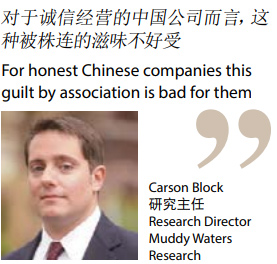 Newer listings are being subject to heavier scrutiny than their predecessors and investors are hammering related stocks, no matter how squeaky clean. “For honest Chinese companies this guilt by association is bad for them,” says Carson Block, founder and research director of Muddy Waters.
“Fraud unfortunately has become a common theme in the United States listing reverse-merger space for Chinese firms,” adds Kevin Barnes, an analyst with Absaroka Capital Management, a US-based private investment manager who has been critical of stocks such as NYSE Amex-listed China Shen Zhou Mining and Resources and Nasdaq-listed SkyPeople Fruit Juice. “Going forward, equity investors will be more diligent in reviewing potential investments.”
A disturbing trend
On 4 April, SEC commissioner Luis Aguilar signalled that the problem finally had the US government’s attention. He said the SEC would investigate a “disturbing trend” of Chinese companies registered through mergers with dormant shell companies. “While the vast majority of these Chinese companies may be legitimate businesses, a growing number of them are proving to have significant accounting deficiencies or being vessels of outright fraud,” he stated.
Experts have welcomed Washington’s intervention but doubt the market has seen the last of dubious practices involving Chinese companies. “Most of these scandals are still unwinding, but the rash of auditor resignations and delayed annual reports indicates we have not yet seen the end,” says Paul Gillis, visiting professor of accounting at Peking University’s Guanghua School of Management.
Traditional regulatory sanctions are unlikely to prevent further scandals, say lawyers. “Throw some of the offending executives in jail, along with their accomplices, including lawyers and auditors,” urges William Federman, a partner in Federman & Sherwood in Oklahoma City, who has initiated a class-action suit against SkyPeople Fruit Juice in a US district court that alleges violations of federal securities laws, including issuing material misrepresentations to artificially inflate the market price.
This being the US, class-action lawsuits have followed swiftly behind regulatory investigations. “Recently many US-listed Chinese companies have been the subject of class actions,” says Jiang Hua, a lawyer at Kang Da Law Firm in Beijing. “The class actions have two main targets. The first is that the financial reporting is false or that the figures reported are incorrect. The second is the violation of information disclosure obligations.”
As a result, companies and law firms alike are weighing the costs of investigations and suspensions. These can tarnish the image of a company; lower its credit ratings; cause its share price to plunge; increase the likelihood of a hostile takeover bid; force the suspension of trading or even loss of listed status; and lead to the imposition of fines, charges and fees by regulators and exchanges.
Some lawyers are exercising the utmost care. “In view of the great risks to which Chinese companies listed abroad by reverse merger are exposed, in a spirit of responsibility to companies this law firm will not do reverse-takeover listings and will only do IPOs,” says Jiang.
Other law firms are in crisis management mode: in June, DLA Piper formed a China securities litigation rapid response team to advise companies “affected by the dramatic upturn in securities litigation and government investigations directed at mainland companies listed on US and Hong Kong exchanges”. The firm says its advice includes pre-litigation crisis management counselling, securities class actions, shareholder derivative actions, investigations by US and Hong Kong regulators and delisting enquiries.
Na?ve?
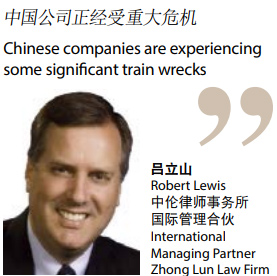 Some lawyers blame the crisis on Chinese na?veté. “Chinese companies are experiencing some significant train wrecks,” says Robert Lewis, international managing partner at Zhong Lun Law Firm in Beijing. “They are not well enough acquainted with the rules of the game of international commerce – not just the rules and regulations but also practices in industries and markets that are known to all participants and to which everyone conforms.”
Lewis suggests that legitimate Chinese companies, having seen the carnage wrought by their dodgy compatriots, have done little more than throw their hands up in dismay. “They haven’t stepped back collectively and asked themselves, ‘Why is this happening?’ There’s been too passive an approach so far as if these answers are unknowable and can’t be managed in a proactive way.”
The current events underline the need for effective due diligence – but this is not easy to achieve. “There are major challenges to conducting appropriate due diligence with respect to Chinese companies,” says Stephen Goodman, a partner with Pryor Cashman in New York who has worked extensively with Chinese companies in public offerings. “If they are going to be listed on an exchange, the necessity of identifying independent directors and establishing audit and compensation committees may be a challenge.”
The answer, say lawyers, lies in education. “As advisers of Chinese issuers the best way to overcome such critical issues is to take the time to educate the management of the Chinese company with regards to the rules of international capital markets,” says Volker Potthoff, a partner at CMS Hasche Sigle in Frankfurt. “Many companies considering an IPO are not mature enough for international capital markets and thus expectations need to be managed.”
According to Wayne Chen, a partner at Llinks Law Offices, “Chinese companies, their directors and senior managers should invest time and effort in studying the regulatory regime, environment and culture overseas. They shouldn’t approach an issue from the same perspective as before they were listed,” he warns, also pointing out that a single issue can “have totally different significance, and have totally different implications, in different jurisdictions”.
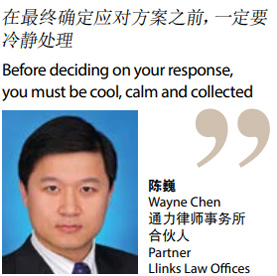 Chen places a premium on level-headedness. “Keep calm, don’t act rashly. There are many reasons why a foreign regulator may launch an investigation, and many types of investigation. Before deciding on your response, you must be cool, calm and collected,” he advises.
In the face of investigation, others stress the need for communication. “The most important thing is to maintain continuous contact and coordination with auditors and lawyers in order to ensure that a consistent story is presented in the face of the investigation,” says Zeng Xi, a partner at Tian Yuan Law Firm. “Another vitally important thing is to communicate with the market and with investors in a timely and appropriate manner. In this regard, engaging an experienced public relations company is crucial.”
 Hu Shenglin, a partner at Guantao Law Firm, places a premium on openness. “A Chinese company facing investigation should conduct its own internal examination and actively address any issues that exist,” he says. “Problems that exist should not be purposefully hidden.”
When faced with allegations of fraud or regulatory misstatements, lawyers are united in recommending immediate recourse to counsel. Chau at Herbert Smith urges truthful, complete and accurate information disclosure and truthful, complete and accurate investor relations and regulatory
communications. “Listen to your lawyer,” he advises.
Listing will be trickier
For Chinese companies – especially those attracted to growth markets where the barriers to listing are lower like Nasdaq, the London Stock Exchange’s second-tier Alternative Investment Market (AIM) or third-tier Plus Market or Toronto’s Venture Exchange – listing overseas is likely to become more difficult. “The regulatory and stakeholder environments in Western and emerging markets are likely to become more complex and difficult to navigate as regulatory requirements become more complex,” says Esther Leung, co-head of capital markets in Asia at DLA Piper in Hong Kong. “Chinese companies will need to plan their overseas investments with care.”
The backlash against reverse mergers involving China-linked entities might also lead to an increased use of traditional IPO routes. “The traditional IPO vetting process is an important process for a company to go through in order to prepare it to become a listed company,” says Seem at Shearman & Sterling. “It involves training of company management, testing of the company’s internal controls and corporate governance structure and thorough due diligence regarding the company’s business and operations.”
The scrutiny Chinese companies are now under also means they will have to work harder on their investor relations. “The strict regulatory environment and severe market conditions will significantly add to the cost of communicating with the regulatory authorities, investors and small shareholders,” says Zeng at Tian Yuan. (He also adds that in his view, “insufficient and inappropriate” communication is a primary reason for the low valuations attracted by some Chinese companies.)
At home, Chinese companies may also find it harder to get the green light from Chinese authorities to list abroad. Despite the flood of listings in recent years, Chinese lawyers say it is already difficult for most companies to gain the required permissions from the China Securities Regulatory Commission (CSRC) and other authorities. “The most common difficulties are the shareholding restructuring and foreign exchange registration with the State Administration of Foreign Exchange,” says Jacky Zou, managing partner at Victory Legal Group in Shanghai. “Some IPO projects get stuck at the SAFE registration because the shareholders have carried out the restructuring exercise first and then tried to register,” Zou explains.
International law firms see corporate governance emerging as a key area in which they can assist Chinese companies. “We definitely can help them to improve corporate governance and US securities law compliance, including recommending qualified and professional candidates for independent directors who really understand the duties of a director of a US-reporting company,” says Chang at Morgan Lewis.
Delisting, relisting
Once listed, some Chinese companies soon find that the costs and obligations can outweigh the benefits of an overseas listing. Two companies from Jiangsu province recently chose to delist from AIM. Both Wuxi-based Jetion, a maker of solar power cells, and Taizhou-based China Shoto, a manufacturer of lead-acid batteries, cited persistently low share prices and the high costs associated with the listing.
“It seems that the US exchanges have been seeing more of this than exchanges elsewhere, although last year witnessed a wave of Chinese companies getting delisted from London’s AIM and transferring to Hong Kong for listing,” says Chau. “The typical reasons for delisting include undervaluation, unfamiliarity with the business system and culture, compliance cost and litigation risk.”
From the US perspective, delisting can take two forms: “going dark” – winding up the company – and “going private” – usually through a management buyout. “Going dark is cheaper as long as the issuer meets the requirements, including less than 300 stockholders of record,” says Chang. “So going dark is not a choice for a company with a big public float.”
Others are so disheartened by poor pricing and the regulatory requirements of listing that they are going private. Going private is a much more complex and expensive transaction which requires extensive disclosures, establishment of the fairness of the transaction and the engagement of a banker to issue a fairness opinion. “Unlike going dark, the SEC may review and comment on the disclosures made in connection with a going-private transaction,” Chang adds.
Jeffrey Sun, a partner at Orrick Herrington & Sutcliffe in Shanghai, thinks that relisting in Hong Kong after delisting elsewhere could become a trend. “We acted for the underwriters in helping West China Cement to delist from London’s AIM board and relist via an IPO in Hong Kong,” he says. “The rationale behind that deal was to allow West China to tap the greater liquidity of the Hong Kong capital market.”
Aloysius Wee, managing partner of Dacheng Central Chambers in Singapore, a joint venture between Beijing-based Dacheng Law Offices and Singapore firm Central Chambers Law Corporation, says the firms are working on a re-listing of a China company in Singapore. Dacheng acted for the company in its Nasdaq listing and subsequent de-listing in the space of five years. “In Singapore we see S chips – China-listed companies – venturing onto other exchanges for a dual listing,” he adds. “This may be motivated by a low P/E ratio in Singapore and a slow market. In Singapore, S chips are all viewed negatively because of a few rotten apples.”
For law firms, an IPO – or even a delisting – can mean the beginning, not the end, of a client relationship. “We continue to work with many of our clients after they have gone public, as they expand into overseas markets and make acquisitions in Europe or the United States,” says Sun at Orrick.
Joseph Lee, a partner at Jones Day in Hong Kong, says his firm hopes to hold on to a client after a listing. “You come to know a client after the IPO and they tend to stay with you.” There are a number of issues that a company faces after its IPO. “Private companies in China are often not polished,” he says. “Once they’re listed it’s like having a newborn baby with all the appropriate genes. After you go through the listing process you try to help them put everything in place, such as corporate governance, compliance and internal control issues.”
As in the case of newborn babies, some firms recommend regularly scheduled follow-ups. “We do propose that a legal audit be conducted on a determined periodic interval to assess contractual documents, agreements and arrangements that the company has entered into,” says Wee. “We are of the view that if we are retained to act for the company post-IPO, we are able to provide regular updates and training if necessary to key management personnel and directors of the company.”
Appetite undiminished?
If the international capital markets are becoming less comfortable places for Chinese companies to be, might those companies turn back to China for satisfaction of their capital needs?
Opinion seems divided over whether the suspension or delisting of a company overseas will adversely affect its parent company back in China. “If an overseas listed Chinese company is suspended or delisted by a foreign regulator, this may not have a substantial impact on that company’s entities or business in China,” says Zeng at Tian Yuan. “That’s because the foreign regulator doesn’t have the power to come to China to enforce its law, and in the vast majority of cases foreign court judgments can’t be enforced in China either.”
 But Zeng admits that some fall-out from scandals on overseas markets is bound to be felt at home. “First, the company may suffer damage to its reputation in China. Second, any possibility of the company raising money on the capital markets in China or abroad will be closed off,” he says.
Chen at Llinks agrees: “The loss of a listing platform will greatly reduce a company’s ability to raise funds” in China. He adds that having a stock suspended or delisted by a foreign regulator “indicates that there are legal, financial or trust issues which may directly affect the view that suppliers, customers and business partners take of the company”.
The CSRC, among others, is likely to take a dim view of any company whose stock has been booted off an exchange in the US or elsewhere. “If a stock is suspended or delisted due to something which is prohibited or disapproved of by the securities regulatory authorities in China, this will also have a negative effect on any domestic listing or mean that the company cannot apply to list domestically within a certain period of time,” says Marvin Min, a partner at Zhonglun W&D Law Firm.
Hu at Guantao makes the same point more bluntly. “If you think about a red chip that wants to return home, the fact it has had to delist [from an overseas exchange] will cause the Chinese regulator to doubt it has operated legally. That is not conducive to it being welcomed back,” he says.
So will all the trouble overseas persuade Chinese companies that a foreign listing is just not worth the trouble? Chen at Llinks thinks not. “A tougher regulatory environment is a neutral thing. It applies equally to all listed entities in a particular jurisdiction,” he says. “The costs of the current tough regulatory environment are not high enough to outweigh the benefits of listing overseas in terms of reputation and funds.”
Law firms urge Chinese companies to choose the right exchange for their business. “There is no perfect exchange to suit everyone,” says Chang of Morgan Lewis. “It all depends on the nature of the business and the shareholding structure.” Chang notes that property companies are still likely to aim for an IPO in Hong Kong, and many high-technology outfits will still prefer Nasdaq because US investors and market analysts have deeper understanding of technology.
 In Hong Kong, mainland Chinese IPOs have recently been outshone by listings of high-profile international companies such as Prada, Glencore and Samsonite. But many believe the appetite for solid China stocks remains, in Hong Kong and elsewhere. “The listing of good quality Chinese companies has been taking place for 20 years and is still continuing,” says Lee at Jones Day.
This has created a 20-year boom for lawyers, who say there is no shortage of Chinese companies still wanting to raise capital through IPOs overseas. “Conventional IPOs in the US markets involving PRC-based companies are getting done, and the backlog is still significant,” says Steven Winegar, a partner at Paul Hastings in Hong Kong.