









With a drastically modified Company Law around the corner, Cheng Guangdong, general counsel at Nanshan Group, dissects key revisions in preparation for a lengthy transition
AFTER FOUR DRAFT REVISIONS since 2019, the latest round of amendments to China’s Company Law was finally published on 20 December 2023. The new law contains 266 articles and is scheduled to come into force on 1 July 2024. Since its promulgation, my colleagues and I have made certain changes in our work in anticipation of the new chapter, and this article summarises our key concerns in this latest phase.
It should be noted that, as the author is employed by a private enterprise, special provisions under the new Company Law that are significant to state-funded companies and organisations will not be extensively covered.
Corporate governance structure
The new Company Law’s implementation has far-reaching impacts on the corporate governance structure, especially in terms of the setting up of the supervisory board, the authority of the manager, and the liability of directors and officers. The status of directorship and the risk it carries has also changed significantly.
Articles 69 and 121 provide that the company may decide on its own whether to establish a supervisory board, or any supervisors. Should there be no supervisory board, the audit committee under the board of directors shall exercise the supervisory powers. Article 74 stipulates that managers shall report to the board of directors, and that their authority is provided by the articles of association or the board of directors, and shall no longer be enumerated under the Company Law.
Article 52 provides for the system of shareholders’ disenfranchisement, which allows the board of directors to issue a notice of disenfranchisement, effective immediately, if a shareholder fails to comply with the obligation to make capital contributions on time within the grace period and without a call notice.
These new rules grant more power to the board of directors and push corporate governance one step further towards “board-centrism”. In several joint-venture projects that I have recently been involved in, discussions on corporate governance structure have indeed been heavily influenced by the above-mentioned provisions, focusing more on the distribution of the board’s power structure and the selection of directors.
On the flip side of the power expansion, directors and officers have also seen their fiduciary obligations and liabilities further clarified by the new Company Law. For example, article 191 unprecedentedly dictates that intentionally or grossly negligent directors and officers shall be held directly liable to the third parties, which significantly raises the practice risks of these offices. Correspondingly, the added article 193 sets out the directors’ liability insurance system.
In addition to directors and officers, the amendments also clarify the liability of “shadow directors”, which is common in practice. This is mainly reflected in articles 180 and 192 of the new Company Law, while articles 181 to 184 serve to refine article 180. Although not explicitly provided, it is my belief that shadow directors should also comply with articles 181 to 184.
In addition, article 265 of the new Company Law adjusts the definition of the actual controller of a company, which was defined under the previous version as “a person who is not a shareholder of a company but is able to hold actual control of the acts of the company by means of investment relations, agreements or any other arrangements”.
Here, the qualification of “not a shareholder of a company” has been deleted. In recent years, the author has encountered cases where minority shareholders, through anonymous proxy or other arrangements, exert control over the company, fully exploiting the original Company Law’s difficulty in identifying them as the actual controller. This problem has now been fixed.
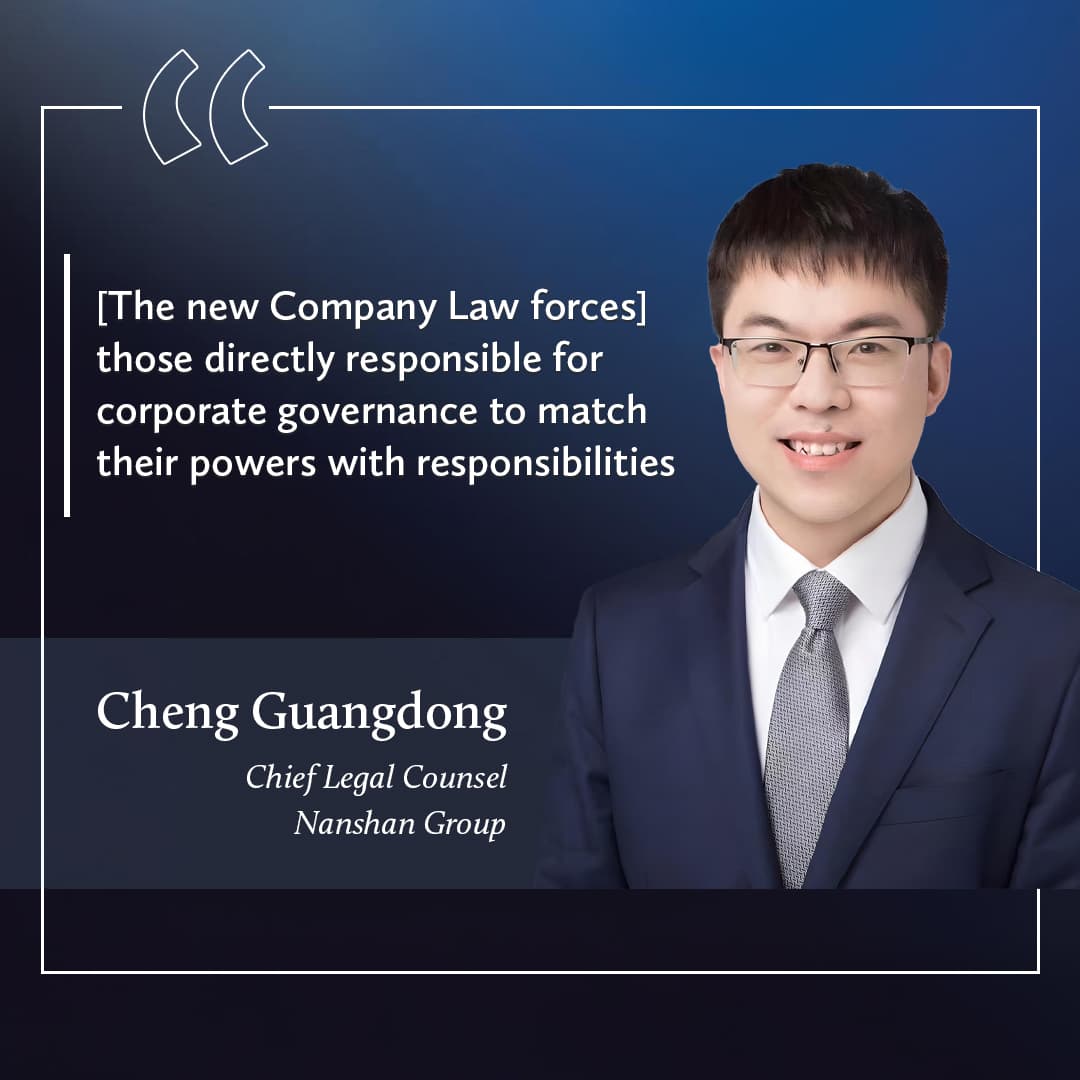
In the author’s opinion, while the adjusted corporate governance structure looks quite different from before, it strikes closer to the requirements of modern corporate governance by not only strengthening the rights and responsibilities of the board of directors and simplifying the corporate governance structure, but also forcing those directly responsible for corporate governance to match their powers with responsibilities.
In addition, the new Company Law takes into account the degree of social acceptance of the new rules. For instance, the establishment of the supervisory board and the powers of the managers are not mandatory, giving companies plenty of wiggle room to make their own choices. They can also either maintain the existing structure or opt for a new one.
You must be a
subscribersubscribersubscribersubscriber
to read this content, please
subscribesubscribesubscribesubscribe
today.
For group subscribers, please click here to access.
Interested in group subscription? Please contact us.
你需要登录去解锁本文内容。欢迎注册账号。如果想阅读月刊所有文章,欢迎成为我们的订阅会员成为我们的订阅会员。