










AS NOTED IN THIS COLUMN almost 15 years ago (see China Business Law Journal, volume 1, issue 6: Terms for describing lawyers and why they matter), English has a number of different terms to describe a legal practitioner, including lawyer, attorney, barrister, solicitor and counsel. By contrast, Chinese only has one term: 濒ü蝉丑颈 (律师), although “legal consultant” (falü guwen, 法律顾问) is also commonly used.
The terms “solicitor” and “barrister” are perhaps the most difficult to translate into Chinese, since they reflect the unique historical evolution of the legal profession in England. The term “barrister” or “barrister at law” arose to describe lawyers who worked as advocates in court (i.e. lawyers who spoke or argued in court on behalf of parties). The term “solicitor” arose to describe lawyers who worked as advisers (i.e. lawyers who advised clients in relation to their personal and business dealings, drafted contracts and other documents, and instructed barristers to appear on behalf of their clients in litigation).
Historically, barristers enjoyed a status that was superior to solicitors as they considered themselves to be part of an “honourable profession”, one in which they were “called to the bar” out of a sense of duty rather than for the purpose of making a living. Although barristers and solicitors now enjoy equal status, the superior status of barristers is still reflected in the ways in which “barrister” is translated into Chinese in some jurisdictions. In Hong Kong, for example, the term “senior lawyer” (da 濒ü蝉丑颈, 大律师) is often used to describe a barrister and the term “primary lawyer” is sometimes used to describe solicitors (chuji 濒ü蝉丑颈, 初级律师).
The earlier column further noted that since the emergence of the legal profession in England, a distinction between barristers and solicitors has been recognised in many common law jurisdictions, resulting in what is often described as a “divided profession”. Several work practices and customs have arisen to reflect this division. For example, barristers maintain separate offices from solicitors and work as individual practitioners, although they usually join with other barristers to lease offices (known as their “chambers”) and to share resources.
This column below explores the design and operation of barristers’ chambers and discusses the launch of new barristers’ chambers in Melbourne in 2024: Ah Ket Chambers.
Origins and development
The origins of barristers’ chambers can be traced back to the English Inns of Court, which were established in London in the 14th century. Four Inns of Court emerged: Lincoln’s Inn, Inner Temple, Middle Temple and Gray’s Inn.
In part, Inns of Court were designed to function as trade guilds; namely, associations organised to support their members in a particular trade or profession. However, they were also designed to provide accommodation and training to lawyers, and to operate along similar lines to universities. As a result, each Inn of Court has a great hall, a library, barristers’ chambers and other facilities, including gardens. Historically, the halls were used for theatrical and other performances. The first public performance of Shakespeare’s play, Twelfth Night, was held at the Great Hall of Middle Temple in 1602.
In his book, A Concise History of the Common Law (Fifth Edition, 1956), the legal historian Theodore Plucknett wrote about the important role that Inns of Court played for barristers and students who were learning to become barristers:
Their life centred in the Inns of Court, which, like a university, provided for their general education and common life. Here they studied law and many other things – history, music and dancing, for example – and this full and fashionable education made the Inns a great resort for the youth of wealth and noble families, even [though] they had no intention of practising law. In the beginning of the 17th century it was in the Middle Temple Hall, before the Queen and a fashionable audience, that Shakespeare’s play Twelfth Night was first performed. There were more than a dozen such inns, and during the 14th century the [barristers and students] changed their quarters many times, leasing first one inn, then another. In exactly the same way came into existence some of the halls at Oxford and Cambridge. The largest of these inns were Lincoln’s Inn, Gray’s Inn, the Middle Temple and the Inner Temple … As numbers grew, subsidiary inns were formed subject to one or the other of the four great inns, and these were called Inns of Chancery; finally these Inns of Chancery were reserved for attorneys and solicitors only.
The Inns of Court have the exclusive right of admission to the Bar. As a result, all people who would like to become barristers must become a member of an Inn of Court. After admission, barristers in London are free to work within any of the over 200 chambers that exist in London.
Today, most barristers’ chambers in common law jurisdictions such as England, Hong Kong and the states of Australia are designed in the same way as other modern offices, with conference rooms, offices for barristers and libraries. They also contain space for administrative personnel such as clerks, who manage the work of the barristers within the chambers. It is relevant to note that barristers practise on a self-employed basis but agree to share administrative and other resources with other barristers. Some chambers specialise in particular areas of practice.
Ah Ket Chambers
This column has previously discussed the life and legacy of William Ah Ket, the first barrister of Chinese origin to practise at the Victorian Bar in Australia (see China Business Law Journal, volume 11, issue 1: Chinese legal pioneers).
In August 2024, about 70 barristers in Melbourne launched a new set of barristers’ chambers named Ah Ket Chambers. The website of the new chambers states as follows:
William Ah Ket signed the Bar roll in June 1904, and was the first barrister of Chinese origin to practise at the Victorian Bar.
Former Chief Justice Susan Kiefel has said about William Ah Ket:
“His answer to the difficulties he faced appears to have been to succeed in what he did; to be a real part of the legal profession; to help others and to act at all times righteously, with courage and with kindness.”
Inspired by his example, we share a common goal of providing an independent, egalitarian, professional and approachable chambers environment.
This columnist was honoured to be invited to deliver a short speech at the launch of the chambers. The speech included the following comments:
The star over William’s legacy has been ascending for a long time. As former Chief Justice Black of the Federal Court noted in a speech in 2022, stories about William were still circulating when Michael Black joined the Bar in the 1960s. This was some 20 years after William had passed away, in 1936, at the age of 60. Indeed, it was during his days at the Bar that Michael Black acquired William’s nominate reports, which now reside in the Melbourne chambers of Chief Justice Mortimer.
An important part of William’s legacy was his contribution to society generally, both as a member of community organisations and also as a devoted husband and loving father to his children. He was a great Australian who made an immeasurable contribution to society, particularly in practising his ideals of bridge-building and reconciliation. His legacy reflects the richness of Australia’s migrant traditions and is one that belongs to, and should be celebrated by, all of us.
And what better way to celebrate William’s legacy, particularly in relation to diversity and equity, than to name these chambers after him.
Following this columnist’s speech, Chief Justice Mortimer of the Federal Court of Australia delivered a speech and handed over to Ah Ket Chambers the set of nominate law reports that William had owned.
A previous column has discussed the history of law reports in common law jurisdictions (see China Business Law Journal, volume 12, issue 3: Law reports). The column discussed the emergence of “private” law reports that were edited by judges and eminent practitioners. These “private” law reports were known as nominate law reports as they were named after the editor or reporter.
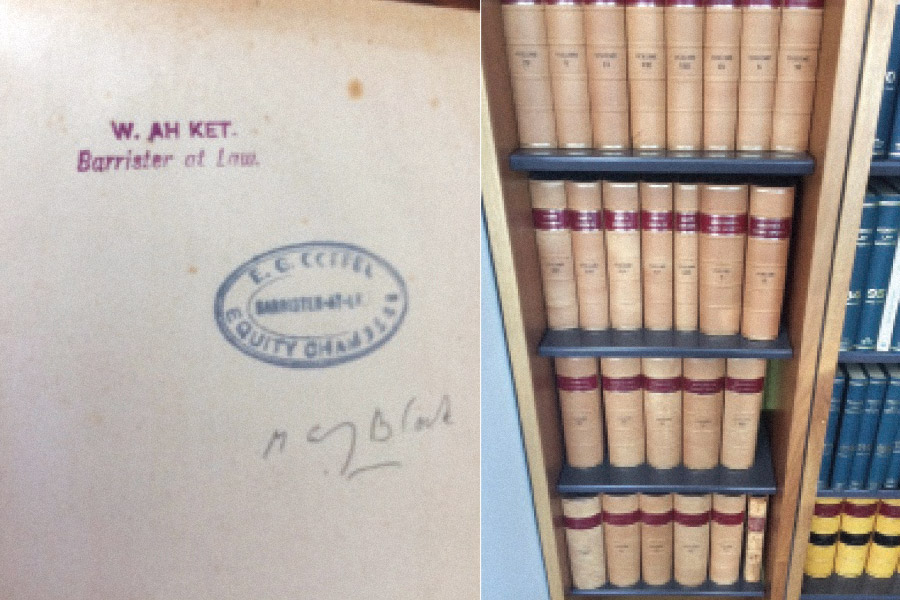
William Ah Ket owned a complete set of Adolphus and Ellis’ Reports, which were named after the reporters John Leycester Adolphus and Thomas Flower Ellis. Each volume in the set bears William’s stamp, together with the stamp or signature of the subsequent owners: E G Coppel, who practised at the Victorian Bar from 1922 until 1965; and Michael E J Black, who commenced practice at the Victorian Bar in 1964 and was appointed Chief Justice of the Federal Court of Australia on 1 January 1991.
It is a great tribute to his legacy that the collection of nominate law reports that William Ah Ket owned has found a new home in the barristers’ chambers that bear his name.

Andrew Godwin previously practised as a foreign lawyer in Shanghai (1996 – 2006) before returning to his alma mater, Melbourne Law School in Australia, to teach and research law. Andrew is currently Joint Associate Director of the Corporate Law and Financial Regulation Research Program at the Melbourne Centre for Commercial Law and Honorary Associate Director (Commercial law) of the Asian Law Centre. Andrew has acted as a consultant to a broad range of organisations, regulators and governments in Australia and abroad. He served as Special Counsel and Acting General Counsel of the Australian Law Reform Commission between 2020 and 2024.