











A wrap-up of the year’s most significant events affecting legal in the region, and how they impacted in-house counsel, policymakers, regulators and law firms
In terms of technological evolution, 2024 could be described as the year of living dangerously. Artificial intelligence truly entered the psyche of the legal sector, for its perceived dangers as much as its benefits, and along with it came major concerns on data management and protection. Adequate regulation proved a recurring theme this past year as many countries struggled to keep up with the sheer pace of change. Based on insights from senior lawyers across 11 Asian jurisdictions, 2024 has been marked by a clash between toughened legal measures and the soaring demands of innovation.
Lawmakers in Asia have taken targeted regulatory steps to tackle longstanding issues, as well as to rein in radical technological transformation. Our research shows that not only have regulators across the region made unprecedented moves, but companies and law firms have also departed from their traditional or decades-long strategies.
From Indonesia’s shocking ban on Apple’s iPhone 16 sale on local content non-compliance grounds, to China’s exodus of US law firms, and Nippon Steel’s ground-breaking USD14.1 billion steel buyout, this year has not been short of surprises challenging conventional wisdom.
With expert views from senior lawyers around the region, let us walk you through the massive upheavals, the biggest deals and the most significant regulation that have shaped this amazing year of change.
Artificial intelligence
More and more law firms in Asia, particularly in key regional economies such as South Korea, have been adopting AI for various reasons, from enhancing management efficiency to contract reviews to legal searches in the past year.
At the same time, concerns ranging from data security to ethics over the rapid growth of AI have intensified, leading to calls for legislative action to regulate the technology in some Asian countries.
The South Korean government in particular was under mounting pressure to bring the tech under regulatory control.
With a backdrop of political uncertainty following then South Korean president Yoon Suk Yeol’s martial law declaration and his subsequent impeachment, the National Assembly passed the Act on the Development of Artificial Intelligence and Establishment of Trust (AI Basic Act) on 26 December. You Jung Lee, managing partner at One Law Partners in Seoul, points to how AI-related challenges have become “glaringly apparent” with the rise of AI-driven deepfake crimes, exposing “profound vulnerabilities” in existing legal structures in the country.
“These alarming incidents not only brought the AI-related issues into sharp public focus, but also prompted lawmakers to introduce targeted legal amendments aimed at enhancing victim protection and holding digital platform providers more accountable,” says Lee.
There was an urgent need to enact the AI law to enhance, among other things, data processing protocols and protective measures for AI systems in South Korea, senior lawyers in the country tell Asia Business Law Journal.

“Amid the global AI boom, companies are increasingly seeking advice on building AI-based systems and responding to AI regulations,” says Jong-Han Oh, managing partner at Shin & Kim in Seoul.
Concerns over the risks of the widening use of AI without specific legal frameworks for the technology are not limited to South Korea. Hong Kong, which currently does not have AI-specific legislation, has also seen a rapid integration of AI into legal operations among law firms this year.
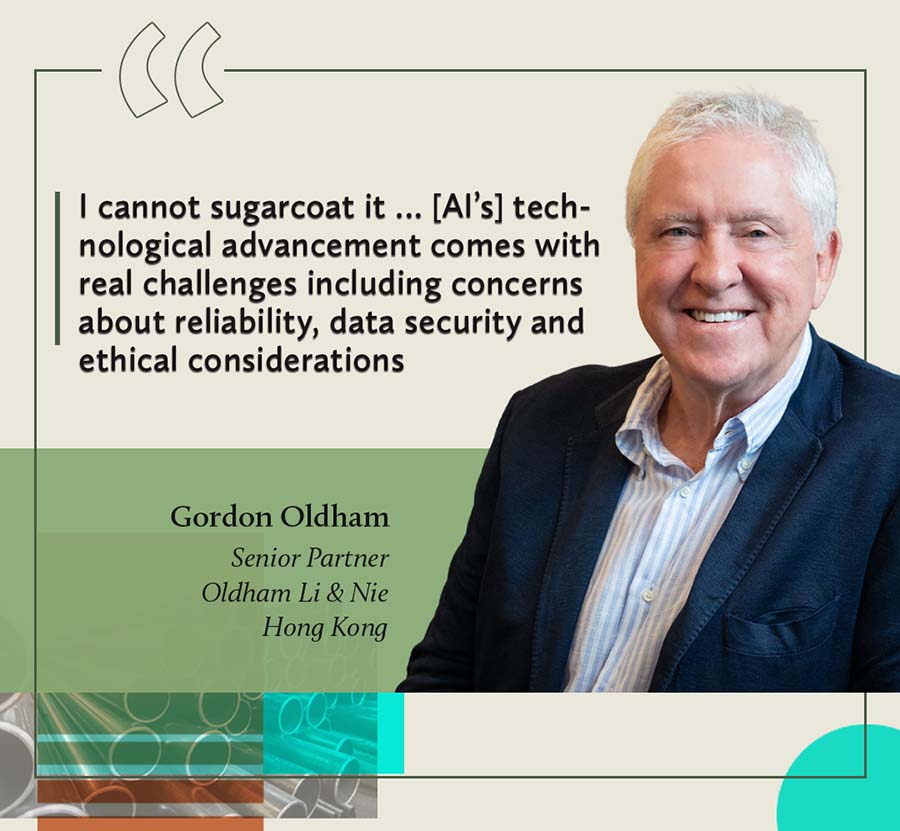
Calling AI a big trend in 2024 and a “double-edged sword”, Gordon Oldham, senior partner at Oldham Li & Nie in Hong Kong, agrees that the technology can significantly streamline routine tasks, freeing lawyers to focus on complex and high-level legal issues.
“But I cannot sugarcoat it … this technological advancement comes with real challenges including concerns about reliability, data security and ethical considerations, raising tough questions about how AI will co-exist with our profession’s core principles,” says Oldham.
Although Oldham worries about “thorny” issues around data security and the need for human oversight as AI adoption accelerates, he points to how the rise of AI in 2024 catalysed a surge in investment in startups with a focus on AI and data transfer.
“The demand for legal expertise in drafting and negotiating documentation for establishing and facilitating investments in startup companies, including but not limited to investment agreements and other initial set-up documentation, has grown exponentially,” he says.
In Japan, which currently has no overarching legal framework for regulating AI, the Ministry of Justice’s (MOJ) guidelines, published in August 2023, interpreting the relationship between AI legal technology and the Japanese Attorney Act has had a significant impact on the further development of AI tools specialised for legal use in Japan in 2024, says So Saito, founder and Akasaka Office president of So & Sato Law Offices in Tokyo.
Amid increasing collaboration between Japanese law firms and legal technology service providers on AI utilisation for legal content, including M&A templates, the MOJ’s guidelines have clarified what, in the provision of AI contract-related business support services, constitutes unauthorised practice of law under the Japanese Attorney Act.
Saito, a Japan and New York bar-qualified lawyer who specialises in advising on web3, financial technology and venture finance, says that even before the guidelines issued in August last year, law firms had already been using legal technology software to look for disadvantageous and missing clauses when doing typical contract checks. He has heard that clients have also been using legaltech software.
“The fact that the provision of AI tools has been interpreted as not, to a certain extent, constituting a violation of the Japanese Attorney Act is likely to lead to further progress in the provision and use of AI beyond typical contract checks,” says Saito.
The rapid integration of AI in Asia’s legal systems highlights challenges in governance, ethics and regulation. While AI streamlines operations and boosts investment, it also raises concerns about security, reliability and oversight. This duality mirrors broader changes in Asia, where innovation meets growing regulatory demands. Similarly, the global focus on environment and social governance (ESG) is transforming corporate and legal landscapes, driving accountability, sustainable growth and policy reforms.
ESG
As global urgency around ESG issues grows, Asia finds itself at the forefront of this transformative shift. In 2024, key developments across the region not only emphasised the importance of ESG principles but also set the stage for an era of heightened accountability, innovation and legal evolution. Legal experts agree that this year marked a turning point, with significant strides in policy, finance and corporate governance.

As Akshay Chudasama, co-managing partner at Shardul Amarchand Mangaldas & Co in Mumbai, points out, climate finance has become a critical driver for ESG adoption in Asia, and the region has witnessed a surge in green bond issuances.
“Climate finance in Asia is growing, driven by the need for climate action and sustainable development. The Asia-Pacific region is also witnessing an increased focus on sustainable finance and ESG considerations,” says Chudasama.
He points to key trends including increased green bond issuances, a focus on climate resilience, and fintech’s emerging role in promoting access to climate finance for SMEs and low-income households, with the Asia Development Bank playing a supportive role in the region.
Chudasama says 2024 was a pivotal year for climate jurisprudence in Asia, marked by landmark rulings and a global focus on the region’s environmental challenges. In MK Ranjitsinh v Union of India, 含羞草社区 Supreme Court elevated the “right to be free from the adverse effects of climate change” as fundamental under articles 14 and 21 of the Indian Constitution.
“The 2024 United Nations Climate Change Conference (COP 29), laid a lot of emphasis on Asia, in terms of emphasising the need for a rapid energy transition, climate adaptation and resilience, enhanced early warning systems, climate-resilient infrastructure, and climate-smart agriculture,” he says.
Kunal Thakore, joint managing partner at TT&A in Mumbai, echoes this stance, noting: “We have also noticed a shift in the government’s focus towards sustainable development and technological integration.”
Countries across Asia have taken distinctive approaches to embedding ESG principles into their regulatory frameworks. In the Philippines, regulatory initiatives like mandatory sustainability reporting and climate change expenditure tagging reflect the government’s proactive stance.

Maria Christina Macasaet-Acaban, partner and head of the corporate, commercial and M&A practice group at Quisumbing Torres in Manila, highlights how these measures are shaping corporate behaviour and attracting foreign investment aligned with the country’s sustainable development goals.
“Philippine companies are actively adapting to ESG and sustainability requirements through various initiatives. These efforts also impact foreign investment and support the country’s sustainable development goals,” says Macasaet-Acaban.
In Malaysia, ESG has taken centre stage, with the Securities Commission introducing robust guidelines for ESG disclosures. Brian Law, managing partner at LAW Partnership in Kuala Lumpur, notes that these requirements are pushing businesses to integrate transparency and accountability into their core operations.
“With increased global awareness of ESG issues, regulators in several Asian countries, including Malaysia, are pushing for greater accountability and transparency,” says Law.
Meanwhile, Indonesia is aligning its regulatory efforts with ambitious net zero targets for 2060. The Indonesian government encouraged and promoted the use of rooftop solar power generation by businesses, governing the installation and operation of private rooftop solar panel systems by customers of public interest electricity supply business licence holders.
Luky Walalangi, managing partner at Walalangi & Partners in Jakarta, says new regulations aim to attract sustainable investment while addressing stakeholder concerns.
“By establishing clear regulatory frameworks, Indonesia seeks to attract both domestic and international investment in sustainable projects, enhancing economic growth while adhering to its environmental obligations,” says Walalangi.

Kudun Sukhumananda, founding partner at Kudun and Partners in Bangkok, highlights how the growing emphasis on ESG compliance has reshaped Thailand’s corporate strategies in 2024. He says businesses are under mounting pressure to overhaul traditional practices, implement comprehensive sustainability frameworks and align with global standards.
“The scrutiny on public listed companies has exposed systemic issues in corporate governance and internal controls, shaking investor confidence and creating significant reputational risks for Thai capital markets,” says Sukhumananda.
The Clean Air Act, for instance, has introduced significant challenges by requiring companies to adopt stricter environmental controls, including reducing emissions and enhancing reporting transparency. These demands necessitate substantial investment and operational adjustments, compounded by heightened investor expectations for credible ESG commitments, and the legal risks associated with non-compliance.
“For law firms, advising clients on navigating untested legislation like the Clean Air Act and managing disputes around environmental liability are particularly demanding,” says Sukhumananda.
With ESG principles redefining corporate strategies and demanding greater transparency, the emphasis on governance has become more prominent. This stress on accountability drives regulatory changes and empowers stakeholders.
Notably, shareholder activism is rising as investors address governance issues, enhance corporate value and align with evolving sustainability expectations. Across Asia, shareholder engagement is gaining momentum, marking a new era where governance reforms are no longer optional but essential for long-term success.
Shareholder activism
As lagging stock prices and subsequent poor returns to shareholders inevitably lead to a much easier opening for shareholder activism, managing partners in Japan and Korea tell Asia Business Law Journal about the surge in shareholder activism in their countries.
We have been involved in a number of activist and defence deals involving unsolicited takeovers, and we expect that the volume of these deals will continue to increase,” says Ryutaro Nakayama, managing partner at Nishimura & Asahi in Tokyo. “Japanese corporations have shown a positive interest in these types of deals as an opportunity to increase corporate value.”
Nakayama says that in Japan, shareholder activism has been on the rise in the form of unsolicited takeover bids after the Ministry of Economy, Trade and Industry issued guidelines for corporate takeovers in August last year.
The new guidelines were designed to encourage corporations to consider unsolicited takeover bids as potential opportunities to enhance corporate value and to secure shareholders’ interests, rather than turning them away. “Though many Japanese corporations have yet to be involved in such transactions, the increase in these types of deals is remarkable,” says Nakayama.
One prime example is the acquisition of Takisawa Machine Tool by Japanese motor maker Nidec via a tender offer. According to TMI Associates, which advised on the deal, Nidec repeatedly referred to the concepts contained in the guidelines and successfully closed its acquisition. This shows how Japanese companies are now justifying their unsolicited takeovers in a country where “hostile” takeovers have long been taboo.
As a result, the rise in unsolicited takeover bids is encouraging shareholders and equity investors to become more vocal, and is creating a more transparent, competitive and dynamic environment to maximise corporate value.
On the other hand, in South Korea, shareholder activists have been demanding the amendment of the Commercial Act in order to fix a situation where the opinions of minority shareholders are excluded in the decision-making process for critical company matters.
South Korea’s main opposition Democratic Party, led by Lee Jae-myung, has been pushing for passage of the Commercial Act amendment bill in the National Assembly throughout the year.
“Many believe that amendments to the Commercial Act are necessary to enhance corporate value through value-up initiatives by improving South Korea’s outdated governance structure,” says Dong Hoon Lee, managing partner at Barun Law in Seoul.
However, with the impeachment of President Yoon Suk-yeol in the spotlight following the recent declaration of martial law, it is widely believed that any amendment bill will not be passed this year.
Jong-Han Oh, managing partner at Shin & Kim in Seoul, says that activist shareholders have been a driving force in the increase of management disputes in the country. “Shareholder disputes, or shareholder activism, related to corporate governance are becoming more active in the Korean capital markets, leading to a significant increase in management disputes and related advisory services,” says Oh.
A notable example of this was when MBK Partners, a Seoul-based leading private equity firm in Asia, recently partnered with Young Poong, the largest shareholder of Korea Zinc, to call for improvement of the governance structure at Korea Zinc. They claimed that Korea Zinc chairman Yun B Choi’s arbitrary management was alleged to have damaged the shareholder value, with Shin & Kim being the legal adviser for Young Poong.
While shareholder activism advocates for improved transparency, fair representation and accountability within corporations, a similar call for oversight is surfacing in the digital realm. The rise of data-driven technologies has placed data protection and privacy at the head of regulatory concerns across Asia.
Governments are beginning to respond to these challenges with stricter data protection laws aimed at securing sensitive information and maintaining public trust. Just as shareholders push for better corporate governance to protect value, regulators are moving to ensure robust data governance to safeguard the evolving digital economy.
You must be a
subscribersubscribersubscribersubscriber
to read this content, please
subscribesubscribesubscribesubscribe
today.
For group subscribers, please click here to access.
Interested in group subscription? Please contact us.
你需要登录去解锁本文内容。欢迎注册账号。如果想阅读月刊所有文章,欢迎成为我们的订阅会员成为我们的订阅会员。