







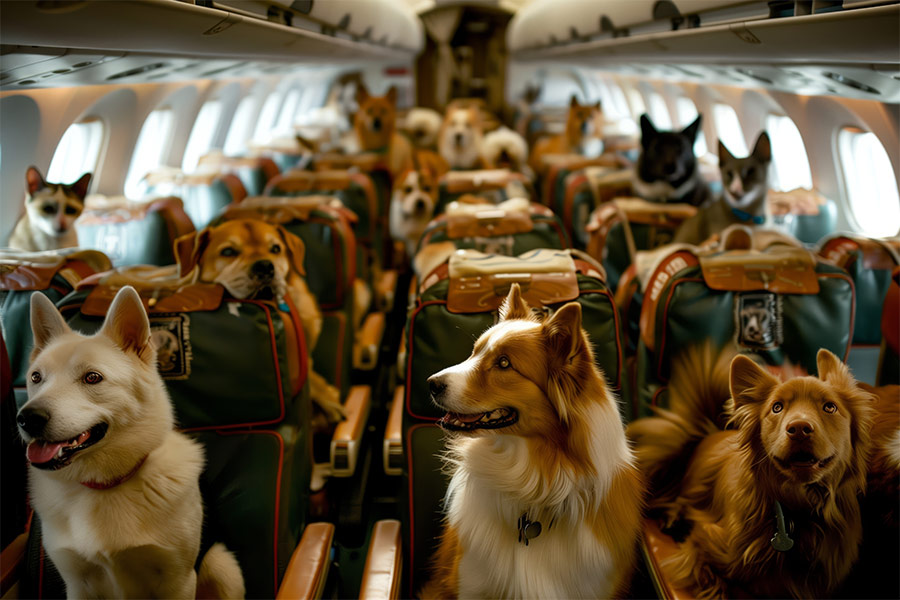


With development of society and the economy, demand for air transportation of pets is rising, leading to more related disputes. This article discusses the main aspects of resolving such disputes by analysing a case history of claiming air transport damage compensation.
The background
In this case, Ms Du entrusted an airline to consign a pet dog from Canada to China, signing a live animal shipper’s certificate and additional disclaimer at the request of the airline, stating that the pet was suitable for air transportation, while the shipper bears all risks, including death.
Unfortunately, the pet dog was confirmed dead at the scene after landing, and Ms Du filed a lawsuit. The court subsequently ordered the airline to compensate for the loss of the pet but rejected Ms Du’s claims for an apology and mental damage compensation.
In such cases, the choice of law, the carrier’s exemption clause in the air transport contract, and the shipper’s mental damage compensation are always the focus of dispute between the parties.
How these issues are addressed in litigation and arbitration – and differences in how judges or arbitration panels consider these issues – also concern the parties involved.
Choice of law
In commercial contracts, parties usually make a prior agreement on the choice of law. However, pet transportation contracts are mostly standard and generally lack clauses specifying the choice.
Article 184 of China’s Civil Aviation Law establishes the principle of priority application of international treaties in the field of civil aviation. Article 1 of the Interpretation by the Supreme People’s Court of Several Issues Concerning the Application of International Treaties and International Practices in the Trial of Foreign-Related Civil and Commercial Cases confirms the above principle clearly.
Regarding this case, China (the destination) and Canada (the place of departure) are both member states of the Convention for the Unification of Certain Rules for International Carriage by Air (Montreal Convention). As such, the case fell under article 1 of the Montreal Convention as international carriage of persons, baggage or cargo performed by aircraft for reward.
Therefore, the Montreal Convention should be applied with priority in this case. The inherent feature of expert trial in arbitration determines that the parties can either choose or request the arbitration institution to appoint industry experts to hear the case.
Industry experts will be more familiar with the content and application of the Montreal Convention. The authors therefore believe that choosing arbitration for international air transport disputes will help such cases to be resolved more professionally.
But it should be noted that the Montreal Convention cannot provide regulations for all matters in air transport disputes. Matters not provided for in the Montreal Convention should be resolved by applying relevant domestic legislation.
Carrier’s exemption clause
In air transport practice, airlines will stipulate liability reduction/exemption clauses in their general conditions of carriage, or require passengers or shippers to sign liability reduction/exemption agreements to avoid liability risks as a carrier.
In this case, Ms Du signed a disclaimer before checking in the pet, indicating that she knew and acknowledged that she was responsible for all risks of death that may result from transporting live animals, and even guaranteed not to make any claims against the air carrier.
However, neither international treaties nor Chinese legal practice support the legal effect of such liability reduction/exemption clauses.
Article 26 of the Montreal Convention stipulates that any provision tending to relieve the carrier of liability or to fix a lower limit than laid down in the convention shall be null and void.
Article 18, paragraph 2, further stipulates reasons for the carrier’s exemption, including “inherent defect, quality or vice of that cargo”.
In this case, the airline claimed the death of the pet dog was due to its own defects (some short-nosed dogs are unable to adapt to air transportation due to their physiological structure or physical fitness). But the live animal shipper’s certificate stated that the animal was in good health and suitable for air transportation. Therefore the court did not accept this defence by the airline.
To avoid such unnecessary disputes, the authors believe the best way to deal with this issue is for both parties to clearly agree on the reasons for exemption after full communication in advance.
However, when dispute arises, the arbitral tribunal will tend to respect the parties’ true expressions of intent more when there is content clearly agreed upon during conclusion or performance of the contract. Therefore, by choosing arbitration for such cases, the parties’ autonomy can be maximally guaranteed.
Compensation for mental damages
Due to the long-term companionship they provide, the death of a pet often causes mental harm to the owner. Article 29 of the Montreal Convention stipulates that punitive, exemplary or any other non-compensatory damages shall not be recoverable in damages claims over the carriage of passengers, baggage and cargo.
This raises the question: Does compensation for mental damages fall under compensatory or non-compensatory damages?
One view is that compensation for mental damages is different from punitive damages in both nature and function. The former is to compensate for mental damage suffered by the victim. Another view is that compensation for mental damages is to compensate and comfort the victim for the psychological damage suffered, and at the same time punish the perpetrator to a certain extent.
It is worth noting that the second view also believes that compensation for mental damages is not a fine and not primarily punitive in principle. Instead, its punitive function is incidental and concurrent, serving mainly to compensate for damages.
But lack of theoretical consensus has led to inconsistencies in judicial practice regarding whether carriers should be ordered to pay compensation for emotional distress in disputes involving pet transportation. Nevertheless, it is undeniable that in cases where a pet dies due to the carrier’s fault, it is not uncommon for the carrier to be liable for mental damages to the shipper.
The court did not find that compensation for mental damage violated article 29 of the Montreal Convention in this case. Instead, it held that the Montreal Convention did not cover the issue of compensation for mental damage.
However, because the shipper failed to provide evidence proving the carrier’s intentional or gross negligence – as required by article 1183 of China’s Civil Code – the court did not support her request for mental damage compensation.
Key takeaway
Arbitration fully respects the autonomy of the parties involved. If the parties choose arbitration in a pet air transport contract, the airline can clearly specify the applicable law in the contract, clarify the operation specifications, and formulate service standards.
Air passengers can also understand the precautions through clear contractual agreements, allowing them to properly handle their rights and interests.
Diao Weimin is a arbitrator of Beijing Arbitration Commission/Beijing International Arbitration Centre and a professor of aviation law at the Civil Aviation Management Institute of China.
Kong Dejian is an associate professor of aerospace law at the China University of Political Science and Law.
JOIN OUR FORUM
China Business Law Journal welcomes your responses to articles that appear in the Dispute Digest section. In line with our desire to make this section a regular forum of ideas, cases and observations, we also invite you to contribute. Articles should ideally be about 900 English words and 1,500 Chinese characters in length. Please send them to cblj@law.asia. We will publish the best and most topical articles each month.