










Legal technology companies in Asia face concerns at law firms and corporations about AI and other technology needs, but regulatory changes are among the factors triggering a shift in thinking, writes Brian Yap
The decision by Mori Hamada & Matsumoto, one of Japan’s four largest law firms, to become the first Asia-based law firm to launch a partnership with legal generative AI platform Harvey is a milestone for lawyers’ adoption of legal technology in Asia.
Moves like Mori Hamada’s are outliers amid the slow take-up of legal technology across the region. Senior figures at legaltech companies in India, the Philippines, South Korea and Singapore tell Asia Business Law Journal that when it comes to legaltech, there continues to be a general fear among lawyers regarding data leaks, inaccurate output and IP infringement.
In Singapore, both the legal industry and the government have been investing in legal technology adoption. As early as 2018, Rajah & Tann acquired LegalComet – which offers legal technology advisory services including e-discovery, forensic technology and data governance – via its unit R&T Technologies. On the government side, Singapore’s Ministry of Law launched the Legal Technology Platform Initiative in 2022, aiming to encourage the city-state’s legal industry to undergo digitalisation.
But law firms in Singapore often face challenges including protecting client data and integrating new technology with existing systems and processes, according to Frederick Antoine, Singapore-based business development director for the Asia-Pacific at London-headquartered Opus 2, which specialises in litigation and arbitration technology.
“Additionally, some express apprehension about the accuracy and reliability of AI-generated outputs,” says Antoine.
Such concerns shared by lawyers in Asia mean legaltech companies need to first alleviate those worries in order to persuade law firms and corporate legal teams to use their products and services.
Seong Moon, co-founder and co-CEO of Seoul-based Bering Lab and a former associate at Yulchon, one of South Korea’s largest law firms, points to confidentiality as the main concern among law firms and in-house departments in his country.
“At Bering Lab, we provide end-to-end encryption in that all the data that comes into our server is fully encrypted. The moment our client or users download the translator output, it is permanently deleted from our service, so there is minimised risk of confidentiality being breached,” says Moon, whose company offers a domain-specific AI translation engine and machine translation post-editing services.
For Opus 2 in Singapore, Antoine says that his company’s AI approach, besides prioritising data privacy and security, focuses on providing controlled and connected intelligence that automates time-consuming tasks, while ensuring that lawyers retain control over the final output.

In the case of India, where domestic law firms want generative AI-supported data customisation but are concerned about data leaks, last year’s market-opening announcement by the Bar Council of India has had a significant impact on the mindset of private practice lawyers, says Karan Kalia, founder and CEO of LegitQuest in New Delhi. LegitQuest, for which the late senior advocate and Indian law minister Shri Ram Jethmalani was founding adviser, offers products in legal research, litigation management, litigation checking and generative AI customised solutions.
Under the new rules, foreign lawyers and law firms registered with the Bar Council of India can open offices in the country and engage as well as procure legal expertise from Indian advocates, India Business Law Journal reported in March last year.
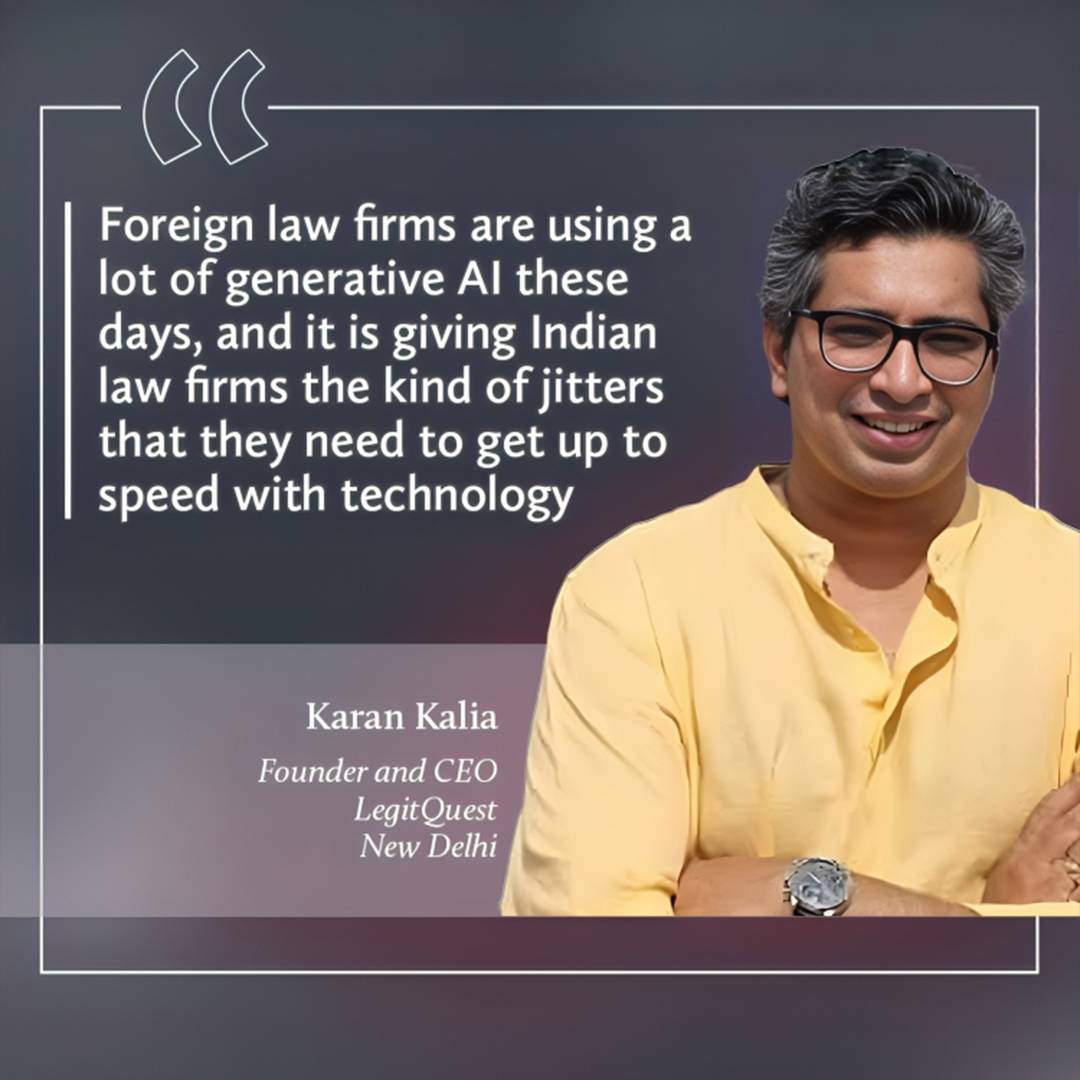
“Foreign law firms are using a lot of generative AI these days, and it is giving Indian law firms the kind of jitters that they need to get up to speed with technology,” says Kalia, who previously practised at Ram Jethmalani Law Chambers. “They understand that human resources aren’t cheap and if they use and spend on technology, they will be able to save more money and time, rather than having more people.”
You must be a
subscribersubscribersubscribersubscriber
to read this content, please
subscribesubscribesubscribesubscribe
today.
For group subscribers, please click here to access.
Interested in group subscription? Please contact us.
你需要登录去解锁本文内容。欢迎注册账号。如果想阅读月刊所有文章,欢迎成为我们的订阅会员成为我们的订阅会员。