











Vietnam is in a phase of administrative and judicial reform where bold change is fuelling cautious optimism. As the government pushes for greater economic transparency and efficiency, businesses must prepare for both opportunities and the lingering unpredictability of a system in transition. Sheryl Ubana reports
Vietnam is executing what lawyers are calling its most ambitious administrative overhaul in decades. Asia Business Law Journal spoke with senior lawyers based in Vietnam who are deeply involved in the country’s legal and business affairs. These leading voices share how Vietnam’s reforms are ushering in a new era of cautious optimism. As the government intensifies efforts to boost economic transparency and streamline process and regulation, businesses must balance enthusiasm for fresh opportunities with the reality of navigating a system still in flux.
Dormancy to decisive change
“Vietnam has been in a long period of dormancy and now it is waking up again,” Le Minh Phieu, managing partner at LMP Lawyers, confidently declares.

Phieu reflects on the evolution of Vietnam’s legal and economic landscape, pointing to several pivotal reforms that laid the groundwork for the country’s modern business environment. Among the most significant, he notes, were the introduction of the 1992 Constitution, the Enterprise Law of 1999, which guaranteed the freedom to conduct private business and eliminated a burdensome licensing system, and the Investment Law of 2000, which unified the legal framework for both domestic and foreign investment, replacing a longstanding dual-law regime.
These reforms, Phieu explains, were followed by a series of decisive actions under the leadership of then-prime minister Phan V?n Khai, who championed improvements to Vietnam’s business climate. Yet, after Khai’s tenure ended in 2006, the momentum for change began to wane.
Against this backdrop, Phieu describes the current wave of restructuring as “the boldest and most ambitious reform initiative in Vietnam since these key milestones”.
Amid the whirlwind of reform, businesses, both domestic and foreign, are navigating uncertainty while trying to glimpse the promised efficiencies on the horizon.
A new face of government
Anchored in Law No.65 on the Organisation of Local Governments, the restructuring initiative aims to streamline the political system by cutting bureaucracy and enhancing operational efficiency.
Key reforms issued by the nation’s politburo and secretariat include the consolidation of provincial administrative units, the elimination of the district level, and the continued merger of commune-level units. Administrative units in Vietnam are official territorial divisions such as provinces, districts and communes. Each unit functions as a local branch of state administration, operating under the guidance of the central government.
Prior to the restructuring, Vietnam’s local governance system comprised 63 provincial-level administrative units (58 provinces and five centrally governed cities), 713 district-level units (including 546 rural districts, 49 urban districts, 51 towns and 67 provincial cities), and 11,162 commune-level units (made up of 8,978 communes, 1,581 wards and 603 townships).
On 1 March 2025, the number of ministries was reduced from 18 to 14, while ministerial-level agencies were reduced from four to three. Some of the most significant consolidations include:
- The Ministry of Planning and Investment merged into the Ministry of Finance;
- The Ministry of Transport merged into the Ministry of Construction;
- The Ministry of Natural Resources and Environment merged into the Ministry of Agriculture and Rural Development (now renamed the Ministry of Agriculture and Environment);
- The Ministry of Science and Technology now oversees telecoms, IT applications, cybersecurity and e-transactions (previously under the Ministry of Information and Communications);
- The Ministry of Culture, Sports and Tourism has assumed press management responsibilities; and
- The Ministry of Home Affairs now oversees labour and employment matters.
The reforms extend beyond the ministerial level. On 12 April 2025, the 13th Party Central Committee announced that its members agreed to consolidate its provincial-level administrative units from 63 to a total of 34, comprising 28 provinces and six centrally governed cities. According to discussions during the 11th plenum on 12 April 2025, the ongoing restructuring will also result in a 60% to 70% reduction in grassroots-level administrative units.
Promise and peril
For the business community, these changes represent both an opportunity and a challenge. Most legal experts agree that the long-term benefits will outweigh the short-term disruptions. “We expect these reforms to bring more positive than negative impacts,” says Phieu.
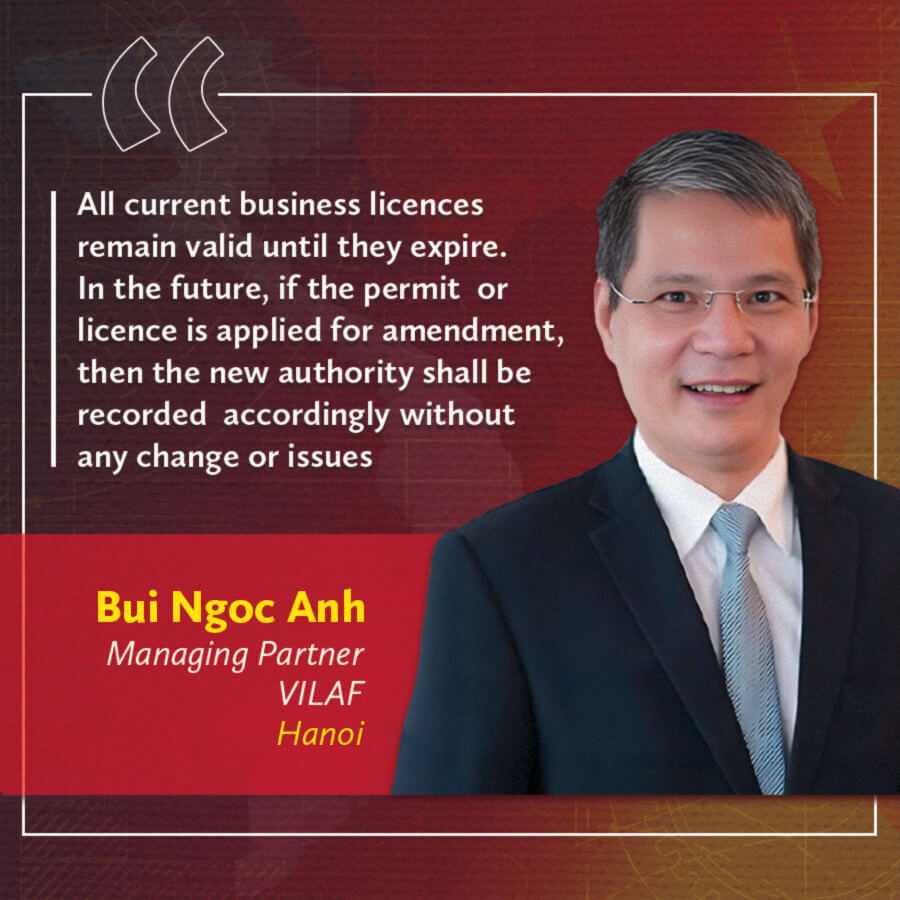
Bui Ngoc Anh, Hanoi managing partner at VILAF, echoes this belief: “It is expected that these policies shall result in much more efficiency in the government structure that facilitates business and social development in Vietnam, helping reduce the red tape and time-consuming procedures to investors.”
Experts point to clear advantages: streamlined procedures, reduced bureaucracy, efficient governance and a more business-friendly environment in Vietnam.
According to Oliver Massmann, a partner at Duane Morris, while businesses will face challenges during this transition, they will eventually enjoy a never before so friendly environment for investment.

Echoing this sentiment, Dinh Le, a partner at Herman Henry & Dominic, says that in the long term, “a leaner administrative system with fewer bureaucratic layers will significantly reduce bureaucracy, creating a more transparent and investor-friendly business environment”.
However, the path to greater efficiency is not without its challenges. As businesses navigate Vietnam’s sweeping government restructuring, they face significant hurdles, including the uncertainty surrounding their implementation.
You must be a
subscribersubscribersubscribersubscriber
to read this content, please
subscribesubscribesubscribesubscribe
today.
For group subscribers, please click here to access.
Interested in group subscription? Please contact us.
你需要登录去解锁本文内容。欢迎注册账号。如果想阅读月刊所有文章,欢迎成为我们的订阅会员成为我们的订阅会员。
RELATED ARTICLESMORE FROM AUTHOR



Vietnam Law Firm Awards
Asia Business Law Journal reveals the country’s top law firms