










A sluggish market and data regulation concerns are common culprits blamed for a spate of foreign law firms shutting up shop in China, but a few outliers have chosen to sail against the tide and expand their businesses. Maisy Mok reveals some distinctive traits that may have ignited the exodus of US firms
US law firms’ Chinese offices are toppling like a line of dominos. The unravelling became especially visible when Proskauer shut down its Beijing office in June 2023. This was a location it had maintained for 12 years. Following Proskauer’s move, both Latham & Watkins and Winston & Strawn also closed some of their China operations.
At least 10 prominent US law firms have bid farewell to their Greater China offices since June 2023. However, they have not been the sole actors of this show. UK-headquartered Evershed Sutherland announced this July its plan to close its Beijing office. Similarly, Linklaters, Ropes & Gray, and Baker McKenzie trimmed their China-based teams last year.
Among the law firms that made the tough decision to shut down, half chose to remain silent on their motives. The remaining firms attributed their exits to shifting client demands or a consolidation of work to other Asian offices.
Take Sidley Austin as an example: its Shanghai-based lawyers requested to relocate or retire, prompting the closure of the branch.
The prevailing notion suggests that a combination of a slow market and enduring geopolitical tensions between the US and China have dealt severe blows to these law firms.
While managing partners and partners interviewed by China Business Law Journal agree that these two factors hold weight, they point to a medley of other reasons behind the exodus, ranging from US-centric decision making and dwindling profit margins to the growing competition from Chinese peers.
At the end of the day, business is business and the law industry is no exception.
Seven years ago…
While recent downsizing has made a splash, numbers show that the departure of foreign firms from China is not a recent phenomenon. It dates back to when the Sino-US honeymoon started to go sour.
According to data from the Ministry of Justice, the gradual decline of foreign law firm offices began in 2017. At that time, there were 244 mainland branches operated by foreign law firms. During the covid period, between 2019 and 2021, the number dropped by 8%, from 225 to 208. From there, it went on to hit a five-year low in 2022, before a three-firm uptick in 2023 dragged the totals back to 2021 levels.
When asked why it has generally been US-headquartered law firms that have closed of late, Ray Liu, Dorsey’s Beijing managing partner, emphasised the undeniable dominance of US firms among foreign law firms operating in China.
In Beijing, there are currently 87 offices established by overseas and Hong Kong law firms. Nearly half of them (40 offices) are US firms, followed by UK firms and Hong Kong offices. A similar distribution is observed in Shanghai as well.
The late 1990s and early 2000s saw an influx of US firms and their clients to China. The country’s accession to the World Trade Organization in 2001 was a crucial step in igniting China-US bilateral relations.
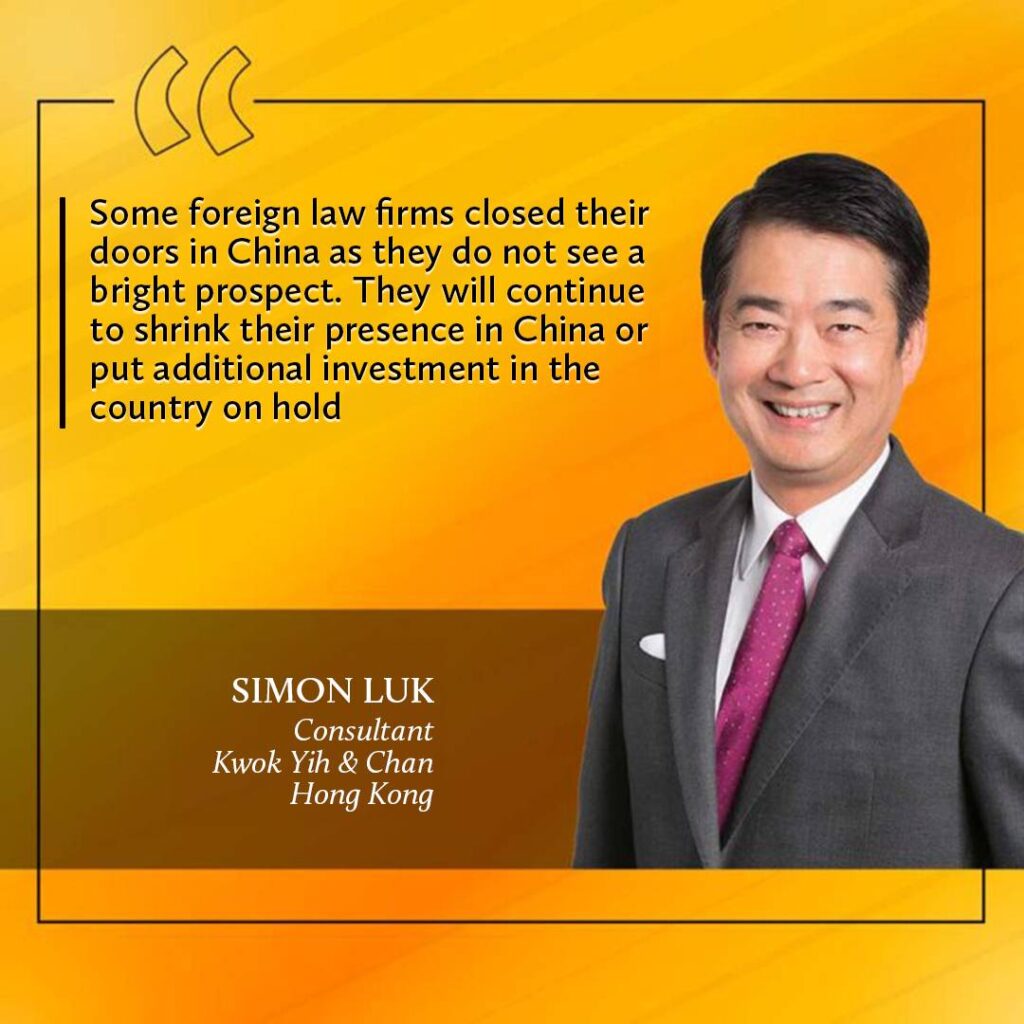
Simon Luk, a consultant at Hong Kong-based law firm Kwok Yih & Chan and former Asia practice chair of Winston & Strawn in Hong Kong, says the once blossoming “romance” between China and the US began to cool off with the onset of Donald Trump’s presidency in 2017.
Ensuing political and trade conflicts weighed on US law firms with offices in Hong Kong and the mainland.
“Major US law firms used to advise on a lot of US IPOs, but we’ve seen a reduced number … and many delistings over the years,” says Luk. “US investors and Chinese companies that want to debut in the US were discouraged by Washington DC’s additional scrutiny. Beijing has also tightened its regulations, which have led to US and European companies fleeing from China; the business environment has changed.”
Prominent foreign law firms departing from China in the past decade are predominantly US-based. For instance, in 2018, Atlanta-based Troutman Sanders pulled out of Hong Kong, Beijing and Shanghai, while Seattle-headquartered Davis Wright Tremaine closed its 24-year-old Shanghai office to focus on the US market.
In 2023, foreign investment in China hit a 30-year low, which stood at USD33 billion of inbound foreign direct investment in liabilities, according to Beijing’s State Administration of Foreign Exchange.
Some US firms have been rendered less resilient than their UK counterparts through a hyper-sensitivity to geopolitics and a unique positioning with their clientele.
Liu, of Dorsey, says the currently vast US domestic legal market has impacted the international strategic layout of US firms, making some rely strongly on the domestic market.
In contrast, UK law firms that are known for their international presence continue to seize cross-border business opportunities. “Certain UK law firms, such as the ‘Magic Circle’ firms, have expanded overseas over the past decades with spreading geographical presence and diverse practice portfolios,” says Liu.
He says US firms that remain in China are those that have been deeply cultivated in the Chinese and Asian markets for decades and are equipped to assist Chinese companies in their global endeavours.
“Taking Dorsey as an example, we have tailored our legal services to meet the needs of local clients. These proactive efforts have also been well received by clients.” But of course, he adds, each US firm’s global business plans and deployment varies.
Pullout to cut cost
Profitability is likely at the heart of the matter. Eventually, certain US firms come to decide that, in a harsh economic climate, diminishing returns in China no longer align with their risk appetite. There is a shared sentiment among several lawyers when discussing the closure of offices: law firms are businesses, after all.
A partner who requests anonymity and works in a law firm that closed an office in China says: “US firms are constantly looking for areas in which they can cut expenses, where practices look more and more like cost centres. China headcount, because of the drying up of M&A work and apparent increased risk profiles, is becoming something that a lot of whoppers have decided to cut or reduce.”
Two traits common among some US law firms are maximising profits per partner and a single-minded focus on cases that generate substantial profits upfront. This often leads to them turning away clients seeking counsel in areas such as trademarks, labour and employment, patent prosecution and immigration.
The unnamed partner says many practices “that are potentially important to some of their clients end up going by the wayside. You can’t bill out standard trademark work at USD1,600 an hour, can you?”

A former Herbert Smith Freehills Beijing managing partner, Tom Chau, now a Hong Kong-based partner at Haiwen & Partners, says Chinese clients looking for services in the capital market and non-dispute services are not as willing as European and US clients to splurge on legal services.
“If law firms offer the same services in the US and China, the fees in China are lower and the profit margin isn’t able to sustain operations. Therefore, managing partners will consider leaving this market and focusing on another,” says Chau.
He says foreign law firms could take just two to three months to close their doors in China if they project that business will not revert in half a year.
The difficulty in finding profitable partners who can bring “a meaningful book of business” has pushed one law firm to close its office in China. “I would say you have a demonstrable book of business in excess of USD1 million in revenue a year,” says an unnamed partner from the firm. “That’s not big, just okay. There are not a lot of candidates out there that fit that bill.”
The unnamed partner says currently thriving firms have a strategic commitment to the Chinese market and offer diversified services. Foreign law firms that can help clients deal with operational risk and changes in the current environment are better positioned to weather the storm.
Ray Liu, of Dorsey, agrees China’s legal market has undergone rapid transformations. Law firms that have focused on traditional industries such as real estate, capital market, M&A and PE/VC have experienced market turbulence and adjustment.
Nevertheless, the demand for services such as dispute resolution, bankruptcy and restructuring, intellectual property, cybersecurity and data privacy is high, he adds. Industries such as new energy, new materials, smart manufacturing, AI, life sciences and pharma are thriving.

“Under the drastic change in the legal market, the ‘2-8 principle’ will be further accentuated,” he says. “The 20% of law firms that have proactively and strategically planned in advance, offered diversified services, and adapted to new legal service demands along with the market recalibration can capture 80% of the market opportunities.”
You must be a
subscribersubscribersubscribersubscriber
to read this content, please
subscribesubscribesubscribesubscribe
today.
For group subscribers, please click here to access.
Interested in group subscription? Please contact us.
你需要登录去解锁本文内容。欢迎注册账号。如果想阅读月刊所有文章,欢迎成为我们的订阅会员成为我们的订阅会员。