









Against the backdrop of rising international disputes involving PRC companies, Singapore’s dispute resolution authorities spoke of the role the Lion City’s legal sector will play in resolving contentious matters.
Ministerial authorities and the heads of dispute resolution centres shared their thoughts during the opening ceremony of Rajah & Tann’s Shenzhen office on 25 November.
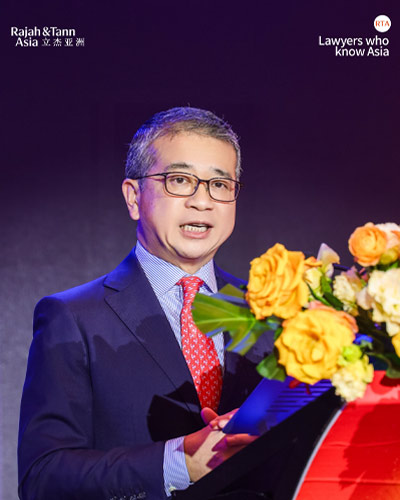
Singapore’s Minister for Culture, Community and Youth and Second Minister for Law
Edwin Tong, Singapore’s Minister for Culture, Community, and Youth and Second Minister for Law, said Sino-Singapore trade had always been high on the Lion City’s agenda, as China and Asean had been each other’s largest trading partners for many years.
“The geopolitical tensions around the world have cost countries, large countries, large corporates to look inward, to be protective, to be focused on bilateral relations rather than the multilateral,” Tong said. “So, I hope that the focus for China, Asean and Singapore … can play a part in opening up the trade lines.”
Despite the clouded global political climate, Chinese companies remain enthusiastic about expanding abroad after the pandemic, but this opens the door to more cross-border disputes. Gloria Lim, CEO of the Singapore International Arbitration Centre, said more than 90% of the arbitration cases that the SIAC handled were international. Most of the parties in the past decade were from the UK, mainland China, Hong Kong and India.
SIAC data in 2023, revealed that the centre’s top foreign users were Hong Kong, mainland China and India. Among them, mainland China ranked second with 851 parties involved, five times more than India.
“The challenge is not so much in preventing the dispute but how you can manage them,” said Tong. “For us in Singapore, our approach has always been to give parties as many choices as possible. Parties can choose to go to a high court, for example, the Singapore International Commercial Court for international commercial disputes, or they can choose arbitration, mediation or conciliation, or they can choose a variety of different mechanisms to resolve their disputes.”
In addition to arbitration, Singapore has been actively developing mediation as a dispute resolution tool in recent years. The Singapore International Mediation Centre (SIMC) has maintained close ties with the China Council for the Promotion of International Trade and has been promoting mediation in mainland China.
This year marks the SIMC’s 10th anniversary, with the number of cases it has handled surging from two in its first year to 890 last year, most of which have been cross-border cases.
SIMC’s CEO Chuan Wee Meng said, “Over the last 10 years, what we’ve seen is a growing interest in mediation as a way to complement and supplement litigation and arbitration. I want to be clear that mediation is not here to replace arbitration and certainly not here to replace litigation … it’s a way in which we can preserve relationships.”
As China plays an increasingly important role in Singapore’s dispute resolution business, Charlene Chang, Singapore’s Deputy Secretary of the Ministry of Law, welcomed Chinese arbitration organisations to set up offices in the Lion City.
Chang added that Singapore has been developing its dispute-resolution ecosystem in a three-part approach: over-, business- and future-oriented. For example, the country now allows foreign counsel to directly represent clients in arbitration without needing to partner with a Singapore practising lawyer.
The event’s focus was to celebrate the Shenzhen office opening of Rajah & Tann, which is one of Singapore’s Big Four law firms. It had also obtained the mainland’s stamp of approval to establish an office in Qianhai in July this year.
The firm’s managing partner, Patrick Ang, said Shenzhen was a digital and green economy hub, with young and innovative talents that could bring advanced technology to the world. The Qianhai office would help clients to seize international opportunities and expand their businesses beyond China, he added.
In contrast to the exodus of US law firms, Singapore’s top counterparts have shown confidence in the Chinese market this year. Aside from Rajah & Tann, Allen & Gledhill established a representative office in Shanghai in February, marking its first expansion outside Southeast Asia.
READ MORE
Singapore, China officials at launch of A&G’s Shanghai office
Allen & Gledhill (A&G) has officially launched a representative office in Shanghai, marking the Singapore firm’s first overseas presence outside Southeast Asia

Rajah & Tann to open Shenzhen office in Q4
Singapore’s Rajah & Tann, one of the big four law firms, is expanding into China after 21 years, opening a new office in Qianhai, Shenzhen, in the fourth quarter of this year

For more stories about China’s legal market, visit law.asia.