









As the EU rolls out its strictest product safety rules, Mah Soon Sin, the head of legal for product compliance, IP rights and marketing for the US and Latin America at Alibaba’s international e-commerce platform, AliExpress, decodes the new regime for exporters accessing the European market
THE EU’S General Product Safety Regulation (GPSR), which entered into full force on 13 December 2024, is being described as the sibling legislation to the General Data Protection Regulation (GDPR). Both regulations share a common purpose of safeguarding fundamental EU consumer rights, with the GDPR focusing on personal data protection while the GPSR ensures the safety of consumer goods.
Scope of regulation
The implementation of the GPSR marks the official replacement and repeal of the EU’s 2001 General Product Safety Directive (GPSD). Beyond updating two decades of product safety governance, the regulation introduces a fundamental change by elevating the legal instrument from a “directive” to a “regulation” under EU law.
A directive merely requires EU member states to achieve specified objectives while granting flexibility in how to implement them, allowing nations to determine their own legislative approaches. A regulation, by contrast, is a binding legislative act that must be applied across all member states.
This shift demonstrates the European Commission’s determination to standardise product safety requirements through the GPSR, reflecting its heightened commitment to safeguarding both EU consumer safety and the integrity of goods.
The GPSR applies to most non-food consumer products sold in the EU and Northern Ireland markets, including but not limited to electronic devices, electronic products, garments, textiles, footwear, toys, children’s products, furniture and home furnishings. The regulation explicitly excludes medicinal products (either for human or veterinary use), food, animal feed, living plants and animals and their derivatives, antiques and aircraft components.
The GPSR applies equally to online and offline sales, encompassing new, used, repaired, reconditioned or second-hand goods without exception.
Under the Northern Ireland Protocol, while Northern Ireland left the EU alongside the rest of the UK, it must continue applying EU rules on agricultural and manufactured goods to preserve the Good Friday Agreement and maintain regional peace and stability.
Export compliance
Chinese manufacturers producing goods destined for the EU and Northern Ireland markets must comply with the GPSR requirements. The author’s analysis indicates that the regulation also extends to virtual products such as prepaid cards and gaming credits sold in the EU.
According to China’s 2024 Statistical Communique on National Economic and Social Development, released by the National Bureau of Statistics on 28 February 2025, China’s goods exports to the EU reached RMB3.67 trillion (USD511.9 billion) last year, making the bloc China’s third-largest export destination after Asean and the US.
The figure represents 14.4% of China’s total exports, marking 4.3% year-on-year growth. These figures underscore how crucial GPSR compliance has become for Chinese exporters.
The GPSR clearly delineates the roles, responsibilities and obligations for various market participants, with the heaviest compliance burden falling on “economic operators” – including manufacturers (whether EU-based or not, covering Chinese companies), authorised representatives, importers introducing products to the EU market, distributors (wholesalers and retailers), and fulfilment service providers, such as logistic service providers.
Manufacturers without an EU establishment, such as Chinese companies, must appoint an EU-based authorised representative (the EU representative) registered within the EU to meet the GPSR requirements.
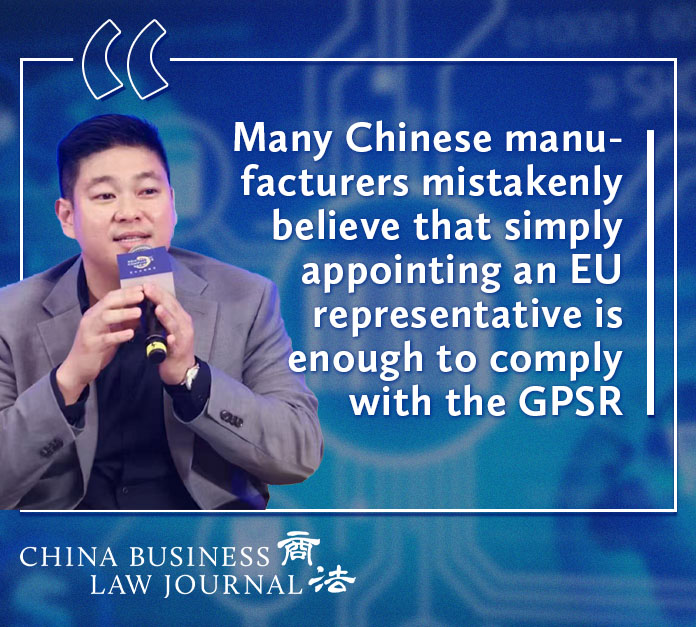
Many Chinese manufacturers mistakenly believe that simply appointing an EU representative is enough to comply with the GPSR. This is a serious misconception, as the regulation imposes stringent obligations on economic operators, particularly manufacturers.
Under the GPSR, manufacturers must conduct thorough risk assessments, prepare and maintain comprehensive technical documentation before placing goods on the EU market, and retain such technical documentation for at least 10 years for auditing by EU authorities.
Manufacturers must ensure their products are fully traceable, with clear and easily visible markings that include the company name, trademark, contact details, as well as the product model, batch or serial number on the physical goods.
Where the product’s size or nature makes direct marking impractical, this information must instead appear on the packaging or in accompanying documentation. All Chinese manufacturers exporting goods to the EU must comply with these requirements.
The regulation further mandates that products must provide clear instructions and safety information in easily understandable language for consumers. This presents significant challenges for manufacturers, as products destined for markets such as Spain, France, Poland or Germany also require local language adaptation, where few consumers’ native tongue is English.
You must be a
subscribersubscribersubscribersubscriber
to read this content, please
subscribesubscribesubscribesubscribe
today.
For group subscribers, please click here to access.
Interested in group subscription? Please contact us.
你需要登录去解锁本文内容。欢迎注册账号。如果想阅读月刊所有文章,欢迎成为我们的订阅会员成为我们的订阅会员。