









Leadership transitions in Indonesia are painfully slow and fraught with dissent and uncertainty, so why was this year’s election different? Lawyers in Jakarta give John Church their assessments on political shifts, and legal and business expectations going forward
Months on from a decisive 14 February election result to end the tenure of popular incumbent President Joko Widodo, Indonesia finds itself on the verge of fundamental shifts in its political agenda, but not for the reasons one may expect.
Yes, the world’s fourth most populous nation still buckles under the weight of hefty corruption (scoring a dismal 34 out of 100 on Transparency International’s Corruption Perceptions Index for 2023).
Yes, claims of vote buying and political nepotism are rife, including concerns that Vice President-elect Gibran Rakabuming Raka is inappropriate as the son of Widodo (or Jokowi, as he is popularly known). Recent protests in Jakarta have surrounded another of his sons running in November’s local elections.
But a reforming economic landscape is drawing international interest and, in Jakarta, law firms are discussing this year’s elections with a guarded optimism rarely seen during the lengthy and drawn- out process of transferring a new leader to power.
Widodo has adeptly reformed archaic laws on foreign ownership through his much-vaunted Omnibus Law, and at the same time fostered moves towards local ownership of manufacturing and processing beyond exports of raw materials, particularly in the mining of nickel and other more sought-after minerals. Online processing for licensing and registration of everything from businesses to project approvals to visas is speeding up what were often arcane and corrupt processes.
A functioning MRT system is a reality and growing in Jakarta, providing hope for a reprieve from the infamously gridlocked road system. And the pipe dream of a new capital has taken a firm footing, although the transfer of top-tier administration slated for an independence day inauguration pronouncement on 17 August, from the new presidential palace at Nusantara, on the eastern coast of Borneo, was toned down to a more sedate ceremony.
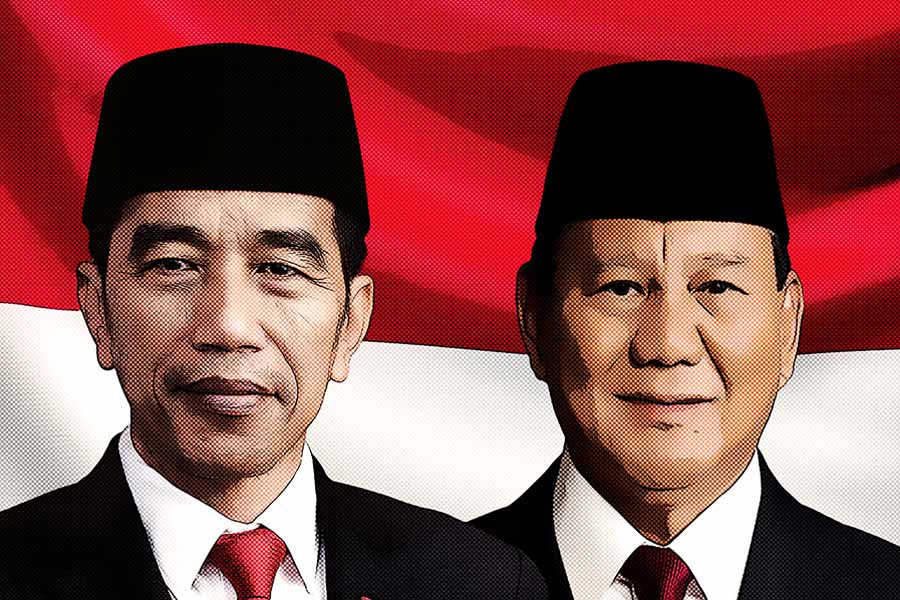
But the fundamental shifts that lawyers are quick to point out come in the form of an incoming regime that isn’t trumpeting new ideas to sweep away previous policies, as per the norm. President-elect Prabowo Subianto has instead vowed to continue Widodo’s reforms, a strategy largely cited for Prabowo’s success at the poll. The February election result was followed by Constitutional Court vindication in April and will culminate on 20 October with the swearing in of Prabowo, following which a cabinet will be formed.
The long wait is attributed to past experiences of time required after the vote for inevitable protests and court challenges regarding the result itself. It has almost always been a certainty that a runoff vote is required when the candidates do not accrue enough votes to rule in a majority (50%+1 of the total popular vote). This was factored into a second round scheduled for 26 June, which of course did not occur, such was the success of the winning ticket.
“On 20 October the new president is sworn in, followed by the president appointing his cabinet,” explains Eko Basyuni, a partner at Assegaf Hamzah & Partners. “In the meantime, we have a lame duck period where we have a president-elect waiting to be sworn in but still have the current administration who is waiting to finish the term.
“Traditionally, it is the period where the cabinet and the government do not take on new strategic policies. They will continue with what they have decided previously, and no drastic changes should be expected.”
Luky Walalangi, managing partner at Walalangi & Partners, says the past decade with Jokowi at the helm has been consistent in liberating foreign investment and opening up previous restrictions. “For example, opening logistics for foreign-invested hospitals – in the previous regime this was restricted,” he says. “And introducing the Omnibus Law has helped improve consistency between one regulation and another.
“Having [Widodo’s] son as VP gives a strong message to business that nothing will change. Prabowo will continue the policies of Mr Jokowi, including the new capital plan. I think from the perspective of regulation, at least for the next two years, no significant changes will come.
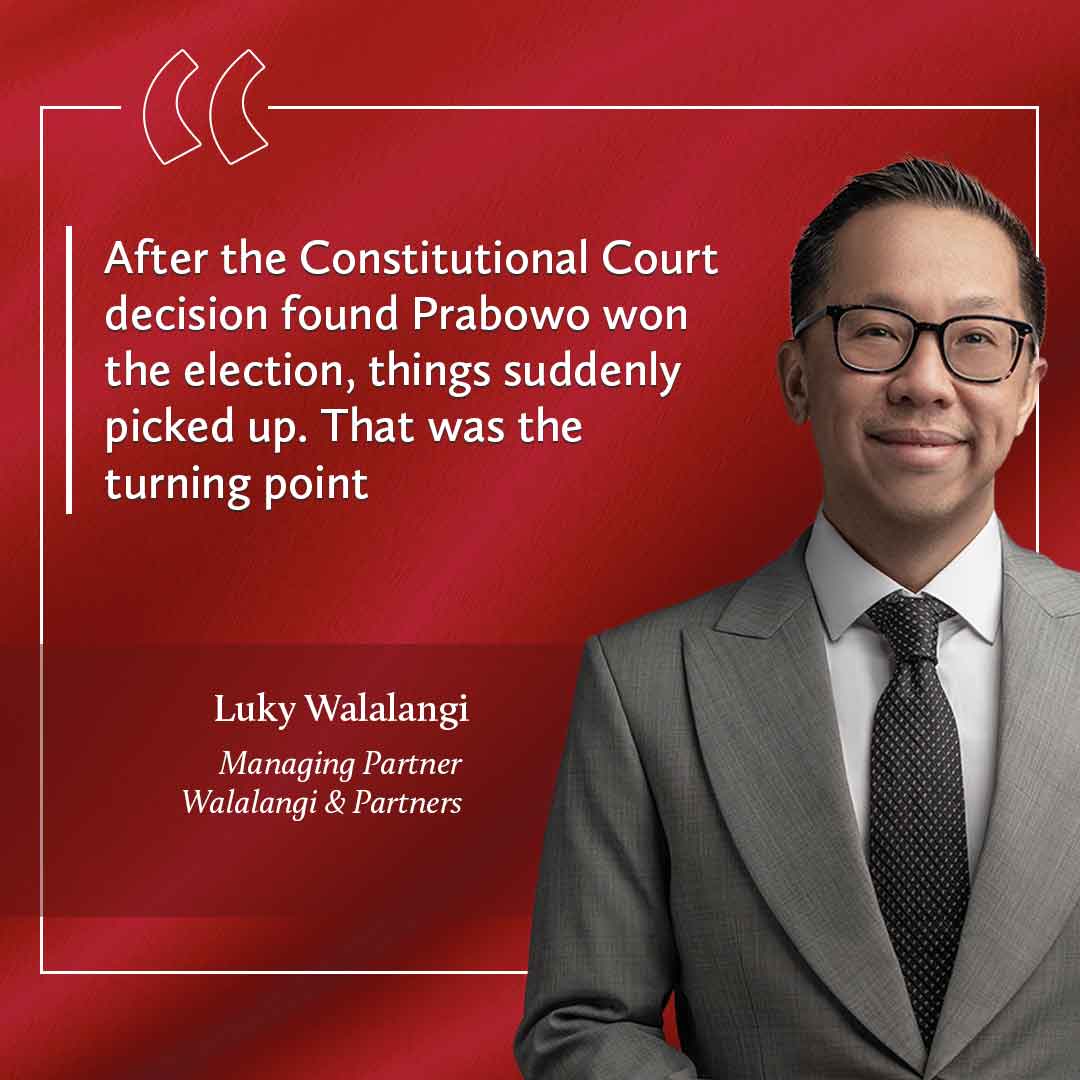
“Prabowo is supported by all the major parties except for the PDI-P, so we expect to have a status quo of quiet politics, which is very good news for our investors, because one of the main concerns of our clients is political stability. In the next two years we have a very stable situation.”
He adds, “After the Constitutional Court decision found Prabowo won the election, things suddenly picked up. That was the turning point.”
The PDI-P, or Partai Demokrasi Indonesia Perjuangan (Indonesian Democratic Party of Struggle), is led by former president Megawati Sukarnoputri and holds more seats in parliament than any other party. It has not yet pledged support for Prabowo, but negotiations on new cabinet positions will undoubtedly factor into whether this changes. Negotiations have been known to continue right up until the day the new president is sworn in.
Prabowo has already aligned a coalition capable of governing without the PDI-P. Losing at the polls is not necessarily a bad result in Indonesia if you can bargain your way into power with your numbers and support. This, in turn, bolsters Indonesia’s multi-partied version of democracy, but Prabowo’s strong win (the highest of any candidate in a democratic election in Indonesia), coming on top of his predecessor’s unprecedented popularity, has set the stage for something new – continuity. Most notably, this phenomenon takes some of the “lame” out of the duck during this transition year.
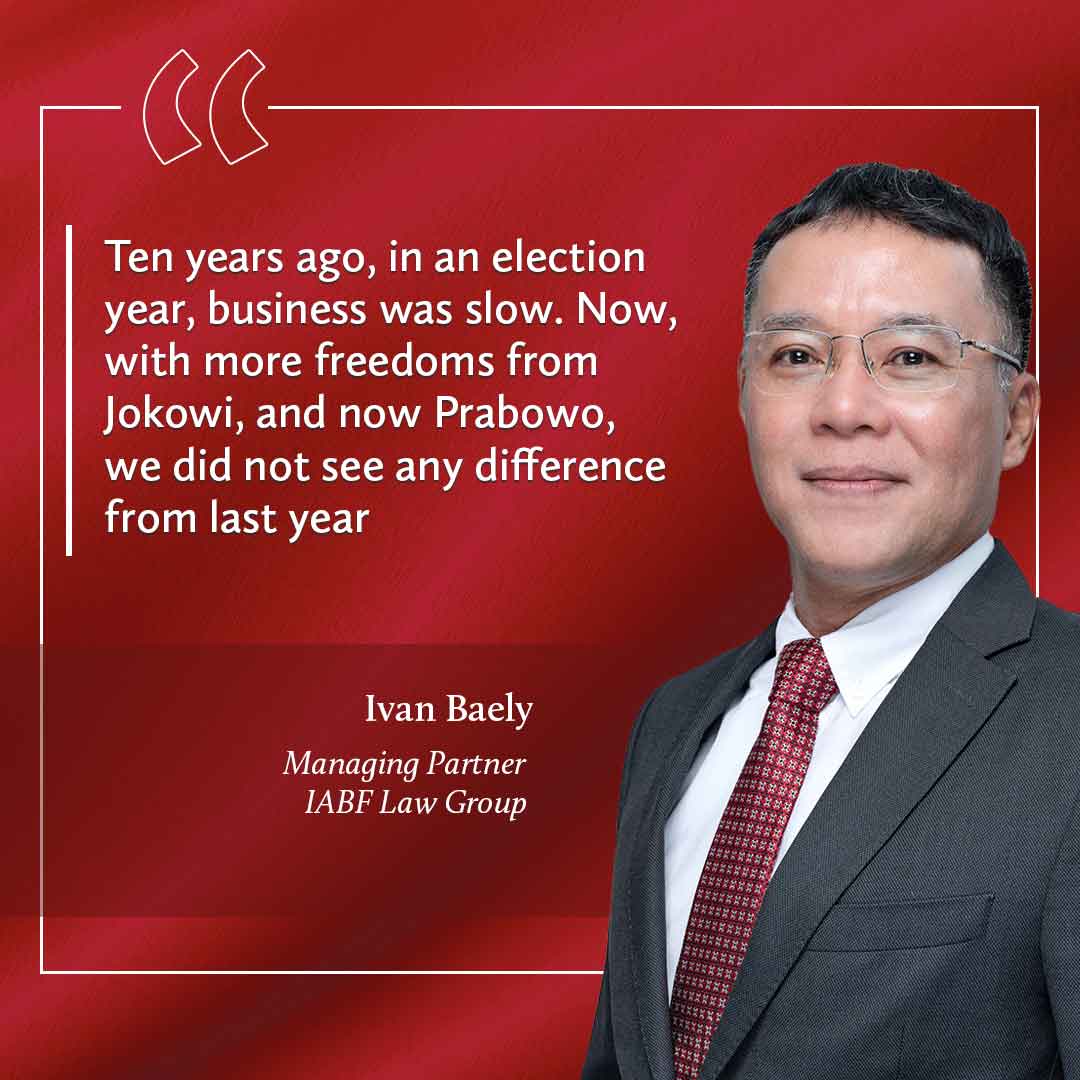
“In legal practice it is business as usual,” says IABF managing partner Ivan Baely. “Ten years ago, in an election year, business was slow. Now, with more freedoms from Jokowi, and now Prabowo, we did not see any difference from last year.
“What’s keeping us busy is quite a lot of state-owned companies. Now we are in transition – all their projects and national projects, they want to complete before the handover in October, so they want them complete by September.”
Adds Rio Lassatrio, managing partner at LHBM, “The last three to six months, the business of finding out who will be the next president has passed. Even in terms of business we have had ongoing tenders postponed because they don’t want to process tenders in the midst of an election, even though it is not related, but politically they don’t want this to be interrupted by the process.
“Now we have clarity and in terms of who’s going to run the country for the next five years and the tenders are slowly moving on again, progressing with the new prospects of five years. It’s a good thing. Business is running.”

ATD Law managing partner Abi Abadi Tisnadisastra says that, regardless of the winner, the good news is the president-elect has committed to policies of the existing regime. From a stability perspective the result is the best of all possibilities for Indonesia.
“We are aware that in certain situations, when there’s a new government, especially when it comes from the opposing parties, policies and all the [previous government’s] decisions will go the other way. But hopefully, again with the commitment of the president-elect, we’ll see a stable transition,” he says.
“For foreign investors, there is always concern, and wait and see, with every election. They want to observe and understand the situation.”
Turangga Harlin, managing partner at MHMS Advocates, adds, “I don’t expect a lot of changes and I believe this is a good thing. Jokowi is well liked and even the political parties supporting Prabowo still want this continuity to happen. Clients do not expect a lot of changes either. It’s all about continuity, and that’s what we are facing now.”
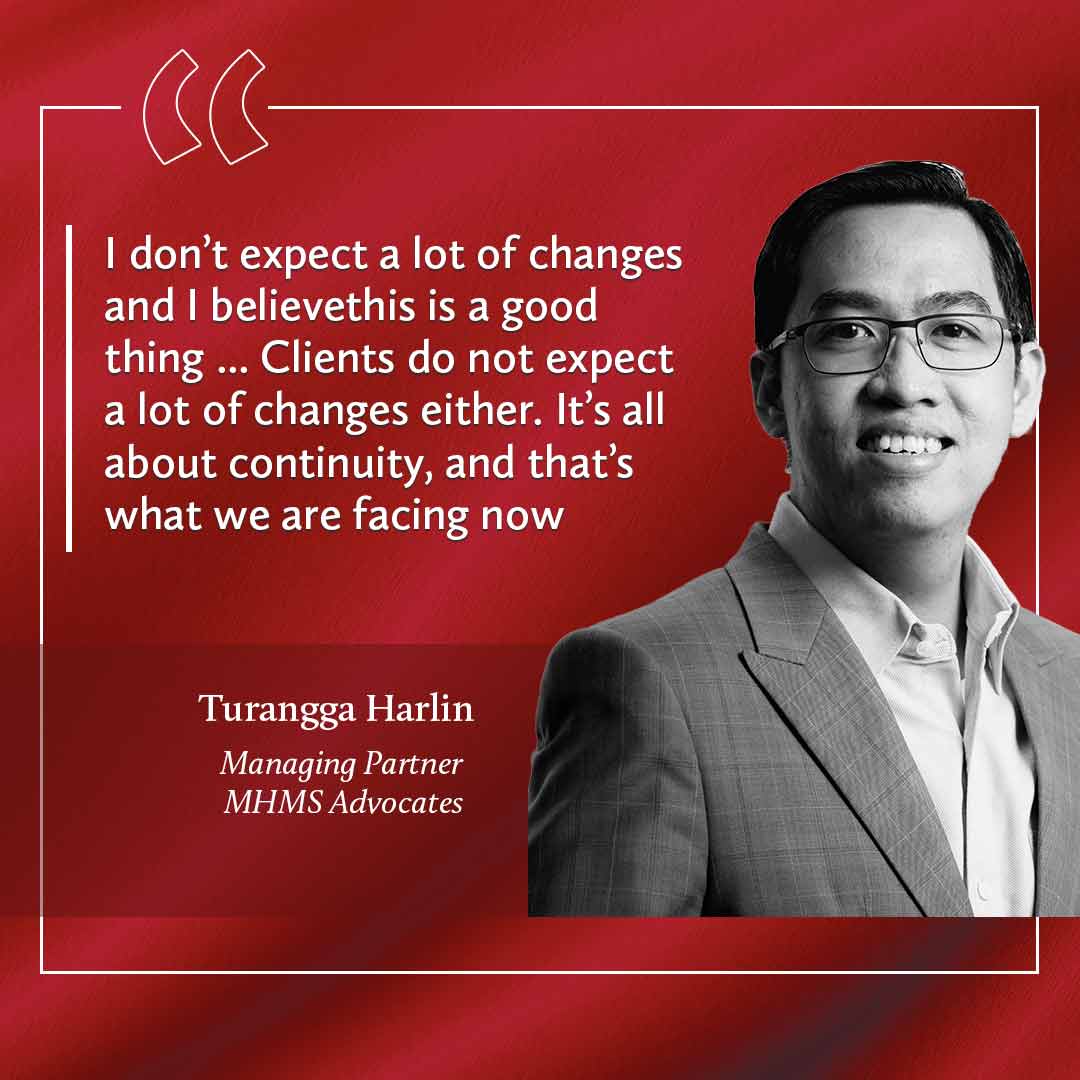
Harlin also points to massive regional elections for Indonesia, from September to November, smack-bang in the period of change to a new federal government. “So people are talking about who will be the next governor of Jakarta. Political parties will inject a lot of time into this. Passing laws or amendments will not be on top of their agenda. Now for the coming months the countdown is on. Thirty-seven provinces and governors, hundreds of regencies and regents – this is very big as well.”
Giffy Pardede, a partner at AGI Legal, notes, “Local government is truly important when we talk about large-scale projects in any of the regions. Some things, not as many, are still subject to regional [government and parliament] control, so it makes sense if you have a certain project in an area that is about to have a change in [local] leadership, you want to wait and meet with them. The change in the top leadership of the country doesn’t change the concept of ‘local kings’, who may have more direct authority on the details of regional rules and policies.”
You must be a
subscribersubscribersubscribersubscriber
to read this content, please
subscribesubscribesubscribesubscribe
today.
For group subscribers, please click here to access.
Interested in group subscription? Please contact us.
你需要登录去解锁本文内容。欢迎注册账号。如果想阅读月刊所有文章,欢迎成为我们的订阅会员成为我们的订阅会员。
RELATED ARTICLESMORE FROM AUTHOR

Indonesia Law Firm Awards 2025
Asia Business Law Journal names the country’s top law firms

Indonesia’s top lawyers
We reveal our choices for the nation’s top lawyers and also the top Legal Icons in Indonesia

Indonesia Law Firm Awards 2024
Asia Business Law Journal names the country’s top law firms