










As Hong Kong’s capital markets regain momentum, companies face a reshaped fundraising landscape. With renewed liquidity comes fresh opportunities and new rules of engagement for capital-hungry firms. Sophie Cheng reports
In the past year, the initial public offering (IPO) markets in Hong Kong, the US and mainland China have told a tale of mixed fortunes. Benefiting from policy tailwinds and market conditions, a surge of A-share listed companies seeking a dual listing status in Hong Kong, mainly featuring hard tech and new quality productive forces, has carved out a window of opportunities for Hong Kong’s capital market.
Meanwhile, mainland companies eyeing US listings continue to find niche opportunities amid geopolitical headwinds in specialised sectors, although multidimensional challenges still loom. The persistently sluggish mainland IPO market mirrors a regulatory environment of “tightened oversight, enhanced compliance and performance-driven scrutiny”, underscoring a paradigm shift towards quality and sustainable development for listed companies.
With the implementation of the filing-based system for overseas listings of domestic enterprises, companies must now have a deep grasp of the evolving review processes and underlying regulatory logic for listings in Hong Kong and the US to improve their chances of getting filings approved. The cooling frenzy around the innovative capital vehicles represented by special purpose acquisition companies (SPACs) is also prompting IPO candidates to adopt a more prudent approach.
Hong Kong boom
This year, Hong Kong’s IPO market has staged a long-awaited and remarkable resurgence, with a vibrant scene of numerous issuers vying for prominence. In May, Chinese electric vehicle battery maker CATL made a stellar debut on the Hong Kong bourse as the year’s largest IPO worldwide by size, adding a bold stroke to this capital market revival.
In the first four months this year, 116 listing applications were filed with the Hong Kong Exchanges and Clearing (HKEX), up from 89 listing applications submitted during the same period last year. Among these filings, Ronny Chow, a partner and head of the corporate finance practice group at Deacons in Hong Kong, has noticed a higher proportion of first-time applications (versus refiling after the initial listing application has lapsed), as compared to the same period last year.
Mainland companies remain the dominant force in the Hong Kong IPO landscape. Nan Li, the managing partner of Tian Yuan Law Firm’s Hong Kong office, highlights a defining feature that sets the current boom apart from all previous ones: China’s top-tier innovators are no longer “crossing the river by feeling the stones laid by the US”.
“Unlike the era of ‘copy from the US’, ‘me too’ or ‘me better’ strategies that defined past generations of followers, this time it is a China-led story where Chinese enterprises are driving global technological advancement and innovation,” says Li.
A trend of A-share companies seeking an A+H dual listing in Hong Kong has also become obvious. As of 30 April this year, there were a total of 25 active A+H listing applications, compared to only three as of 31 December 2024.
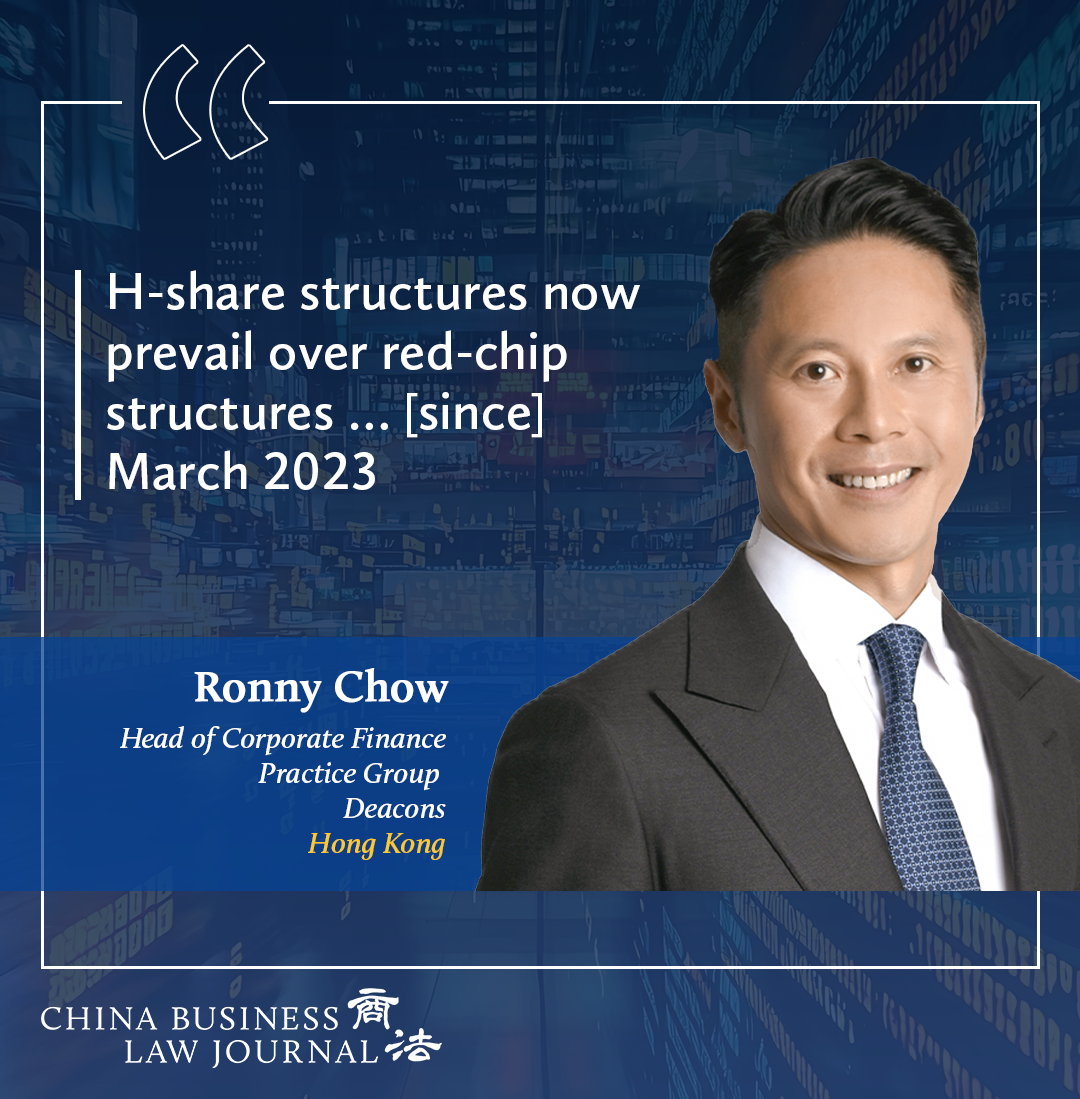
“H-share structures now prevail over red-chip structures following the implementation of the new filing regime introduced by the China Securities Regulatory Commission (CSRC) in March 2023, which is applicable to all companies with principal operations in mainland China,” says Chow. “Red-chip structures are mostly confined to companies that had their offshore ownership arrangements in place prior to 2023.”
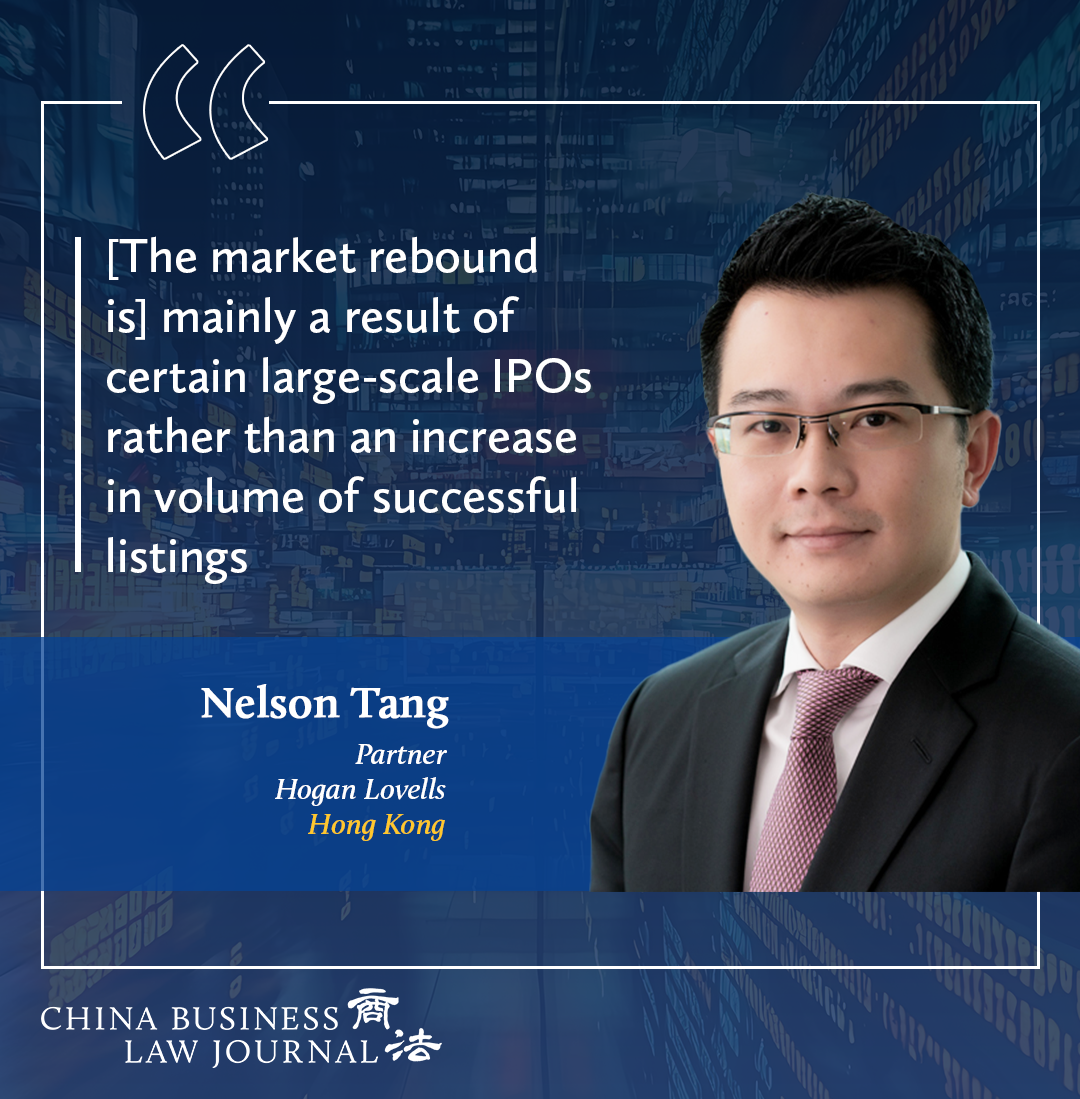
Yet, Nelson Tang, a partner at Hogan Lovells based in Hong Kong, cautiously attributes this rebound to “mainly a result of certain large-scale IPOs rather than an increase in volume of successful listings, indicating a concentration of capital in fewer, larger deals”.
In terms of sector distribution, Tang has seen increasing interest from investors in artificial intelligence, advanced technologies, energy and the consumer industry, while Chow observes that based on the current pipeline, the market focus includes AI, IT solutions, semiconductors, electric vehicles, smart charging, biotech, healthcare and consumer markets adopting “omnichannel+” models.
The resurgence of Hong Kong’s IPO market is underpinned by bold policy incentives from mainland and Hong Kong financial regulators in recent years. In April 2024, the CSRC introduced five measures to strengthen capital market co-operation with Hong Kong, supporting leading mainland enterprises in pursuit of Hong Kong floats.
This was followed by the joint statement on the enhanced timeframe for the new listing application process from the Securities and Futures Commission (SFC) of Hong Kong and the HKEX in October, establishing a “fast-track review channel” for qualified A-share companies valued at more than HKD10 billion (USD1.3 billion).
According to Guo Xiaodan, an equity partner at Zhong Lun Law Firm in Shenzhen, under these supportive policies, the filing cycle for companies meeting the criteria of market capitalisation of more than HKD10 billion with complete compliance records can now be shortened to 65 business days.
Since March 2023, when the HKEX unveiled a listing regime for specialist technology companies which encompasses AI, semiconductors, new energy and other hard tech sectors, Guo has observed a clustering effect among tech enterprises on a significant scale.
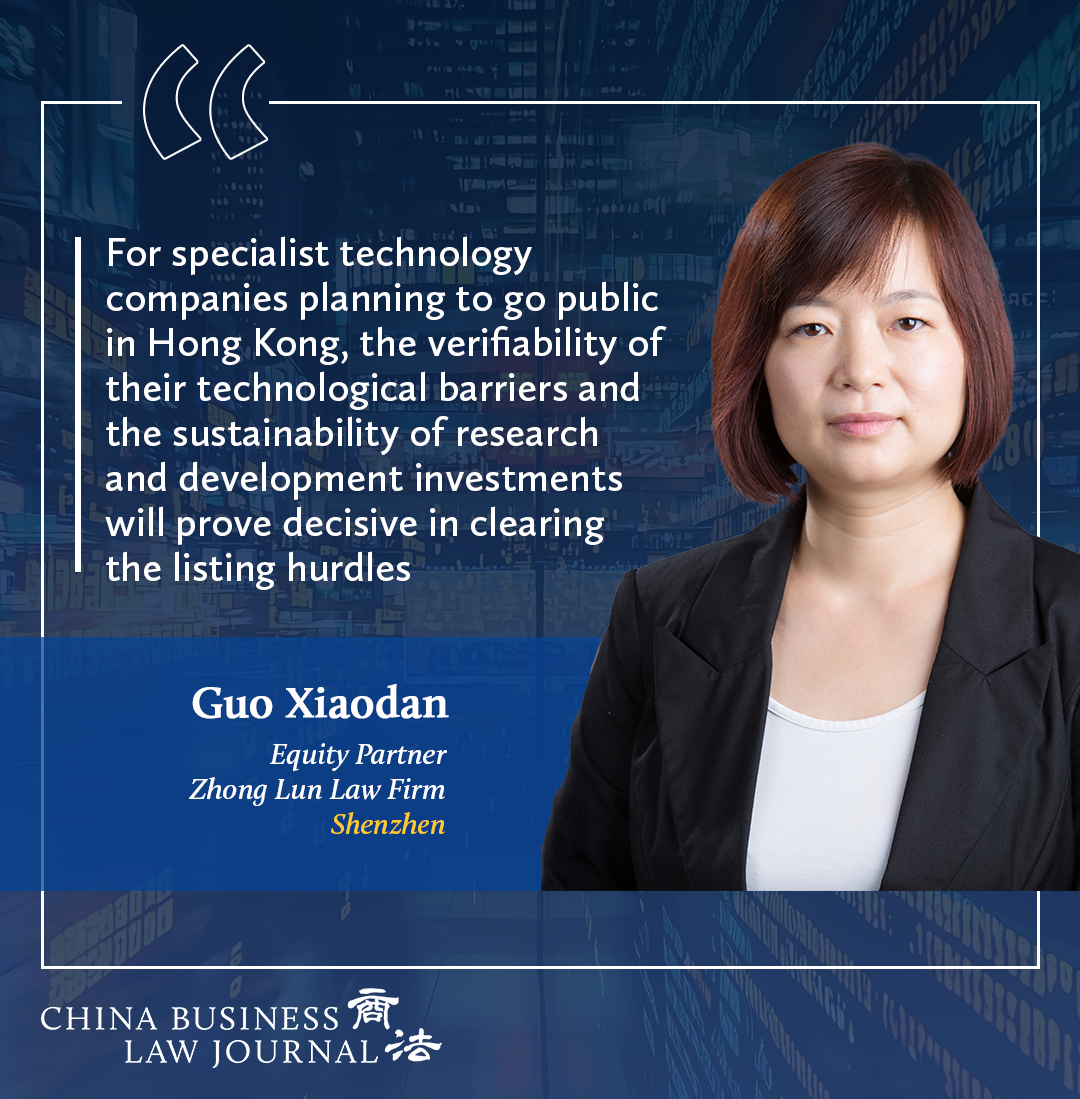
“Recent cases demonstrate the HKEX’s strategic pivot from being a ‘rule follower’ to a ‘system innovator’ in vying to become the premier listing destination for global hard tech firms,” she says. “For specialist technology companies planning to go public in Hong Kong, the verifiability of their technological barriers and the sustainability of research and development investments will prove decisive in clearing the listing hurdles.”
This May, the SFC and HKEX jointly launched the Technology Enterprises Channel, designed to streamline the listing process for specialist technology and biotech companies. They also introduced a new confidential filing option for these companies.
Chow explains that the publication of draft listing documents at the time of application may result in premature and prolonged disclosure of information on their operational strategies and proprietary technologies in view of the nature of their businesses and industries.
Dubbed by the market as the “first AI Agent IPO”, Yunji Technology filed a fresh application for a Hong Kong listing in March this year. Li, who helms the legal team that leads the drafting of the prospectus, notes that the filing immediately drew significant attention and inquiries from market practitioners.

“Based on the projects we are currently handling and our observations of similar cases in the market, we have compelling reasons to believe that a sizeable robotics and AI agent sector will emerge in the Hong Kong market within the next 12 to 18 months,” says Li. “This is expected to exert a strong gravitational pull on both domestic and global capital. IPO candidates should accelerate their pace to seize this once in a five-to-10-year window of opportunity for the Hong Kong IPO boom.”
Xu Ying, a founding partner at Jia Yuan Law Offices’ Hong Kong branch, echoes this sentiment. Last September, Jia Yuan advised Midea Group’s Hong Kong listing, the city’s largest in three years. “It is Midea’s debut that marked the turning point in Hong Kong’s IPO resurgence,” says Xu. His team’s recent mandates, including IPO preparations for consumer giants, such as Foshan Haitian Flavouring & Food, Eastroc Beverage and Bama Tea, reinforce his conviction that industry leaders in consumer and tech sectors are highly favoured by the capital market.
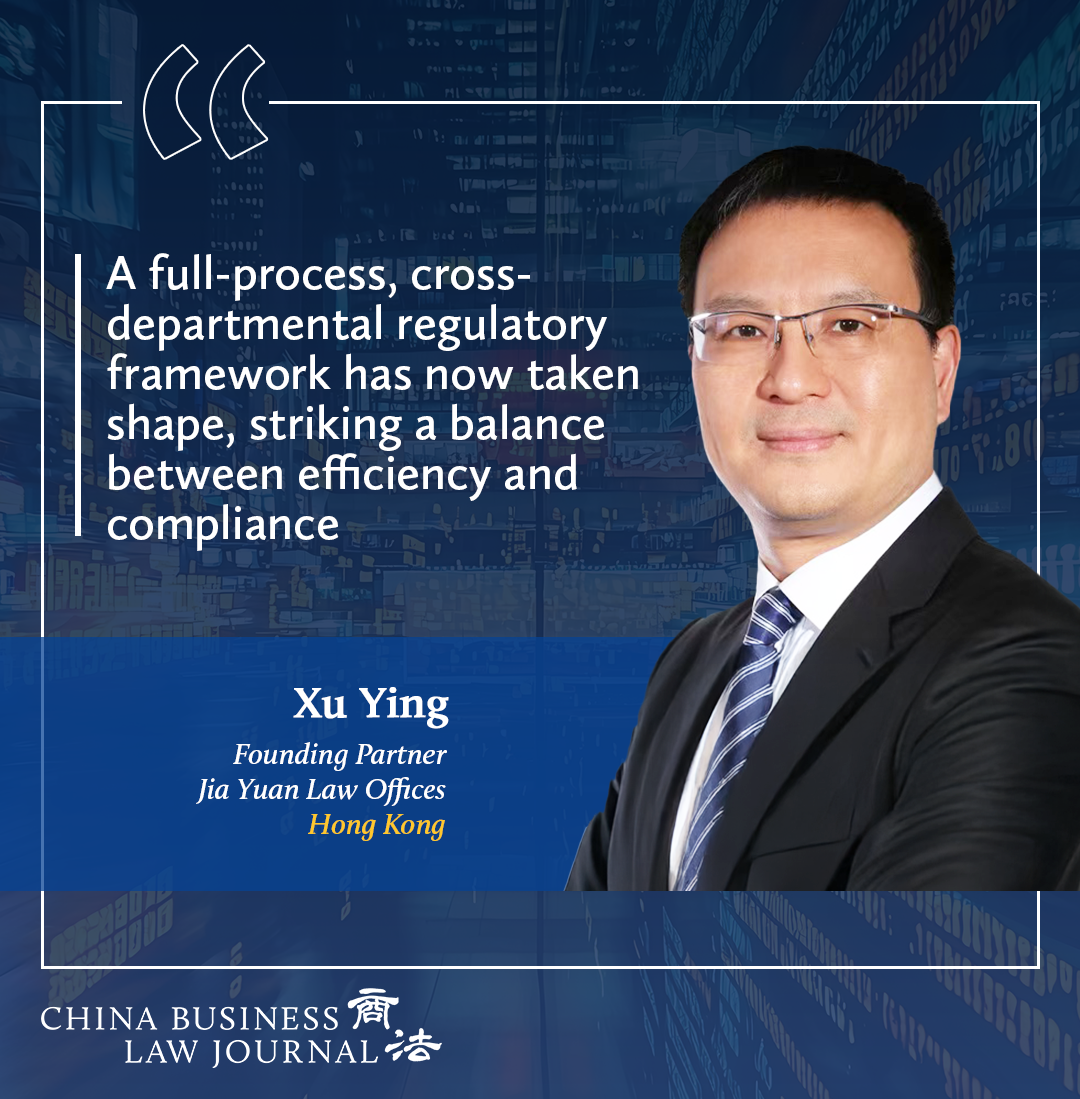
“As mainland enterprises advance global expansion, Hong Kong is solidifying its role as a key platform for industry leaders to raise capital and ramp up overseas presence,” says Xu. “This trend is poised to drive and sustain market vitality for years to come.”
Following the implementation of the enhanced timeframe for the new listing applications, Chow notes that the vetting process has generally accelerated. However, against the backdrop of global economic uncertainties and geopolitical tensions, Tang advises companies to carefully assess their readiness and compliance with Hong Kong’s listing requirements, given the evolving nature of such requirements.
He recommends early engagement and consultation with sponsors, legal advisers and reporting accountants so that material issues and risks can be identified and addressed at an early stage. This helps ensure a more efficient execution of the timetable later on, especially when the launch window may not always be available.
“Further, in order to drive long-term stability, we are hoping to see a more consistent pipeline of mid-sized IPOs coming to the market,” he says.
Guo says that the market-based pricing mechanism of the Hong Kong stock market relies more on institutional investors. Companies planning to go public should focus on engaging professional institutions, such as independent investors with assets under management exceeding HKD1 billion, to boost market confidence.
In addition, they should employ the greenshoe mechanism to reserve over-allotment options to stabilise stock prices, and consider the valuation differences between the Hong Kong and A-share markets when setting prices.
By securing cornerstone investors to lock in subscription commitments, issuers can avoid the risk of issuance failure due to under-subscription. Given the dual regulatory and compliance costs associated with the A+H listings, she also reminds companies to comply with the divergent disclosure requirements and accounting standards in both markets.
You must be a
subscribersubscribersubscribersubscriber
to read this content, please
subscribesubscribesubscribesubscribe
today.
For group subscribers, please click here to access.
Interested in group subscription? Please contact us.
你需要登录去解锁本文内容。欢迎注册账号。如果想阅读月刊所有文章,欢迎成为我们的订阅会员成为我们的订阅会员。
Practitioner’s Perspective Article Series
High time for A-share companies to list in Hong KongBy Stella Yeung and Stephen Luo, Jingtian & Gongcheng |
 |
Key legal compliance issues for cross-border e-commerce IPOsBy Xu Zhiyuan and Liu Yuying, Tahota Law Firm |
 |
Income indicators and risks for pharma IPOsBy Zhang Nan, W&H Law Firm |
 |
New rules on listed companies’ governanceBy Zhang Qiwei and Lu Tongtong, Kangda Law Firm |
 |
Understanding new rules on share disposalBy Wang Zhenyu, Han Kun Law Offices |
 |
Responding to SSE feedback on new bond issuance rulesBy Bao Weihua, Guantao Law Firm |
 |
New rules for securities misrepresentation casesBy Li Amin and Sheng Weirong, Commerce & Finance Law |
 |