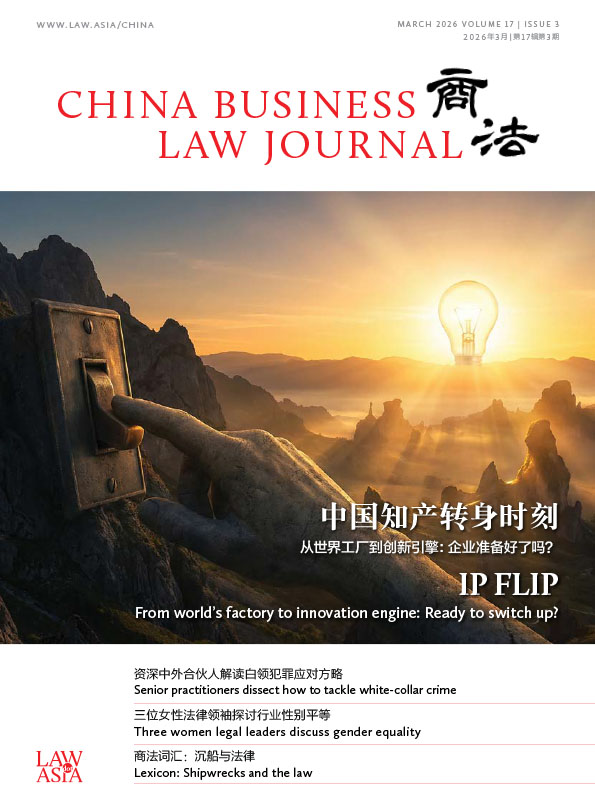




China’s demand for energy and resources is fuelling expansion in mines and smelters, and in law firms the world over. Yet international resources companies in China seem to be heading for the exit.
George W Russell reports on the minerals boom and its implications for Chinese and international companies and their lawyers
China’s demand for commodities, and minerals in particular, has become a gold mine for international law firms.
“We are very excited to be helping Chinese corporations and guiding them through what may be unfamiliar territory for many,” says Simon Poh, a partner at Linklaters in Shanghai. Linklaters acted for Minmetals Resources, majority owned by China Minmetals, on its US$6.5 billion takeover bid for Equinox Minerals, the owner of Africa’s largest copper mine, in Zambia, and a copper/gold mine in Saudi Arabia.
Until recently, international energy and resources ventures were the domain of state-owned companies such as Minmetals, China National Offshore Oil Corporation (CNOOC) and Aluminum Corporation of China (Chinalco). “We have seen continuous growth in demand by Chinese state-owned companies pursuing oil and gas opportunities in diverse places around the world, particularly in places not pursued as actively by other major industry players, such as sub-Saharan Africa and Pakistan,” says Paul Chen, a partner with Dewey & LeBoeuf who manages the firm’s Hong Kong office.
But there has also been more private-sector investment of late. According to Chinese government data from the Ministry of Commerce, private companies were involved in more than half of the 155 international mining projects involving Chinese entities registered with PRC authorities at the end of 2009.
“State-owned companies have been the main force in China’s investments overseas, but private companies have been catching up over the past few years,” Wang Yanguo, deputy secretary general of the China International Chamber of Commerce and chief counsel at China United Mining Investment, told a recent mining industry conference in Beijing.
Caution and patience
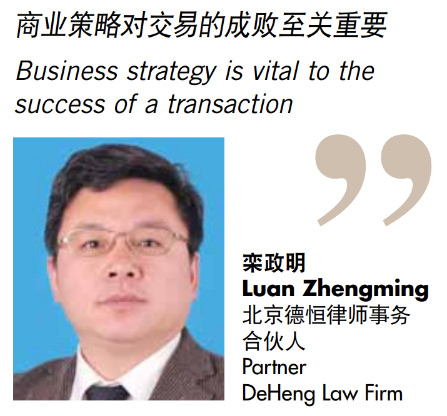 Lawyers agree that Chinese clients investing in overseas resource assets – whether from the state or private sector – must be cautious and patient. “We think business strategy is vital to the success of a transaction,” says Luan Zhengming, a partner and director of the mining and energy division at DeHeng Law Firm in Beijing. “It is most important for Chinese investors to have a flexible way of thinking according to each particular case.”
Caution and patience appear to be needed in spades. Chinese companies investing in other countries have met a range of other obstacles, such as foreign ownership limits, competition issues and real or perceived national security concerns. One example was intervention by the Australian government in 2010 to halt a Chinese acquisition of a mine site that adjoined a military area.
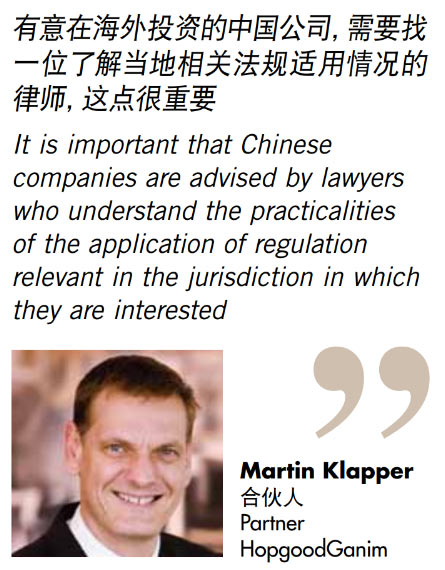 “It is important that Chinese companies are advised by lawyers who understand the practicalities of the application of regulation relevant in the jurisdiction in which they are interested,” says Martin Klapper, a Brisbane-based partner at Australian law firm HopgoodGanim. Lawyers need to have an “open and constructive dialogue with key regulatory decision-makers,” he adds, referring primarily to the Australian Securities Exchange and the Foreign Investment Review Board.
“These obstacles still remain, but are having less of an impact as both sides are becoming more familiar with each other,” says Jamie Ross, director and principal consultant at Melbourne-based Mining Risk Management, a consultancy. “Chinese companies are becoming more aware of how to work with government bodies to overcome potential obstacles, and host countries are becoming more welcoming of Chinese investment and the reasons and benefits behind it.”
In some markets, any aversion to Chinese buyers of resources assets is tempered by the lack of suitable rivals, lawyers note. “There is still limited competition in the market to buy foreign assets, and as such, Chinese companies today are presented with many opportunities to succeed in outbound acquisitions,” says Wan Li, a partner and head of DLA Piper’s corporate group in Shanghai.

Yet Chinese entities seeking to acquire overseas resources companies have often run into popular opposition. Environmental issues are high on the list of public concerns. Lawyers warn their clients seeking to go overseas that they have to raise their standards. “Another issue to be considered is how to conduct a responsible mining operation using international best practices,” says Luan at DeHeng.
“For many, the joint venture route is an optimal strategy,” says Wan. “For other companies however, different forms of partnership may be more viable and will depend on careful consideration of the business, legal and cultural challenges particular to their industry as well as their own operating style and goals,” he adds.
Legal resources
Law firms have responded by beefing up energy and resources practices with China in mind. In 2010, for example, Mayer Brown JSM appointed prominent corporate lawyer Ge Xiangyang to its Beijing office as head of projects in China, hiring him away from Winston & Strawn.
Corporate China’s hyperactive energy and resources acquisitions often require a raft of cross-border legal advice. In April, Minmetals Resources, a Hong Kong subsidiary of state-owned China Minmetals Group, announced a US$6.5 billion unsolicited offer for Equinox Minerals, a copper mining company with offices in Perth and Toronto. Minmetals hired Freehills to serve as Australian counsel, Davies Ward Phillips & Vineberg as Canadian counsel and Linklaters as English counsel. Allen & Overy is Equinox’s Australian legal adviser, while Osler Hoskin & Harcourt is advising it in Canada.
Norton Rose expects its acquisition of South African firm Deneys Reitz and Canadian “Seven Sisters” firm Ogilvy Renault significantly to boost its energy and resources client base, especially as China has keen interest in both markets. “Access to Canada includes easier access to the Toronto Stock Exchange – a global powerhouse in mining listings – while South Africa is a critical player in the development of Africa, the growth of its economy and its trading and investment links with the rest of the world,” says Robert Milbourne, a Norton Rose partner in Brisbane.

Local African firms are also taking notice of China’s interest. “Commodities are at the core of China’s push into Africa,” says Bruce Dickinson, a partner with Webber Wentzel in Johannesburg. “The firm has advised a number of Chinese companies on acquisitions of or investments into, particularly, iron ore, manganese and coal projects and related ancillary investments.
Shafted
But while Chinese companies are leaving China in search of resources, it appears that international mining and resources companies are leaving too. For different reasons.
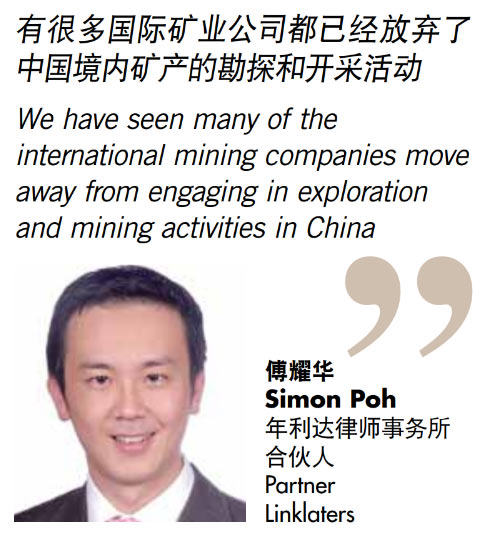 “We have seen many of the international mining companies move away from engaging in exploration and mining activities in China,” says Poh at Linklaters, whose firm helped shepherd BHP Billiton out of its Lanping lead and zinc project in Yunnan province and Anglo American out of its coal ventures in Shaanxi province.
Lawyers blame the unfavourable regulatory landscape in China as the main reason for international companies shifting out of exploration and operations. “There is currently very little opportunity for international mining companies to operate in China,” says Chen at Dewey & LeBoeuf.
It’s not just Western multinationals: Asian companies are exiting, too. Singapore-based Rainbow Mining disposed of its 60% interest in Rainbow Minerals to Guangxi Dameng Manganese Industry Co, China’s largest manganese miner, for US$45 million. Joseph He and Miao Miao of WongPartnership acted for Rainbow.
For the time being, it seems that China’s geopolitical imperatives will shape the investment environment in a way that remains unfavourable to international companies. “I believe China will continue to invest heavily in developing its own domestic resource projects, in order to gain better control over the markets it needs to buy minerals in, and the prices it has to pay,” says Ross.
“This is as much about guaranteeing and having control over supply to China as it is about investing to make money,” Ross adds. “China has sufficient cash resources not to require international investment in mining projects, and is developing these projects to supply internal demand rather than make money on exports.”
V&T Law Firm writes a regular column on energy, resources & infrastructure in China Business Law Journal. For this issue’s column, see page 90.