










As China sharpens its counter-sanctions toolkit, foreign businesses must balance on wires stretched between East and West. Luna Jin reports
“When the winds of change blow, some build walls, others build windmills.” This Chinese proverb illustrates the delicate dance multinational companies (MNCs) now face as China tightens its legal defences against foreign sanctions. With the rollout of new implementation regulations under its Anti-Foreign Sanctions Law (AFSL) in March 2025, China has laid down a more structured, if still politically charged, framework for retaliating against what it deems discriminatory foreign measures.
The Regulations on the Implementation of the Anti-Foreign Sanctions Law represent the latest addition to China’s increasingly sophisticated counter-sanctions framework. Over the past five years, the country has methodically built a triad of legal instruments to respond to foreign pressure: the Anti-Foreign Sanctions Law, the Unreliable Entities List and the Rules on Counteracting Unjustified Extra-Territorial Application of Foreign Legislation and Other Measures.
As Melody Yang, a co-head at YaoWang Law Offices in Beijing and Shanghai, puts it, “In today’s world, adopting sanctions becomes much less unipolar.”

For foreign businesses deeply entrenched in China, the moment calls for both agility and foresight. The new rules are not merely symbolic – though symbolism abounds – but also have real teeth and their enforcement is already reshaping corporate risk calculations in boardrooms from Beijing to Brussels.
From sabre-rattling to strategy
Although the language of China’s AFSL and its implementing regulations is notably stern, Kang Yingjie, a Beijing-based partner at Fangda Partners, notes their enforcement has so far been measured.
“The Chinese government remains relatively cautious,” he says, especially in applying these laws to foreign commercial entities.
Kang says current countermeasures primarily target US defence firms involved in arms deals with Taiwan, as well as entities perceived to be meddling in China’s internal affairs, such as in Hong Kong, Xinjiang or Tibet.
Yang of YaoWang echoes this assessment. She says the nature of these countermeasures is “responsive and defensive rather than aggressive”, led by ministries also tasked with driving economic development.
Yet, the list of tools available to regulators is far from toothless. As Shi Wei, a partner at Cyan Law Firm in Beijing, outlines, the new regulations empower authorities to impose a wide range of restrictions: from visa denials and deportations to asset freezes and bans on participating in entire sectors such as education, science or tourism.
Article 6 of the regulations even opens the door for intellectual property seizure – a chilling prospect for tech giants such as Microsoft with deep R&D roots in China.
Targets of these countermeasures are not limited to these companies. They may include senior executives and ultimate beneficial owners. Given this broad applicability, Yang advises that “it’s essential now to look carefully at the exact orders issued by the Ministry of Foreign Affairs or the Ministry of Commerce” to determine who is sanctioned and what specific measures are in place.
Another significant aspect of these regulations is that the threat of sanctions, more than their actual use, is becoming a geopolitical lever.
This “strategic ambiguity and the threat of punitive measures”, as Shi calls it, can influence corporate behaviour even without active enforcement.
While much focus remains on state-level targets and their signalling power, the implications for private sector actors, especially foreign investors, are no less significant.
Yang notes that the extraterritorial reach of China’s countermeasures is particularly relevant to foreign firms investing in or partnering with Chinese entities. She advises clients – mostly funds and financial institutions – to conduct rigorous anti-money laundering checks and continuously monitor counterparties. If a counterparty becomes subject to China’s countermeasures, Yang urges firms to review “the exact order” and seek professional legal advice before acting. Depending on the situation, the appropriate response could range from “ceasing the transaction” to “initiating a mandatory redemption” or even applying an asset freeze.
Compliance in the crossfire
For MNCs operating in China, the regulatory landscape has become a minefield. The new rules directly challenge foreign sanctions laws, creating a legal paradox for businesses that must comply with both US and Chinese frameworks – often in conflict.
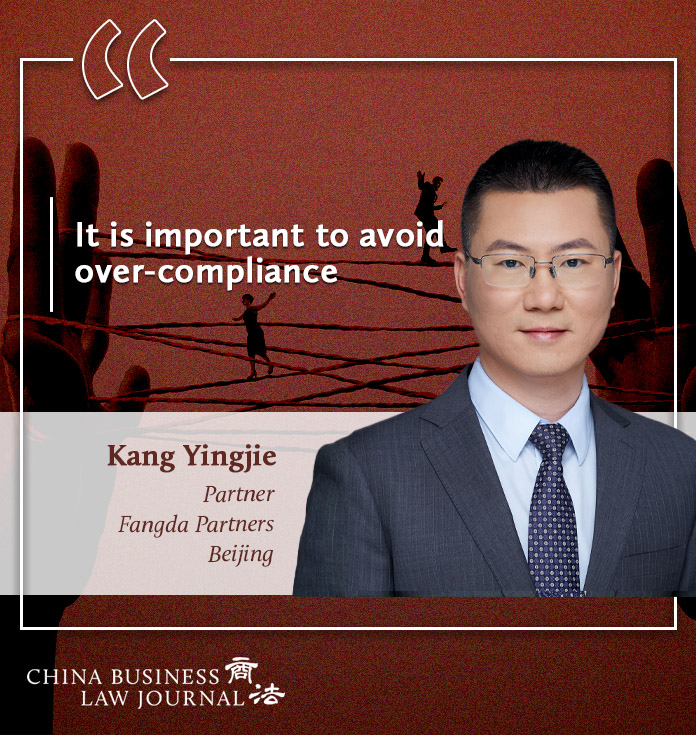
“It is important to avoid over-compliance,” warns Kang. He advises MNCs to comply with foreign laws only to the extent necessary and avoid exceeding those obligations, which could trigger authorities’ enforcement.
His observation reflects a growing trend: MNCs doing business with China are increasingly prioritising compliance with China’s anti-sanctions regime, revising internal policies accordingly.
The sectors most exposed include technology, defence, finance, logistics and professional services – industries at the intersection of strategic value and international legal entanglements. Kang identifies the most pressing risk as “how to deal with Chinese business partners who have been listed as specially designated nationals”.
Reflecting this heightened focus, Shi says that companies he works with, especially Chinese state-owned enterprises and foreign MNCs, have developed “robust contingency plans” that are both proactive and scenario-driven, “anticipating not only direct penalties under the law but also the broader strategic uncertainty it creates”.
You must be a
subscribersubscribersubscribersubscriber
to read this content, please
subscribesubscribesubscribesubscribe
today.
For group subscribers, please click here to access.
Interested in group subscription? Please contact us.
你需要登录去解锁本文内容。欢迎注册账号。如果想阅读月刊所有文章,欢迎成为我们的订阅会员成为我们的订阅会员。