





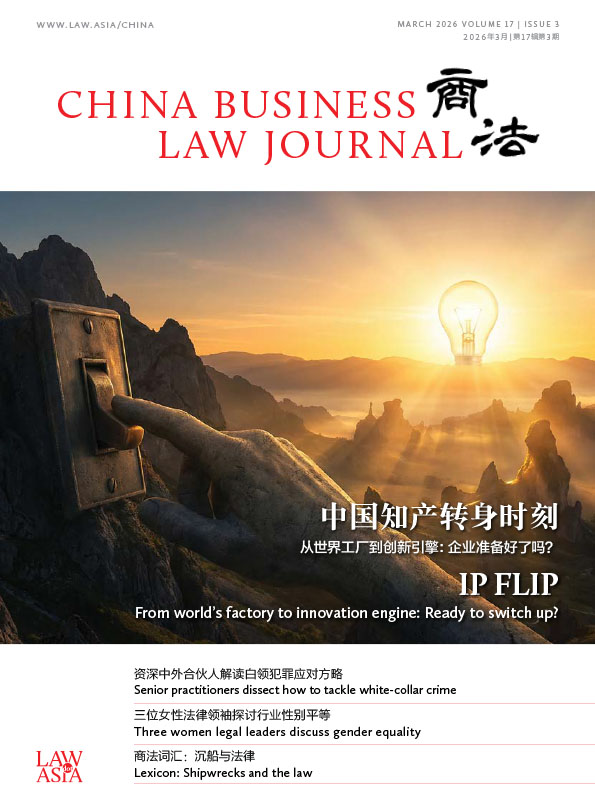





Caught between national ambition and market reality, law firms in Chengdu and Chongqing are reshaping their paths. Once seen as a promising frontier, this regional market is now in the midst of transition. Pan Xinyi reports
O
n one side of the Sichuan Basin stands Chongqing, its futuristic, cyberpunk skyline aglow with neon. On the other is Chengdu, unhurried and content, known for its giant pandas, easy pace and famously fiery Sichuan cuisine. Linked by history yet distinct in character, these two neighbouring cities in southwest China are increasingly drawing global attention.
A review of more than 30 national and local law firms across the two cities shows how major national strategies – including the Strategic Rear Base of the Nation, the Chengdu-Chongqing Twin-City Economic Circle, and the New International Land-Sea Trade Corridor – are driving regional growth.
Yet behind the optimism lies a tougher reality. Lawyers describe cut-throat competition, price wars and a market still taking shape.
Local firms are now rethinking their strategies and positioning. Despite the challenges, their resilience offers cautious optimism for the market’s future.
The two cities have taken divergent paths. According to 2025 data, per 100 permanent residents in Chengdu there are 18.4 registered business operators, compared with 12 in Chongqing.
Chengdu’s service-oriented and innovation-driven economy has given rise to a dense ecosystem of small and medium-sized enterprises, while Chongqing’s strength lies in modern manufacturing, anchored by major national and state-owned industrial companies.
These contrasting economic foundations have shaped the character and structure of the legal services markets in both cities, creating distinct opportunities and challenges for firms operating in each.
Chengdu: Fierce competition
As Sichuan’s provincial capital, Chengdu recorded a GDP of more than RMB1.2 trillion (USD169 billion) in the first half of 2025, accounting for 37.9% of the provincial total. Its share of registered market entities stands even higher, at 44.2%. This remarkable concentration of economic activity naturally attracts resources and talent from across and beyond Sichuan.
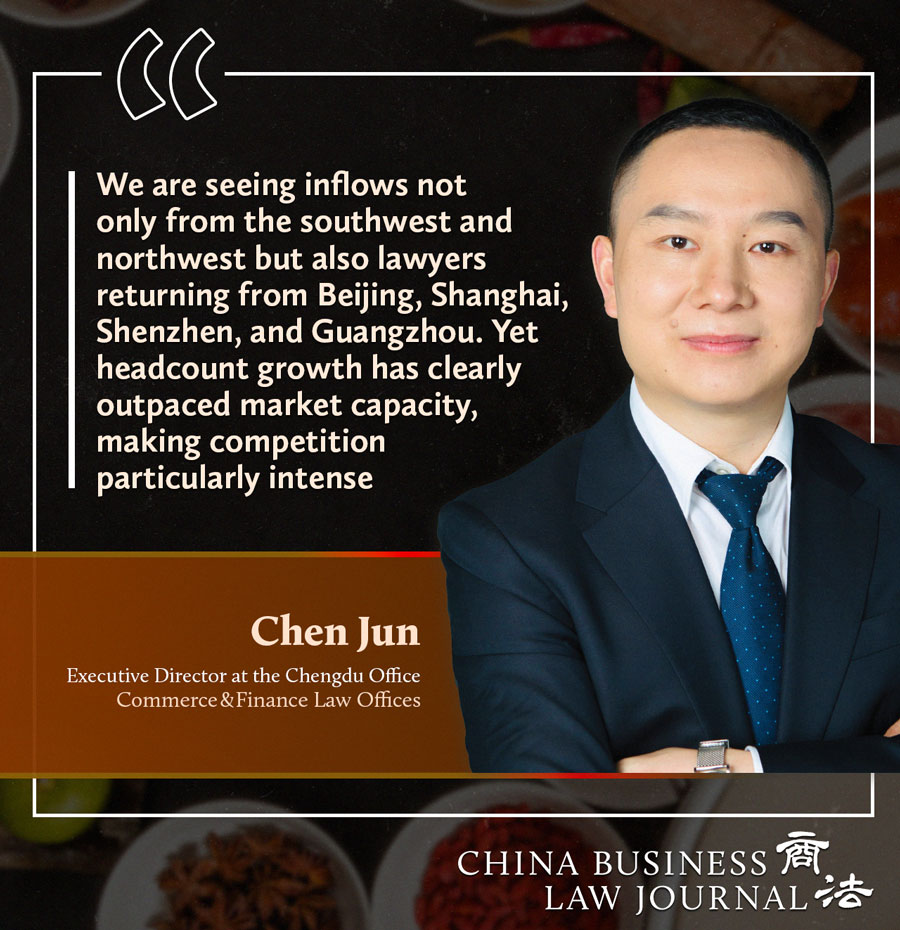
Yet behind the upbeat economic figures, the local legal services market presents a far more complex picture. “The number of lawyers in Chengdu is growing much faster than the local economy,” says Chen Jun, the executive director of Commerce & Finance Law Offices’ Chengdu office.
“We are seeing inflows not only from the southwest and northwest, but also lawyers returning from Beijing, Shanghai, Shenzhen and Guangzhou. Yet headcount growth has clearly outpaced market capacity, making competition particularly intense.”
But Chen also sees encouraging signs. In recent years, a wave of multinationals and headquarters-oriented enterprises has settled in Chengdu, while defence-related supply chains are beginning to cluster across Sichuan. “Competition among lawyers is undoubtedly heating up, but as more companies arrive and industries realign, new opportunities for legal work are steadily emerging,” says Chen.
He adds that litigation has been Chengdu’s fastest-growing practice area in the past two years, accompanied by a notable rise in M&A involving state-owned buyers and private sellers.
Many companies, he says, are showing a stronger appetite for Hong Kong listings, with law firms’ capital markets work steadily picking up as they seek to seize a “window of policy and market opportunity” through channels offering clearer standards and smoother procedures. Firms’ outbound work is also expanding, with clients increasingly targeting the Americas, Southeast Asia, and the Middle East.
Li Xiaomei, a director at Jingtian & Gongcheng’s Chengdu office, observes that Sichuan’s service sector continues to grow steadily, particularly in consumer industries.
She points to the globalisation of the hotpot business: “Several Sichuan brands have opened outlets in Southeast Asia and Europe, and for some, overseas revenues already exceed domestic earnings.” She says this overseas expansion drive is fuelling stronger demand for cross-border legal services to support local brands going global.
Law firms have also observed growing opportunities in bankruptcy and restructuring work. According to Cao Haochen, a partner at Grandall Law Firm’s Chengdu office, demand for advisory and support services in bankruptcy matters has risen sharply in the past two years, particularly from investors, and in cases involving financial stability or multiple stakeholders.
“In Sichuan, state-owned capital and enterprises remain the main forces behind restructuring investment,” he says. “They are now taking a more proactive approach, entering areas such as non-performing asset disposal and asset management. For many, restructuring has become a way to gain corporate control at lower cost.”
Meanwhile, Chengdu’s digital cultural and creative industry is emerging as a new growth frontier for the legal services market. The success of blockbuster titles such as Honour of Kings and Ne Zha not only demonstrates Chengdu’s growing strength in digital production, but also drives a clear upgrade in related legal demand.
Liu Weijia, a partner at Grandall Law Firm’s Chengdu office, cites the “Chengdu Digital Cultural and Creative Industry Alliance” as an example. Guided by government and driven by enterprise, the alliance brings together law firms, creative companies, universities and financial institutions to build an integrated service ecosystem spanning “creative incubation, technology R&D, capital connection and compliant operation”. According to Liu, this model offers law firms new entry points for business development amid the city’s fast-evolving, new-economy landscape.
As Chengdu’s key industries, such as electronics and automotive manufacturing, become more deeply integrated into global supply chains, companies are facing significantly higher risks from international trade controls. Their demand for cross-border legal services has risen in parallel. In 2024, the city’s total imports and exports already accounted for 38.6% of its GDP, underscoring Chengdu’s growing role as western China’s gateway for global trade.
Dong Meng, a Chengdu-based partner at Tahota Law Firm, says Chengdu now ranks among China’s leading centres for matters involving geopolitics, export controls and sanctions. She attributes this to the city’s dual role as a defence-industry hub and a focal point for photovoltaic supply chains.
Over time, she says, local firms have built practical expertise in navigating international regulatory compliance and solar-industry supply-chain issues, experience that has since matured into a distinctive competitive edge.
Chongqing: Refining resilience
Straddling the Yangtze River, Chongqing stands at a crossroads of industrial transformation, a shift that is redefining both the demand structure and business direction of the city’s legal services market.
The manufacturing powerhouse is undergoing a sweeping industrial realignment. Many of the city’s once dominant private industrial firms are now under strain, with only a handful of biotechnology companies managing to grow against the tide. At the same time, state-owned manufacturers are stepping up consolidation as policy resources continue to favour strategic manufacturing sectors.
“Technology-intensive and capital-intensive sectors are now largely dominated by state-owned enterprises [SOEs], fields that few private firms either dare or are able to enter,” says Yang Rui, the director of DeHeng Law Offices’ Chongqing office. “One notable shift is the pullback in the market-oriented operations of state-owned platforms, as administrative power once again takes the lead in allocating resources,” he says.
According to Yang, the Third Front construction programme, a massive state-led industrial campaign launched in the 1960s to develop inland China for national defence, laid a solid foundation for Chongqing’s manufacturing base, yet it also reinforced a growth model dependent on scale expansion, leaving the broader livelihood-oriented economy underdeveloped.
“The city’s economic structure has become divided into two poles,” says Yang. “It is either undertaking mega projects that ‘move mountains’, or facing a vacuum with little to do. Between the two, it is hard to find the space for organic, incremental transformation.”
Against this backdrop, Chongqing is rolling out a reform package known as “Three Tough Battles and One Revitalisation”. The initiative seeks to revitalise the city’s economic base by shutting down “zombie” enterprises, consolidating overlapping operations and clarifying the respective roles of government and SOEs, all moves designed to put state assets back to work and reshape the city’s economic foundations.
The reform has had a profound impact on the legal services sector. The city’s more than 2,000 SOEs have been consolidated into about 600, cutting routine legal-service demand by more than one-third. Most of these policy-driven restructurings involve the absorption of local state-owned firms into central-level groups.
These transactions are largely shaped by political considerations, where the decisive factors lie in government-to-SOE negotiation and policy co-ordination, leaving limited scope for substantive legal work.
Beyond policy-driven restructuring, bankruptcy reorganisation and non-performing-asset disposal are emerging as key market-based tools for revitalising existing assets.
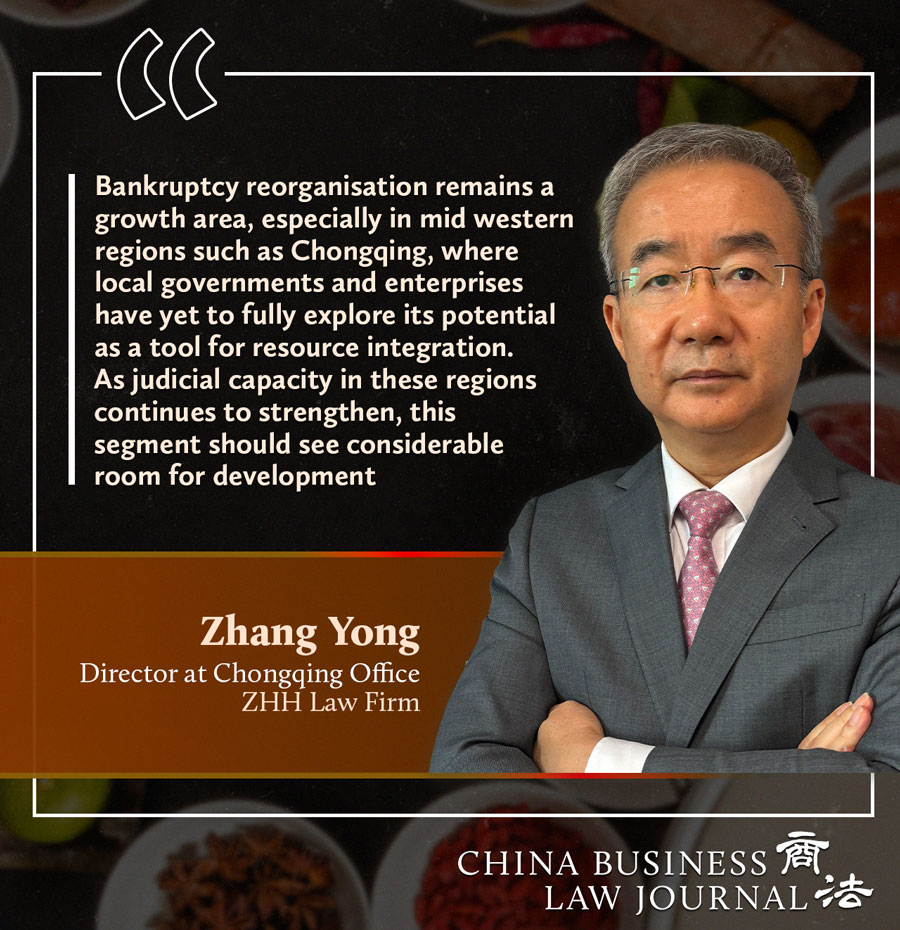
Zhang Yong, the director of ZHH Law Firm’s Chongqing office, identifies two major bottlenecks facing companies in reorganisation. The first is the pace of asset depreciation. “Assets that were once highly valued are now selling for a fraction of their worth, with overall recovery rates down to around 10%,” says Zhang.
“The second is the shortage of investors. Local state-owned firms and government platforms are pulling back, while funds and financial investors view returns as too low, and hesitate to enter.”
Even so, Zhang believes that “bankruptcy reorganisation remains a growth area, especially in mid-western regions such as Chongqing, where local governments and enterprises have yet to fully explore its potential as a tool for resource integration. As judicial capacity in these regions continues to strengthen, this segment should see considerable room for development.”
Construction and engineering, long among Chongqing’s key economic pillars, and at times eclipsing manufacturing in importance, are also undergoing structural adjustment. With the property market in decline, traditional real estate construction has contracted, and the broader construction sector has felt the strain.
Yet Zhang Hong, a senior partner at Hui Ye Law Firm’s Chongqing office, notes that large-scale projects in new energy, public infrastructure, and the city’s expanding light-rail network continue to sustain substantial workloads.
Market volatility is also keenly felt in dispute resolution.
Qiu Yu, a Chongqing-based senior partner at Hui Ye Law Firm, says that “the number of cases accepted by the Chongqing Arbitration Commission this year is roughly double last year’s, but average claim values have fallen sharply, and small-value disputes are soaring. This indicates a clear drop in market liquidity.”
He predicts that “litigation activity may be approaching its final peak, after which domestic dispute volumes could see a steep decline”.
While traditional practices come under pressure, new areas of business are quietly emerging. Zou Ying, a senior partner at Tahota Law Firm’s Chongqing office, points to a small firm whose new-media legal team has leveraged short-video platforms and live-streaming to generate annual revenues exceeding RMB10 million. Zou advises live-streaming companies and influencer IPs.
“Although the new-media sector looks novel, its legal needs remain largely conventional: contracts, termination and compliance,” he says. “What makes it different is that practitioners tend to have high incomes and a strong willingness to pay. As the sector becomes more regulated, its reliance on legal services is clearly increasing.”
A TALE OF TWIN?CITY CO-OPERATION, COMPETITION
Since the launch of the Chengdu-Chongqing Twin City Economic Circle initiative, the region’s GDP has surged, reaching RMB8.7 trillion (USD1.2 trillion) in 2024 – accounting for 6.5% of China’s national output. It has firmly secured its place as the country’s “fourth growth pole”, joining the ranks of the Beijing-Tianjin-Hebei cluster, the Yangtze River Delta and the Guangdong-Hong Kong-Macau Greater Bay Area.
As economic integration deepens, the twin?city region is reshaping the legal ecosystem of Sichuan and Chongqing. Yet, among lawyers, sentiment remains divided; some see growing collaboration and opportunity, while others warn of intensifying competition and market overlap.
Luo Qiao, a senior partner at Mingju Law Firm’s Chengdu office, observes that the current situation is “more about reallocating resources within the existing scale”. She points to the Supreme People’s Court’s recent adjustment of jurisdiction in financial cases as an example. While some matters have been channelled to Chongqing, she notes that the disparity in market size means that “the effect of such redistribution is limited”.
In her view, achieving genuine mutual benefit will take time. “Policy needs time to work,” she says, adding that the regional economy must “expand the pie”, allowing the broader economy to mature, before it can be fairly divided.
Li Baoshan, a lead partner of King & Wood Mallesons’ Chengdu office, takes a more upbeat view of the twin-city collaboration. The two cities, he says, now enjoy “an unprecedented level of policy co-ordination and mutual recognition”, which creates tangible opportunities for domestic and foreign investors alike. But he cautions that, compared with statutes, policies are “more flexible and time-sensitive”. Foreign companies must keep pace with changing regulations or risk exposure.
For Yang Yong, a senior partner at Mingju’s Chengdu office, “genuine regional co-operation is not about uniformity but about harnessing complementarity – building on what one side lacks and the other possesses, or where one is stronger and the other less so”.
Chongqing remains in the lead in new-energy vehicles, supported by its early-mover advantage and the presence of state-owned automakers such as Changan Automobile. Chengdu, with a conventional fuel-vehicle industry facing pressure to transform, has in turn established a foundation for differentiated growth. Building on AVIC Chengdu Aircraft Company’s extensive experience in aviation manufacturing, the city is also well positioned to cultivate distinctive strengths in emerging industries such as the low-altitude economy, an area where Chongqing is comparatively weaker.
“The complementarity of industrial chains is at the heart of Chengdu-Chongqing co-operation,” says Yang.
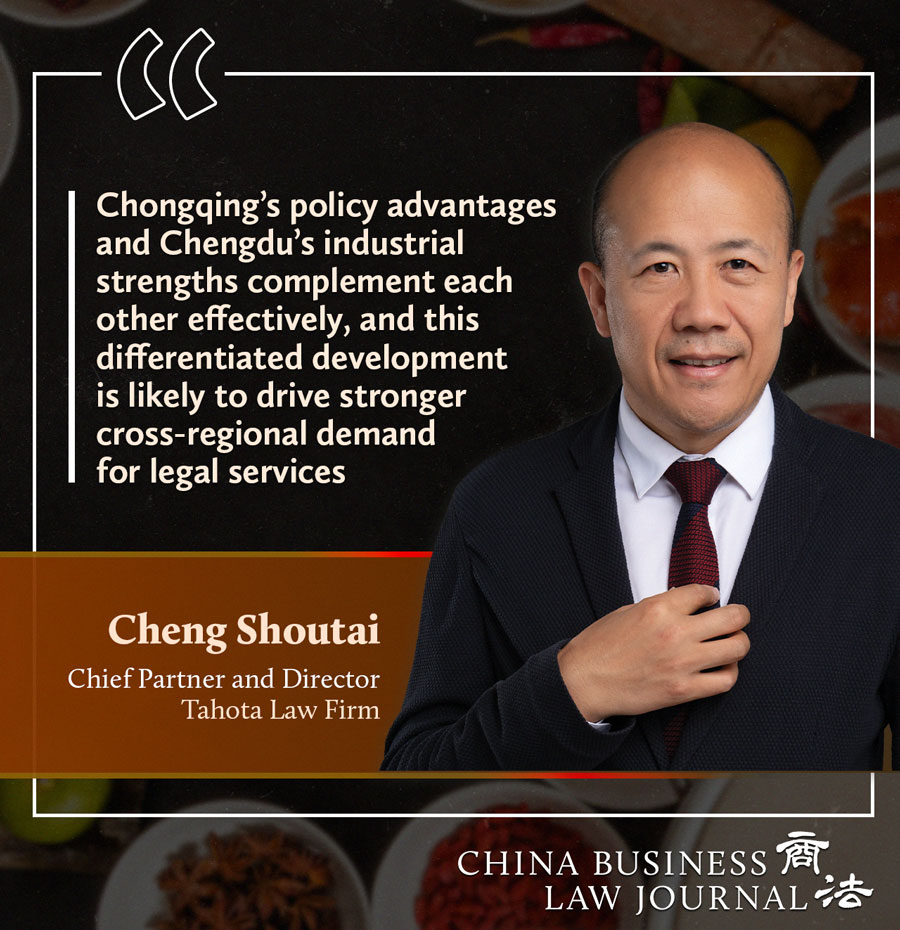
Cheng Shoutai, the Chengdu-based chief partner and director of Tahota Law Firm, says: “Chongqing’s policy advantages and Chengdu’s industrial strengths complement each other effectively, and this differentiated development is likely to drive stronger cross-regional demand for legal services.”
He points to the jointly developed Gaozhu New Area as a case in point, arguing that the building of the economic circle is not a zero-sum game, but a process of fostering new growth areas through deeper co-operation.
You must be a
subscribersubscribersubscribersubscriber
to read this content, please
subscribesubscribesubscribesubscribe
today.
For group subscribers, please click here to access.
Interested in group subscription? Please contact us.
你需要登录去解锁本文内容。欢迎注册账号。如果想阅读月刊所有文章,欢迎成为我们的订阅会员成为我们的订阅会员。