





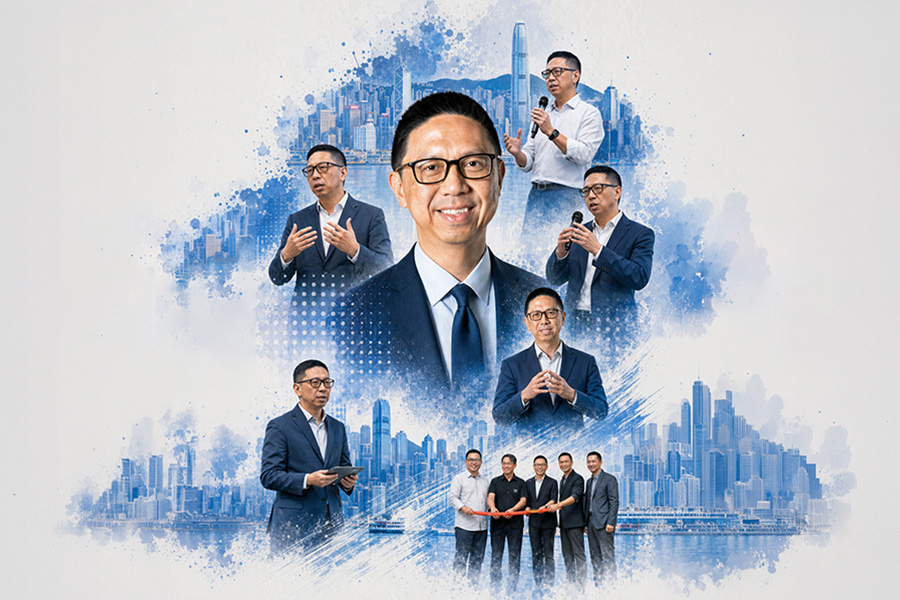


Paul Chow balances two challenging positions at Hong Kong Exchanges and Clearing Limited, but that comes with twice the opportunity to make a difference, writes Bimal Mirwani
Paul Chow, who wears two hats as both group general counsel and group chief sustainability officer at Hong Kong Exchanges and Clearing Limited (HKEX), strides into a 50th floor meeting room overlooking Hong Kong’s Central district with an easy confidence.
He speaks with clarity and conviction, demonstrating his commitment to the legal dimensions of his role while also conveying genuine enthusiasm for the sustainability and philanthropic initiatives he leads.
In his conversation with Asia Business Law Journal, Chow offers a nuanced perspective into the nature of his two roles, while also exploring the opportunities and potential risks associated with the use of artificial intelligence (AI) within the exchange’s legal department.
On the sustainability front, he delves deeper into Core Climate, the HKEX’s carbon credit platform, outlining its strategic objectives. This is complemented by his dedication to the exchange’s broader efforts to “give back” through various charitable programmes.
Asia Business Law Journal: Can you outline your career briefly, and explain the major differences you’ve found between working in private practice and in-house?
Paul Chow: I spent the majority of my career in private practice working at firms [including Davis Polk & Wardwell, and Linklaters], really focusing on M&A and capital markets work, and financial regulatory work as well, primarily in Hong Kong – although I did spend nearly five years in Beijing as well. That was when I was at Linklaters, I looked after the Beijing office.
That was the majority of my career until 2019, when I then decided to move from a private practice role to in-house. I became the group general counsel for Cathay Pacific. I stayed there for two years, and I was then approached by the HKEX in 2021.
ABLJ: Can you give an overview of both of your roles with the HKEX?
Chow: I’m the group GC for the HKEX. I look after the legal and secretarial services division, handling governance for all our subsidiaries. And we have quite a lot of subsidiaries including, for example, the London Metal Exchange (LME). Then on the legal side, I head up the legal team. I also work with the LME legal team, who report to me.
In Hong Kong, we are basically managing the legal risks faced by the group. Now, one thing just to be clear [about], because not everybody understands us – particularly people outside of Hong Kong – is we are a very unique company. We are not only a public company, not only do we also operate the securities market in Hong Kong, but we are also a regulator.
My legal team doesn’t really get involved in the regulatory side of things. That’s done by the listing division, so there’s what we call a Chinese wall between the listing division and the rest of the firm. We are on the other side, where we basically focus on operating the securities market in Hong Kong as a public company. So that’s the group GC role.
Then, as the group chief sustainability officer, I drive the sustainability strategy of this group, and that also includes the London Metal Exchange. We also operate a carbon credit platform, which is called Core Climate. And then we look after what we call the corporate responsibility of us as a public company.
So that includes, for example, our own climate strategy; how do we go about decarbonising for ourselves? How do we promote ourselves within the community, and to really help the community as well? And that gets me to the HKEX Foundation, a charitable foundation, which my team also looks after. We have a lot of great things which we’re doing there.
ABLJ: How does legal work at the exchange differ from working with a legal department at, say, a large financial institution or multinational?
Chow: It’s a very unique business. All the things we do, by definition, there are no precedents. It’s not like we are in a bank where we look at: ‘oh, what is the other bank doing? They have this product, should we do this product? Maybe we just do the same.’ We don’t really have that kind of thinking.
We’re always thinking about Hong Kong as a city, as a jurisdiction, how can we improve? Hong Kong is an IFC, as we all know, an international financial centre, and we’re always thinking about how we can maintain this and really ensure that it becomes the world’s best IFC, as it should be. All the things we’re doing are to deepen that ecosystem, attract capital from overseas into Hong Kong, and connect China with the rest of the world, which is what I think we’re very good at. We call ourselves a super connector.
If you think about that, then what London, what New York is doing, we look at them, but a lot of times it’s not relevant because they are in a different country. Dynamics, culture are very different, products are different, etc. So it means that the legal work is very interesting, it’s very unique, it’s not commoditised.
We have some contracts as a corporate that other corporates would be facing. Say, maybe, employment questions or real estate, intellectual property. Some of these, you would find them at other corporations as well, but I think the majority of the questions [of law] here, really challenging and fascinating questions, you can only find them here.
And we really have to think about going back to basic principles, thinking about how we’re helping, how we can help the business to achieve the strategic objective here. It just makes it really fascinating.
ABLJ: How is AI impacting the work of the legal department? What are the advantages and disadvantages?
Chow: Obviously, at the exchange itself, before I turn to the legal division, we have been very focused and sensitive to AI because of its power. And at the same time there are risks, there are considerations which one needs to take into account.
We have different divisions doing different things in a co-ordinated way. One example is, when my listing colleagues, when my regulatory colleagues, vet an annual report. In the past, they would probably spend a lot of time trying to go through each sentence. Now with the help of AI, they can do it much more efficiently, doing word searches, AI telling them these are the disclosure areas that they need to focus on, making the whole exercise much more efficient. So we’ve been very focused on that.
For the legal division, we use the database a lot. It’s about helping us, perhaps in some ways, to draft contracts, where we can improve our contracts. But at the same time, we are very cognisant, I think, of the risks and the considerations, the hallucination risk, the bias risk, things like that.
I would say, we just need to balance the efficiency that we achieve and the risks. But the direction of travel would be that we are very much into this. Let’s just see how it can help us in our work in a way which is most effective, while balancing the risks that it can entail.
ABLJ: How does your experience in law influence your approach to advancing sustainability and philanthropy as group chief sustainability officer at the HKEX?
Chow: I had been involved in, for example, in the carbon market before, so from a legal standpoint I obviously understand the rules and some of the risks we’re facing.
It’s a new area, the carbon credit market. There are challenges. Most people would say there are certainly standard issues, for example, around transparency. These are things which always fascinate me, because as a lawyer, in a financial world, if you want a product to be liquid and to be competitive, you do need to make sure that the legal rights and the way people look at it is pretty clear [so that] they can understand the rights and obligations. I think for carbon credits, they’re still a relatively new product, but a lot of improvements have been made. So what we’re doing is to improve the integrity of the product.
With sustainability, what really interests me is, as a business, how we look at it. We are obviously promoting advocacy, something which is good for society, which is within our DNA, and it’s at the heart of everything.
But at the same time, I do think it is important that we are able to do sustainability as a business, so that it actually is sustainable. And I think that is interesting because we as a financial [entity], in a financial world, if you want people to really be interested in this product, it has to be financially attractive to people.
If you look at sustainability and law itself, I think one of the things I would say is that neither are clear cut. You have a lot of cases where quite reasonably, people debate about the merits of something in the sustainability world, certainly we see some of that [in law] as well.
And I think the way you analyse, how you approach a problem as a lawyer, that helps you when you go into a sustainability world and understand, is this something worth doing? Is this a product worth doing? What are the controversies behind it? Why are people criticising this, etc.? And you have to really think it through and see through the issues, just like a lawyer.
ABLJ: How does the HKEX balance market development with its responsibility to uphold market integrity, resilience and long-term sustainability?
Chow: First of all, the two of them are not mutually exclusive. Both are important to us. At the heart of this exchange, it’s about the trust you have in the marketplace. And this is really the DNA, the most important thing to us: why do people come and trade with us? It’s because they realise that when they come to us, there is the comfort that a transaction will be completed in the way that they expect. The price discovery, there is integrity behind that process. There’s no tampering, for example. I think that is very important.
At the same time, we hear a lot from our market participants on what kind of products they want. We’re always interested to hear that, and to really innovate and see whether there are products that can help them to deal with their financial risks or to hedge, for example, a particular situation. We do a lot of that in the financial world. The main challenge is when we have a new product, we need to make sure that it has the same integrity as other existing products so that people really understand what they are buying, what they are selling.
ABLJ: Can you elaborate on your strategic vision for the development of the Core Climate environmental and ESG product trading platform?
Chow: We started Core Climate in 2022. We started with a carbon credit, with projects from different jurisdictions. We have Gold Standard and Verra Standard – these are the two leading standards of carbon credit. And we have RMB settlement and USD settlement as well.
We now have more than 100 participants with projects from different places, from Belt and Road countries, for example. And we have traded over a million tonnes already of carbon dioxide. So that is, I think, by itself an achievement.
What we are thinking of is the next stage of the platform itself. I think the direction of travel would be more products, for example, can we think about other environmental allowance products, not just carbon credits. That’s certainly the direction we’re heading.
The other thing that we’ve been focusing on and devoting a lot of time to is to work with PRC market operators. In mainland China, there’s the mandatory carbon market, but there’s also the voluntary carbon market. And the government has said that they want to internationalise the voluntary carbon market.
This is where we come in and say ‘how can we help with that?’ So as a result, we’ve been talking to the different carbon exchanges in China. We signed an MoU with a number of the GBA [Greater Bay Area] carbon operators late last year. That’s the Shenzhen, Guangzhou and Macau carbon exchanges. We signed an MoU with the Beijing Green Exchange. This was about three years ago now.
This is the thing we’re good at, bringing in the foreign investors’ experience, their expectations, sharing it with people, agencies within mainland China, and seeing how we can work with them, understanding their considerations, their concerns, and how we can meet them, and help in really internationalising the mainland carbon market as well.
ABLJ: You mentioned there are further products that you are looking into. What kind of products are in the pipeline?
Chow: Essentially, the way we think about it is there are different people out there who need to offset different types of emissions. There’s a scope one, two, three right now. We are thinking about something which will allow people to perhaps offset their scope two emissions more effectively. That would be one direction of travel. But essentially, it’s catering to different people’s preferences when it comes to offsetting their own carbon emissions.
ABLJ: What are some of the recent initiatives that the HKEX Foundation is pushing forward? What changes and impacts do you hope to bring through the HKEX Foundation’s work?
Chow: The HKEX Foundation started in 2020. We’ve been running two programmes. One is called a Charity Partnership Programme, the other is the Impact Funding Scheme. Both are basically funding NGOs, charities, social enterprises in Hong Kong in different areas – financial literacy, underprivileged, environmental awareness, etc. We have been very conscious of the need to actually work with the community and to really make Hong Kong society, as a whole, a better society.
One of the things we’ve been thinking is, how can we do that more effectively other than the two programmes I’ve just mentioned. They’re great programmes, fantastic people, and we’ve been funding a lot of different agencies, more than 100 projects over the last five years already.
Having discussed with a lot of communities, stakeholders, etc., we introduced the [Care for] Caregivers Programme. We officially launched it just two months ago to work with agencies and charities to give support to caregivers. You might have seen that in the press over the last one, two, three years, there have been some stories – and some of them are quite tragic – about caregivers being under a lot of pressure. They need to take care of elderly parents or maybe kids with difficulties. And at the same time, trying to work in a normal job and obviously earn money and feed the family.
These are the people whom we feel in Hong Kong deserve a lot of help, a lot of support. The other thing driving us is we’ll all become a caregiver ourselves, or we might already be caregivers. We look at our employees, and a lot of them are, including myself, are caregivers. I have an elderly father I need to take care of. So it’s something which resonates, I think, with our staff as well.
I think this is something you will see us doing quite a lot over the next few years, and that’s something I think the team is very proud of. I’m very proud of the team. I think it’s just a great way to really contribute back to society.