









In the first issue of China Business Law Journal (page 37) we conducted a round-table discussion on price-fixing. That discussion followed the publication by the National Development and Reform Commission (NDRC) of a consultation draft of its Anti-price Monopoly Rules. On 1 February this year, the Anti-Price Monopoly Rules, together with three more sets of implementing rules issued by the State Administration for Industry and Commerce (SAIC) (including the Prohibition of Monopoly Agreements Rules), came into effect. How will these four sets of rules affect business and shape the implementation of the PRC Anti-Monopoly Law? We invited Cheng Yuan, head of the China competition/antitrust practice at international law firm Linklaters, and Tom Yu, legal director at Anheuser-Busch InBev China, to discuss these and other issues
CBLJ: The “rule of reason” principle is used to determine whether there is monopolistic behaviour. During our previous discussion, participants indicated that the Anti-Monopoly Law was not very clear on this concept. Have the new implementing rules made things any clearer?
Cheng Yuan: Yes. The Anti-Monopoly Law is implemented in accordance with the “rule of reason”: a competition analysis is conducted to see if the business under investigation has a valid reason for its behaviour, and whether such behaviour has negatively affected competition in the relevant market. This is very different from how the PRC Price Law and the PRC Anti-Unfair Competition Law are implemented. Both of these use the per se principle: that is to say, as long as your actions fall within the prohibitions of the law, you have acted illegally; there is no need for any competition analysis.
The implementing rules offer a better solution, but the way in which NDRC and SAIC go about their work are different. Taking the abuse of dominant market position as an example, the NDRC clearly lists the circumstances which constitute “valid reasons” for monopolistic behaviour. On the other hand, the SAIC has two guiding principles to determine what makes a “valid reason” (see article 8 of the Prohibition of Abuse of Dominant Market Positions Rules): firstly, is the action taken for the purpose of the business’s normal trading activities and returns? Secondly, what is the effect of the behaviour on market efficiency, the public interest and economic development?
The SAIC’s approach is more flexible, but at the same time more abstract. In fact, the SAIC itself is not too happy about it. One official from the SAIC’s Anti-Monopoly and Anti-Unfair Competition Enforcement Bureau said during a seminar that there should be a rule stating that whether an action has a valid reason should be subject to the test of whether the consumer has suffered any harm from that action. Furthermore, analysis of whether the action in question has an impact on “market efficiency, public interest and economic development” is too broad to be practicable.
Vertical monopolistic agreements
CBLJ: On 15 March this year, the China Automobile Dealers Association wrote to Beijing Mercedes Benz on behalf of Mercedes Benz dealers, asking it to lift its “double limits” policy which imposed a minimum sale price and a limit on sales territories. Which parts of the Anti-Monopoly Law did Beijing Mercedes Benz allegedly infringe?
Cheng Yuan: Imposing a minimum sale price is definitely problematic. Article 14 of the Anti-Monopoly Law prohibits businesses from reaching vertical monopolistic agreements with contractual counterparties which set the lowest price at which products can be resold to third parties.
However, as to whether it is illegal to restrict sales territory – for instance dealers in Beijing being prohibited from selling to customers in Tianjin – neither the Anti-Monopoly Law nor the implementing rules make any clear provision.
Tom Yu: In fact, territorial restrictions have been seen by some officials as a way to promote competition. I have seen some American studies which reveal that in certain situations, removing territorial restrictions can actually adversely affect the survival of smaller businesses.
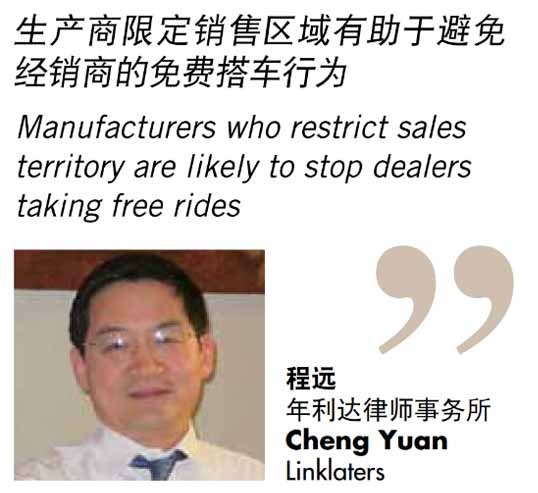 Cheng Yuan: The logic is this: let’s say a car manufacturer grants one of its dealers exclusive dealership in Beijing and requires the dealer to sell only its products. Meanwhile it stops other dealers from selling its cars in Beijing. This way, the manufacturer can ensure that the Beijing dealer will concentrate on selling its products, which could be said to enhance competition in the automotive market. Territorial restrictions will also prevent what is known as “free rides”. For instance, there may be two dealers dealing in the same brand, but one of them offers test drives though its prices are slightly higher. The other does not offer test drives, but its prices are lower. Customers will take advantage of the test drive from one, and then go to the other to buy the car. Manufacturers who restrict sales territory are likely to stop dealers taking free rides.
Tom Yu: For example, if a manufacturer offers party A exclusive dealership in Beijing, that party will use every possible means to do it well, and consequently customers will be more loyal to the manufacturer’s products. But if the manufacturer also offers a dealership to party B in Beijing, A and B may get into a price war in order to win market share. This will upset the market, and customer service may also suffer. Ultimately, it is the customer who will lose out.
CBLJ: We know that vertical price monopoly agreements are regulated by the NDRC. Does this mean that monopolistic agreements which do not have a price element will be determined and regulated by the SAIC, in accordance with article 8 of the Prohibition of Monopoly Agreements Rules?
Cheng Yuan: The rules you mention do not clearly address vertical monopolistic agreements. The SAIC official mentioned this specifically at the recent conference. He said that generally speaking, the SAIC does not wish to regulate this sort of agreement because the Anti-Monopoly Law’s main target is vertical price monopoly agreements. Other vertical restraints do not fall within the law’s main aims, unless the relevant business’s market share is so great that it will have an oppressive and exploitative effect on its competitors.
CBLJ: The EU’s anti-competition rules have a “safe harbour” concept: that is, if a business’s share of a market is smaller than 30% of the whole market, it will not be pursued by the authorities even if it enters into a vertical monopolistic agreement. Does the SAIC have a similar yardstick when it investigates vertical agreements?
Cheng Yuan: The SAIC official suggested that if one’s market share is below 30%, this kind of agreement is not an issue. However, those with a market share of between 30% and 50% may be investigated, to see if the agreement restricts or eliminates competition. If the market share is more than 50%, it is no longer just a vertical agreement problem, it may also be an abuse of dominant market position. This is only the official’s verbal explanation; the law itself does not clearly state this. Nonetheless, it may be a guiding principle when they implement the law.

CBLJ: Article 19 of the Anti-Monopoly Law sets out three situations in which a business is deemed to have a dominant market position. One of those is where a business has a market share of 50% or more. What are the other two situations?
Cheng Yuan: The other two situations are these: although a business’s own market share does not reach 50%, the combined market share of it and one other business reaches two-thirds, or the combined share of it and two others reaches three-quarters. The legal terms for these two situations are duopoly and oligopoly, respectively. These concepts exist in German competition law, but many countries don’t have them at all.
CBLJ: If the businesses have no intention to eliminate or restrict competition, nor do they have this kind of agreement or concerted action, surely you cannot say that they are abusing their dominant market position simply because their market shares happen to add up to the right thresholds?
Cheng Yuan: This provision is not particularly mature, in theory or in practice. In my opinion, the authorities won’t really resort to it.
Jurisdictional overlap and delegation of power
CBLJ: The three authorities, being the Ministry of Commerce (MOFCOM), the NDRC and the SAIC, cover different types of monopoly. In practice, there may be overlaps of jurisdiction or a lack of clarity over who has jurisdiction. Do the new implementing rules deal with this?
Cheng Yuan: MOFCOM mainly deals with merger review, which is easier to differentiate from other monopoly behaviour, but in practice there are still overlaps. For instance, my parent companies have sale and territorial agreements between them, and I happen to include these in my filing to MOFCOM for a merger review. When MOFCOM gives its approval, does it mean that these agreements have also been approved? There is no clear answer to this, as these agreements may fall into the category of horizontal monopoly agreements, which is not part of MOFCOM’s merger review.
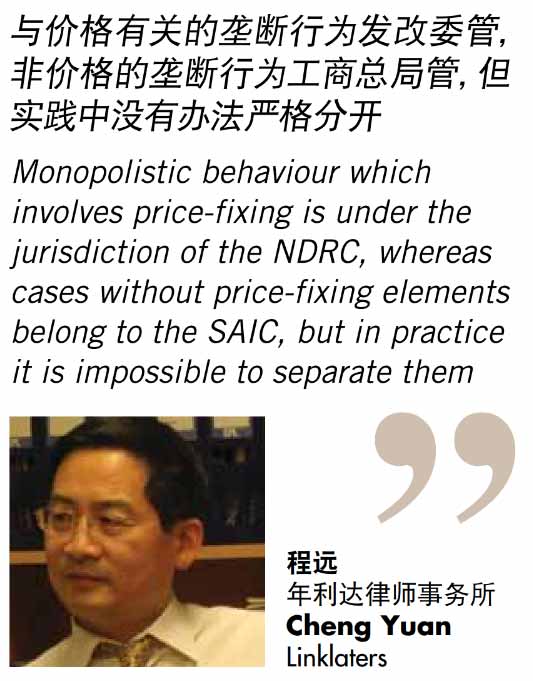 On the other hand, overlaps arise more easily between the SAIC and the NDRC. Theoretically, monopolistic behaviour which involves price-fixing is under the jurisdiction of the NDRC, whereas cases without price-fixing elements belong to the SAIC, but in practice it is impossible to separate them. Of the 20 to 30 cartel cases investigated by the EU in the last few years, most of them are monopoly agreements which involve both price-fixing and non-price fixing elements, such as dividing up market share among different businesses. Of course, there are cases which are solely about price-fixing, and others which do not involve price-fixing at all, such as the SAIC’s case earlier this year about Jiangsu Cement Association. Generally speaking, there is no price-fixing, as it involves the Association organizing various enterprises to divide up and maintain the market share between them.
The difficulty now is how to deal with this overlap of jurisdiction. Neither the implementing rules nor the relevant procedural regulations address it. The SAIC says it has reached an understanding with the NDRC: if it is clear that there is, or isn’t, price-fixing, the authority which does not have jurisdiction will pass the case on to the one which does. If the initial conclusion is that there are both price-fixing and non-price fixing elements, then both authorities will sit down and discuss it, to see which element is more predominant. If it is the pricing element, NDRC will deal; if there are more non-pricing issues, SAIC will deal. Lastly, if both elements are mixed and inseparable, then both authorities will deal with the case together. However, this is all just their internal understanding. It is not written anywhere in the law. It remains to be seen whether in practice this is what they will do.
CBLJ: How do these three authorities delegate their powers to regional authorities? During our last discussion, the participants expressed concern that decentralization might affect the efficiency and effectiveness of the Anti-Monopoly Law. What is now happening in practice?
Cheng Yuan: MOFCOM basically never delegates – it exercises all its powers regarding merger control.
The SAIC decides on a case-by-case basis whether it will delegate to provincial departments. Factors include whether the case falls solely within the geographical area of the province concerned, and whether the provincial department has the ability to handle the case. Departments which are stronger (such as Shanghai and Zhejiang), in a case that is relatively simple, will have the powers delegated to them. If the case is more complicated, or it involves larger companies (such as national or multinational companies), there will be no delegation. Further, provincial departments have to report back to the SAIC before they can make a final decision; the SAIC has the final say. In the Jiangsu Cement case, the authority in Lianyungang city reported to the provincial authority, which then reported to the SAIC, which then delegated power to the provincial authority to investigate the case. The provincial authority transferred more than 20 officials from city and provincial level, took over 100 days and collected over 100 pieces of evidence before they came to a decision.
CBLJ: Does the NDRC have similar regulations and procedures?
Cheng Yuan: The NDRC is rather different. The NDRC will generally delegate, and each provincial authority normally deals with monopoly cases within its own geographical area. The NDRC itself only deals with cases which span more than one province. In addition, there is no obligation on the provincial authorities to report back to NDRC before making a decision, though in practice I reckon they still do.
 My understanding is that to date, the NDRC has not initiated or completed a single investigation. But looking at the number of complaints (particularly complaints about price-fixing), the NDRC should have had the most cases. However, they seem more willing to use the Price Law instead of the Anti-Monopoly Law while investigating and punishing price-fixing behaviour. To my knowledge, the NDRC and SAIC are very different in terms of internal structure. The SAIC has a pyramid structure, so that the upper levels can use the resources of the lower levels, whereas NDRC has a more horizontal structure, which means it cannot transfer officials from the provincial, city or county levels.
CBLJ: In some provinces, cities or counties, there are both regional departments of the NDRC and price bureaus. Does this have any impact on how NDRC implements anti-monopoly laws?
Cheng Yuan: At the central government’s level, both the department of price and department of price supervision are internal bodies within the NDRC. On a provincial level or below, this is not so – some have the NDRC department and price control bureau together, some have them separate and independent. This is another possible source of confusion in implementation.
Price Law or Anti-Monopoly Law?
CBLJ: Monopoly cases require a lot of economic analysis. Some fear that there is a lack of people with the necessary economics background in the NDRC and SAIC, resulting in difficulties in dealing with cases. Are these two authorities taking on people with this sort of background?

Cheng Yuan: My understanding is that in the past, enforcement divisions in both the NDRC and SAIC were manned purely by law graduates. Nowadays, they do have some staff knowledgeable in economics. There are also some officials with a background in economics in MOFCOM’s merger control department.
CBLJ: Would the current number of officials be sufficient for the needs of implementing the law?
Cheng Yuan: This is a huge problem. In actual fact, at ministerial level there are only a few people – the NDRC has five or six, some of them being responsible for legislation, the others for supervision. The SAIC has eight people, four for legislation, four for implementation. This is hugely different from the EU and America where they have teams of several hundred people. China, although a large country, has only got these few people. As a result, they barely have the capacity to handle investigations. Therefore, they still rely on informal procedures to deal with cases, instead of resorting to anti-monopoly investigations.
Tom Yu: Our internal training deals with the reason why the Anti-Monopoly Law is so important to us. This is because we are a big company, and as such it is easy for us to become a target for anti-monopoly investigations. Smaller businesses are simply not likely to be targeted by the anti-monopoly authorities.
CBLJ: Regarding price control behaviour, the NDRC implements the Price Law and Anti-Monopoly Law. I understand that in practice the NDRC is more likely to rely on the Price Law to deal with price control issues. What are the main reasons for this?
Cheng Yuan: The Price Law is simpler because it follows the per se principle, obviating the need to have complicated evidence, as well as having to conduct full investigation or analysis. Conversely, under the Anti-Monopoly Law the authorities have to investigate whether a business’s price control actions are justifiable. You have to give them a reasonable chance to explain themselves, and you even have to decide whether there is any impact on competition. Last year, when NDRC investigated the price-fixing acts by Zhejiang Fuyang Paper Manufacturers’ Association, although it was decided that the association infringed both the Price Law and the Anti-Monopoly Law, the procedure used and penalty handed down were both based on the Price Law.
Based on what one official from the NDRC’s department of price supervision said at conferences, they look at three factors in deciding which of the Price Law and the Anti-Monopoly Law to use.
Firstly, does the behaviour have a clear anti-competitive effect? If there isn’t, they would rather use the Price Law and not the Anti-Monopoly Law.
Secondly, it depends on the business’s market position and influence. If it is a large enterprise with a dominant position, there is the possibility that it is abusing its dominant market position or there is a price cartel; if it is a small to medium-sized enterprise, then it is more likely that the Price Law will be used.
Thirdly, they will look at whether there is a serious negative impact on market competitiveness (such as the action being on a large scale, continuing for a long time, or having a strong social impact). For example, in last year’s case of civil airlines discounting their tickets, several companies agreed on the lowest discount they were prepared to give, in order to avert a price war. This was clearly a price cartel. However, because it didn’t last very long, and it stopped immediately after a complaint was lodged, the companies were ultimately not punished.
Exemptions and extraterritorial jurisdiction
CBLJ: Under some circumstances, a business may get exemptions for its monopolistic behaviour. Has anybody been exempted based on this provision?
Cheng Yuan: Article 15 of the Anti-Monopoly Law provides for exemptions. In the Jiangsu Cement Association case, the businesses had asked for an exemption, because market competition was so fierce that what they were doing was to save their businesses from bankruptcy. SAIC did not allow it, but in other countries, cartel actions taken in emergencies like this can be exempted. Article 15 also allows exemptions for “efficiency cartels” and “export cartels”.
CBLJ: Would China’s export cartels be subject to anti-monopoly laws abroad?
Cheng Yuan: If your cartel agreement has an impact in another country, you may be penalized by the other country’s laws. Chinese laws are the same. Article 2 of the Anti-Monopoly Law says that if monopoly behaviour occurs abroad but has an impact within the PRC, China’s anti-monopoly rules will apply. An example would be if foreign mining companies concluded a cartel agreement regarding their sales into the Chinese market.
CBLJ: But why have we never seen any Chinese legal action taken over this kind of behaviour pursuant to the Anti-Monopoly Law?
Cheng Yuan: There are two practical difficulties. One is evidential: how are you going to obtain the evidence to show that they have this kind of agreement between them? The other is even more practical: if you were to punish them, how would you go about it? Stop them exporting? That could cause hyper-inflation in the prices of metals and minerals. Therefore, in practice, there is still no perfect way to deal with this.
Fines and confiscation of profits
CBLJ: Another worry for businesses is that some provisions in the Anti-Monopoly Law are not clear enough, which results in the authorities having too much discretion in their implementation. Do the implementing rules deal with this?
Cheng Yuan: I feel that the rules are certainly an improvement on the Anti-Monopoly Law, in areas such as the analysis of dominant market position which we’ve just mentioned, as well as the interpretation of what constitutes “valid reason”. But overall, there is still a good deal of uncertainty in the implementation of the law, because it depends on the quality and training of the officials, as well as other reasons which may influence their decisions. That said, I think they will tend to be more cautious, and may be more lenient in handing out punishments.
CBLJ: Under the Anti-Monopoly Law, a fine equivalent to 1%-10% of an entity’s previous year’s turnover can be imposed. This is a huge range. Do the authorities have any guidance on how this rule is implemented?
 Cheng Yuan: In the Jiangsu Cement Association case, there were apparently 15 businesses involved. Some five or six of them, plus the association itself, were fined, but the SAIC didn’t reveal the amount of the fines. Therefore you can’t determine whether the SAIC calculated the fines according to turnover. Another problem is that even though 1% is the lowest percentage, to a multinational company it is still a frighteningly big amount.
CBLJ: Is the reference to one’s global turnover or just the turnover in China? Wouldn’t it be the turnover of the relevant market, that is to say the market in which the monopolistic behaviour occurred?
Cheng Yuan: There are no fixed rules on this. Looking at the explanation of some NDRC and SAIC officials, their personal inclination seems to be towards turnover in the relevant market, and only the turnover of the offending business, not of the whole corporate group. But how is turnover defined? NDRC and SAIC believe that this awaits the State Council’s interpretation.
CBLJ: Under the Anti-Monopoly Law, in addition to fines, a guilty party may also find profits made from illegal activity confiscated. Can these two penalties be imposed at the same time?
Cheng Yuan: Confiscation of illegal profits as a concept does not exist in competition law abroad. The fine already takes into account profits generated, so why should there be another way to confiscate profits?
Tom Yu: My understanding is that the authorities believe that the 1%-10% fine is merely a punishment. The profits generated by the illegal activity may be more than this; it could even be as high as 30% or 50% of turnover. If the fine is not high enough to take away all the illegal profits, isn’t it in effect encouraging illegal activity?
CBLJ: In that case, how do the authorities calculate profits attributable to illegal activity? Is it based on net profits?
Tom Yu: No, it is not based on net profits. The SAIC has special calculation rules in this regard. And in most cases, profits subject to confiscation amount to an astonishingly high amount, often much more than 1%-10% of turnover.
Cheng Yuan: This is therefore another problem. In practice, how do you confiscate profits if the fines under the Anti-Monopoly Law are already so high? Also, how do you calculate the 1%-10% fine? The implementing rules have not dealt with this.
Leniency and its risks
CBLJ: The Anti-Monopoly Law has a mechanism for whistle-blowing and leniency, which enables a whistle-blower to benefit from immunity or reduced penalty. The implementing rules have some guidance on this. Will this be easy to implement in practice?

Cheng Yuan: For the authorities, it is quite difficult to gather evidence in anti-monopoly cases. Looking at cartel cases which were successfully prosecuted in the West, it appears that it is mostly due to there being a whistle-blower. Unfortunately, the Anti-Monopoly Law’s leniency regime is not very clear, and the rules of the NDRC and SAIC differ in many ways, although NDRC’s are more detailed.
I recall during a conference, the official from the SAIC asked which, as between the two (i.e. the NDRC and SAIC), with their different reporting regimes, would the audience prefer? Whose rules would people use first to report a case? In the end, nobody put their hand up or answered the question. All he could say was that “it seems that our rules in this regard are a failure”. In my own opinion, nobody will use the leniency programme for the time being, mainly because the fines are so unclear, aside from the fact that the NDRC and SAIC have different rules. If the fine was merely a few tens of thousands or even a few hundred thousand, who would bother to report monopolistic agreements or concerted action? But if it was a heavy fine, say in the tens or hundreds of millions, then everyone would seriously think about leniency.
Tom Yu: The authorities may also entice businesses to report. In our internal anti-monopoly training programmes, the most common thing that an authority may say is “if you don’t report it, then someone else will!”, and then if you do report it, you’ll be told “congratulations! You are the first to report it!”. Therefore, we are teaching ourselves to comply with the law and not to try to take a chance with it.
CBLJ: The first person to report can be subject to quite a lot of pressure too. Are there any other considerations leading to an unwillingness in businesses to report?
 Tom Yu: It is true that a whistle-blower suffers from a lot of pressure. People in the industry will brand him a traitor, he’ll be reviled. What is more dangerous is that although the whistle-blower has avoided prosecution under anti-monopoly laws, he has in effect admitted to anti-competitive behaviour. This could be used against him in other litigation, such as group actions by consumers. This is especially the case in industries in which it is easy to keep spending records. Monthly bills are issued in some industries. If the authorities decide that several businesses in those industries have price cartel arrangements between them, it is very easy for a consumer to get out his bills for the past few years and seek compensation from those entities.
I therefore feel that if the NDRC or SAIC really make any decision and publicize the details, such as how much profit an offending entity has made, there are bound to be group actions against the entity. Theoretically at least, there would be sufficient legal grounds for such actions.