






THIS COLUMN EXPLORES the historic use of boxes for storing and protecting legal documents. Although the use of boxes for this purpose is less relevant today, when many legal documents are produced and stored in electronic form, it is interesting to consider how legal documents in physical form were stored in boxes from an historical perspective. We start by introducing the concept of a box in general terms and the use of terminology in English and Chinese. We then examine the different contexts in which boxes were used to store and protect legal documents.
Interestingly, just as law can be categorised by reference to private law and public law, boxes can be categorised by reference to whether they were used for public purposes (such as arrangements involving the government or the state) or for private purposes (such as arrangements involving transactions or relationships between private parties). This column discusses the issues with the historic storage of documents in England and China.
The concept of a box, and terminology
Throughout human history, the box has been used to store and protect many objects, particularly valuable objects. Boxes perform two functions. First, they serve as a safe receptacle for storing objects. When they perform a functional purpose, boxes are designed especially to accommodate the shape and size of the objects that are placed in them.
Second, boxes perform a symbolic purpose in terms of reflecting the value and significance of the objects within them. When they perform a symbolic purpose, boxes are decorated in a way that often makes them beautiful objects in their own right. Of particular interest in this regard are wooden boxes. Wood was the earliest material to be used to make boxes and is capable of being carved and decorated in a highly aesthetic and tactile manner.
The English term “box” is an Old English word that derives from the Latin word buxis, meaning a container. A related Latin word is buxus, meaning boxwood or the box tree. The term “boxwood” refers to fine-grained wood that is hard, durable and good for carving. The term “box” has a number of synonyms, including “chest” and “trunk”, both of which are used to describe containers used to store large items.
There are two Chinese terms that are commonly used to describe the same meaning: 盒 (he) or 盒子(hezi) and 箱 (xiang) or 箱子 (xiangzi). The character 盒 (he) is a combination of the character “合” (he), meaning “gathering and closing”; and the radical “皿” (min), meaning a “dish” or “plate”. Accordingly, the character 盒 (he) “box” refers to a container that has a bottom and a lid, and can be used to store things.
The character 箱 (xiang) is a combination of the radical for “bamboo” (竹部 zhu bu) and the character 相 (xiang), which means to look at trees. As trees are large, the concept of looking at trees represents the need to accommodate things by reference to their size and shape. In ancient China, bamboo was a common material for making things, so the character箱 (xiang) was used to represent a box for storing things.
The use of boxes for private purposes
In both England and China, wooden boxes were used to store legal documents. In England, people traditionally stored legal documents in a box that was called a “deed box”. A “deed” was traditionally a document governing the transfer of title to assets or verifying the title of an asset. As noted in a previous column (see China Business Law Journal, volume 2, issue 2: “Contract” or “agreement” – which is correct?), a “deed” (契约 qiyue) is different from a “simple contract”. Although it creates legal rights and obligations like any contract, there are a few features that give the deed a special status. The first relates to the way in which a deed is executed. Often referred to as a “contract under seal” or a “specialty”, a deed is executed in a very formal manner and is often required to be witnessed.
The second feature that distinguishes a deed from a “simple contract” is a deed does not require consideration. In other words, it is not necessary for each party to provide consideration (i.e. a benefit) to the other party to make the deed enforceable (for a discussion about consideration, see China Business Law Journal, volume 5, issue 1: Consideration).
A third feature is that a deed can be signed by one party alone, in which case it is known as a “deed poll”. Examples include a power of attorney that is granted by one party in favour of another party, and a unilateral contract by which an individual may change his or her legal name (for a discussion about the manner in which deeds are executed, see China Business Law Journal, volume 2, issue 3: Execute or sign – which is correct?).
Wooden deed boxes were used to store a variety of important legal documents, including birth certificates, marriage certificates, death certificates, land title documents, and wills (for a discussion about wills, see China Business Law Journal, volume 14, issue 3: Wills). Wooden deed boxes were often beautiful objects, which were designed and made by master craft persons. Many deed boxes had secret drawers and compartments and could be locked.
The need to store and protect land title documents was particularly important in England and other jurisdictions before registration systems were adopted. This is because title to land could be proven only by paper documents. In addition, to verify clean title, it was necessary to trace every document relating to historical transactions involving the land. This was known as “searching the chain of title”.
The deed box provided documents and other valuables with some protection against loss and environmental damage. Some boxes were made from tin to provide additional protection against fire.
Of course, even though boxes were usually locked and placed in a secret location, they were vulnerable to being discovered and broken into by wrongdoers such as burglars. For this reason, English aristocrats and wealthy landowners built secure rooms, called “muniments rooms”, to hold their deed boxes. Each deed box would be used to store documents relating to a specific property or estate. These rooms often had thick stone walls to protect the documents against fire.
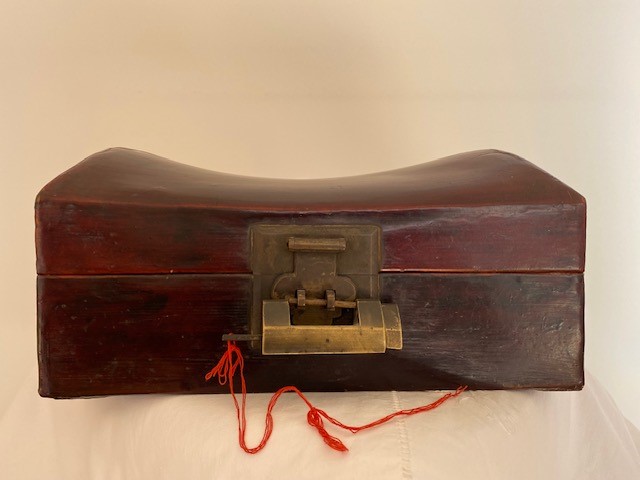
In China, the traditional “pillow box” (枕箱 zhenxiang) was used to store legal documents and other valuable items. Pillow boxes came in many shapes and colours, the most common being the concave “pillow”. People used these boxes to keep household valuables, including important family documents such as land deeds and official certificates, and would use the box as a pillow at night to protect the items from theft. Boxes used by a middle-class family were wooden and rather plain, sometimes covered with ornamental paper and silk fabrics, or painted with designs directly onto the wood.
The most beautiful and sought-after document boxes were used by wealthy merchants while travelling. These boxes were often beautifully crafted with delicate designs of gold leaf and lacquers painted directly onto the polished wood cases or on tightly stretched and padded leather coverings for added luxury and comfort.
Document boxes were also used in Japan, Korea and other Asian countries.
Boxes have also been used for other private purposes in England and China. In England, for example, a “collection box” has been used to collect donations in the form of money. In addition to providing a box for storing the money, a collection box also served a legal purpose. Under the common law, a gift is only legally effective when it is delivered. Once the money is placed in the collection box, the gift is considered to have been delivered or transferred and thereby becomes legally effective.
A similar concept exists under PRC law, as reflected in article 658 of the Civil Code:
Article 658
A donor may revoke the gift prior to the transfer of the rights in the gifted property.
Boxes were also used to store barristers’ wigs (for a discussion about the attire worn by lawyers and judges in courts in England and China, see China Business Law Journal, volume 10, issue 9: Wigs and Robes).
The use of boxes for public purposes
Throughout history, boxes have been used in both England and China for public purposes. In England, for example, the “ballot box” is used when an election is held, and voters cast their vote in the box. In addition, in the Westminster system of government, a “despatch box” is used in parliament to store documents and religious books used when new members enter parliament and swear their oath of office.
In imperial China, edict boxes (奉天诰命圣旨箱) were used to deliver edicts from the emperor. Imperial edicts were documents used exclusively by the emperor for making pronouncements to officials and subjects, including edicts promoting officials. The emperor’s words were considered sacred edicts (圣旨), and his written proclamations “directives from above” (上谕). The imperial edicts were transported to their destination in boxes such as the box in the photograph below.
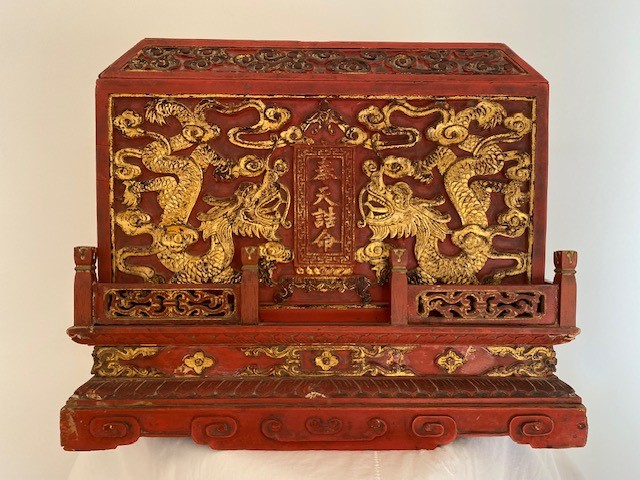
The edict box is ornately carved with dragons, clouds and magnolia flowers. The dragon was the symbol of the emperor and imperial authority. The character for “clouds (云)” is homophonous with “good fortune (运)” and therefore represents the same. The magnolia flower was often found in imperial gardens and represented the nobility and dignity of the imperial family.

Andrew Godwin is currently a member of a World Bank team that is advising a central bank in Asia on potential reforms to its mandate. He previously practised as a foreign lawyer in Shanghai (1996-2006) before returning to his alma mater, Melbourne Law School in Australia, to teach and research law (2006-2021). Andrew is currently Principal Fellow (Honorary) at the Asian Law Centre, Melbourne Law School, and a consultant to various organisations, including Linklaters, the Australian Law Reform Commission and the World Bank.