









As China’s overseas investments grow amid a changing global landscape, companies face a rise in complex cross-border disputes. Sophie Cheng reports
As global tensions rise, cross-border disputes are increasing at an unprecedented rate. Chinese companies expanding overseas now face more complex legal and geopolitical risks than ever.
No longer limited to major corporations, outbound ventures now include startups, e-commerce merchants and individual investors seeking opportunities abroad. But global disruptions – from trade wars and pandemics to economic slowdowns and conflicts – have turned many of them into clients of cross-border dispute resolution services.
To manage these challenges, in-house counsel are strengthening their companies’ capacity to handle disputes across varying jurisdictions. Recent developments, including China’s revised Arbitration Law and the establishment of the International Organisation for Mediation (IOMed) headquarters in Hong Kong, are helping provide a stronger legal foundation for these efforts.
Geopolitical realignment
Dispute resolution is consistently ranked as the most fundamental business in the legal service industry, and partners at many law firms maintain a firm grip on the ebbs and flows of commercial disputes.
“While traditional sectors such as energy and infrastructure continue to generate a high volume of disputes, emerging industries are seeing an unprecedented surge in legal conflicts,” says Cao Lijun, a Beijing-based equity partner at Zhong Lun Law Firm.
In terms of dispute types, as Chinese companies expand overseas, they face not only the usual legal complexity in traditional areas such as engineering, infrastructure and trade, but also new challenges tied to their transition, from product exports to technology and brand exports, says Cao.
This leads to legal issues around equity investments, intellectual property and AI. Additionally, risks arising from post-merger integration failures, performance-linked bet-on clauses and share repurchase obligations are becoming increasingly prominent.
Shaun Wu, a partner at Paul Hastings based in Hong Kong and Shanghai, says he is now acting in increasingly high-stakes cross-border disputes, often involving multiple parties and investment across various jurisdictions.
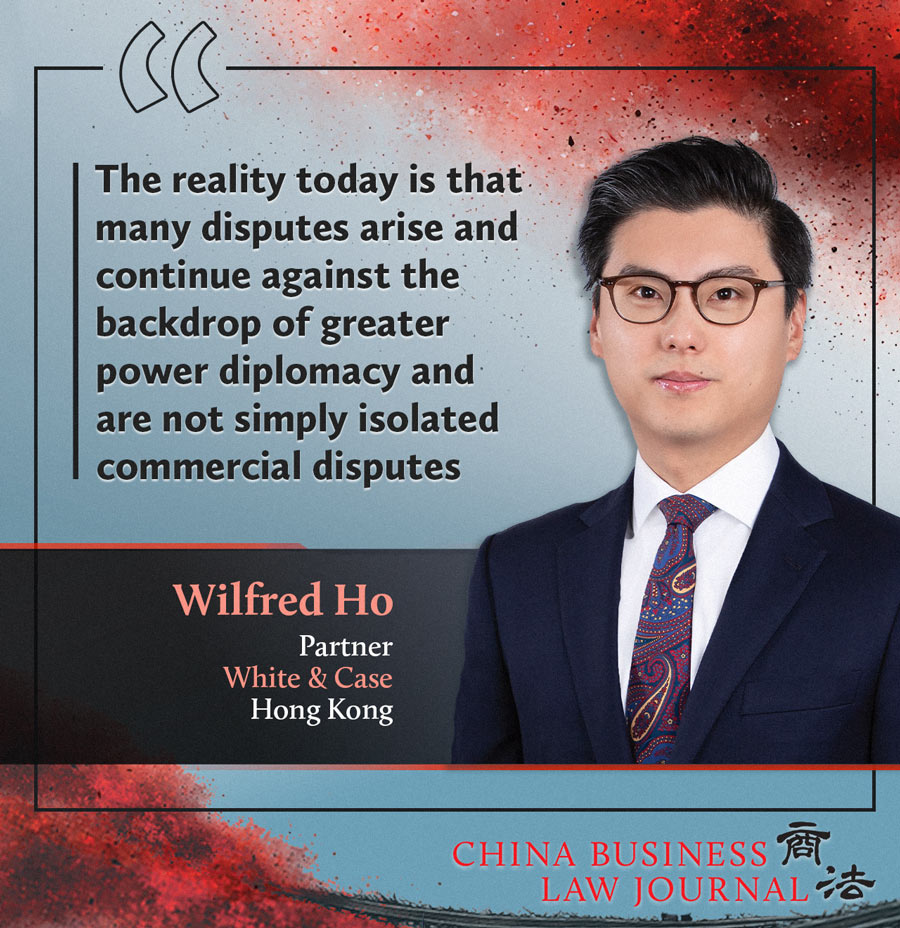
However, there are plenty of legal risks taking effect despite the company’s best efforts at compliance and sound governance. “The reality today,” notes Wilfred Ho, a partner at White & Case in Hong Kong, “is that many disputes arise and continue against the backdrop of greater power diplomacy and are not simply isolated commercial disputes.”
You must be a
subscribersubscribersubscribersubscriber
to read this content, please
subscribesubscribesubscribesubscribe
today.
For group subscribers, please click here to access.
Interested in group subscription? Please contact us.
你需要登录去解锁本文内容。欢迎注册账号。如果想阅读月刊所有文章,欢迎成为我们的订阅会员成为我们的订阅会员。
Practitioner’s Perspective Article Series
Foreign-related arbitration under China’s new Arbitration LawBy Shen Peng and Eva Zhou, Guantao Law Firm |
 |
China’s new Arbitration Law: Modernised and internationalisedBy Vincent Sun and Zhao Yuxian, Han Kun Law Offices |
 |
Recognising, enforcing foreign awards and court judgments in ChinaBy Sun Jiajia and Ariel Gu, W&H Law Firm |
 |
Cross-border debt recovery: Lessons from a guarantee disputeBy Armstrong Chen and Wang Xin, Dacheng Law Offices |
 |
How creditors can protect themselves in cross-border guaranteesBy Huang Xingchao, AnJie Broad |
 |
Good faith in commercial arbitration: China’s evolving approachBy Ren Kaiyu, Langfang Arbitration Commission |
 |
Evolving dispute resolution for securities misrepresentationBy Li Fang, Tiantai Law Firm |
 |