











Investors and their legal advisers are switched on to the most sought after real estate game in Asia, but there are some unique challenges, writes Brian Yap
For Asia, 2025 has seen cross-border challenges arising from ongoing geopolitical and trade uncertainties marked by the Trump administration’s reciprocal global tariff policy, affecting both developed and emerging markets in the region. The real estate space, however, has been bustling with activity in different parts of Asia, with regional and global institutional investors pouring capital into different asset classes including hospitality, logistics, residential, industrial and commercial.
Japan and Australia have been driving real estate investment in the region, recording headline-grabbing deals including Blackstone’s USD2.6 billion acquisition of mixed-use complex Tokyo Garden Terrace Kioicho from Seibu Holdings, and Brookfield Asset Management’s USD2.5 billion sale of Australian senior living operator Aveo to The Living Company. India, Singapore, South Korea and Malaysia have also seen robust cross-border real estate investment from regional and global institutional investors.
Eva Oraham, a real estate partner at Clayton Utz in Sydney, says that her firm has been advising a number of Japanese and Singaporean investors on their real estate transactions in Australia.
Late last year, Oraham was one of the partners advising Japan-listed multinational trading company Sumitomo Corporation on its first investment into Australian real estate. The investment involved Sumitomo entering a joint venture with Mirvac on the Highforest residential development in Sydney’s West Pennant Hills, comprising 165 detached and attached houses, and 249 apartments.
During Asia Business Law Journal’s conversations with senior real estate lawyers spanning nine jurisdictions in the Asia-Pacific, one particular asset class categorised as “new economy” and “alternative” kept coming up: data centres.
Data centre boom
“Among the various asset classes targeted by investors (in Japan), the assets attracting the most interest at the moment include hospitality and data centre assets,” says Joel Rothstein, a shareholder specialising in international real estate and structured finance in Tokyo, and chair of Greenberg Traurig’s real estate practice in Asia.
Norio Maeda, a partner in the real estate practice at Nishimura & Asahi in Tokyo, also points to data centres as being “quite” hot opportunities among investors. He says that, because of the size of such investments, data centre projects normally use several financings involving tranches of lending, leading to various opportunities for data centre investments through debt instruments.
“Although data centres are considered a type of real estate investment, they are very much operational assets,” says Maeda. “There are data centre opportunities that are financed through project finance-type financings, whereas other real estate assets such as hotels, and residential and office buildings, are typically financed by normal, non-recourse real estate lending.”
Global IT services and consulting company IBM defines a data centre as a physical room, building or facility that houses IT infrastructure for building, running and delivering applications and services. It also stores and manages the data associated with those applications and services.
From the start of 2023 to 19 August this year, there have been five announced billion-dollar data-centre deals in Asia totalling USD10.8 billion, Dealogic data show. These included global investment firm KKR and Singapore-based integrated telecoms services provider Singtel’s USD1.29 billion joint acquisition of an undisclosed stake in Singapore-based data centre operator STT GDC, completed last year. Also, announced in June last year, US-based special purpose business acquisition company Cartica Acquisition’s USD2.75 billion merger with India-based data centre provider Nidar Infrastructure is expected to close in October this year.
Thousands of kilometres from Japan, India is also attracting growing interest from investors seeking to expand their real estate portfolios. This growth is supported by strong private equity investment inflows and residential sales, according to US-based global commercial real estate services and investment firm CBRE and UK-founded global property agent Savills.
Data centres have been a key focus for investors expanding their real estate portfolios, says Avnish Sharma, a partner in the real estate practice group in the New Delhi office of Khaitan & Co.
“Data centres have also seen a lot of interest, although primarily concentrated in Mumbai and Chennai,” says Sharma, citing examples including Blackstone’s launch of its own data centre platform, Lumina, in India. “This is largely because these [coastal cities] offer the best undersea fibre-optic cable connectivity.”
In Hong Kong, real estate activity has generally been quiet in the past two years, with a significant increase in activity and transaction volume in the past quarter, according to real estate lawyers at JSM..
Eugene Wong, a real estate practice partner at JSM in Hong Kong, says his team has been busy with distressed real estate matters, particularly involving banks enforcing non-performing loans, acting for receivers in asset sales, for banks in enforcement actions, and for potential buyers acquiring distressed assets.
Wong says that his firm is also seeing growing interest in “new economy” assets such as cold storage?, data centres, logistics and self-storage facilities. This growing interest is creating more financing work for JSM’s real estate practice.
Partner Jasmine Chiu, who specialises in real estate financings in Hong Kong and cross-border property transactions, says that, from a deal origination perspective, new investment money is flowing into alternative asset classes. “For financing new deals, banks are cautious, and they tend to prefer alternative assets such as data centres, cold storage and student accommodation or housing.”
So, why are data centres cropping up so quickly in different parts of the region?
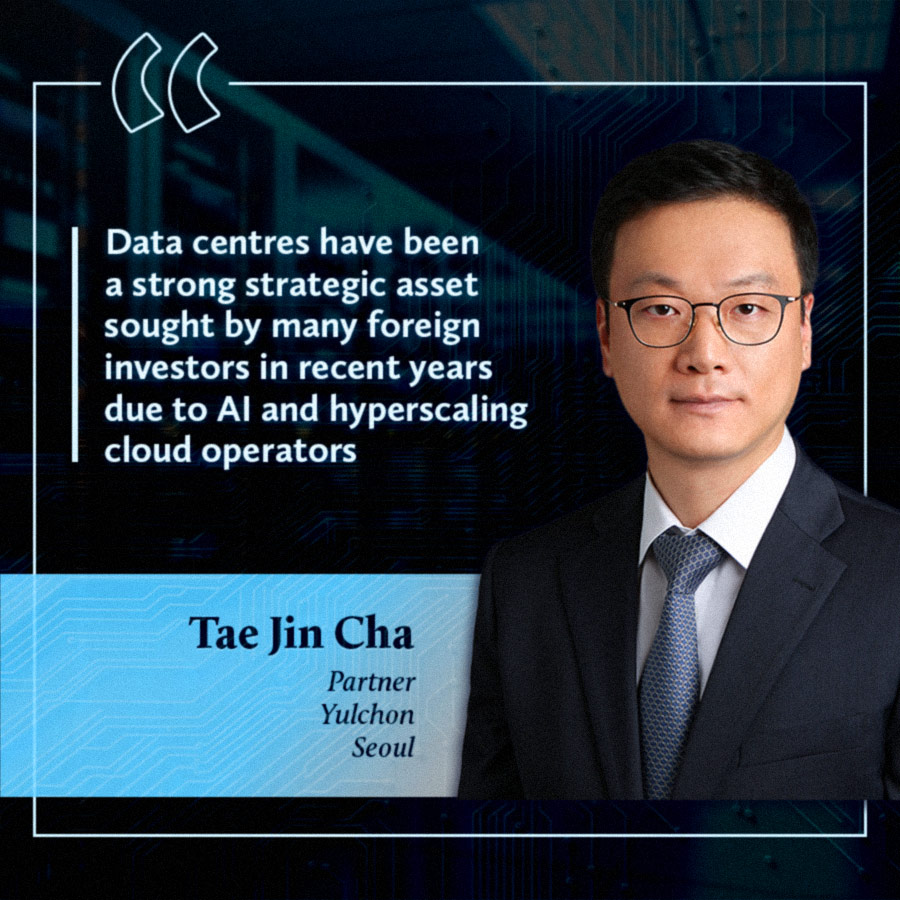
“Data centres have been a strong strategic asset sought by many foreign investors in recent years due to AI and hyperscaling cloud operators,” says Tae Jin Cha, a partner and head of the real estate and alternative investment team with the corporate and finance group of Yulchon in Seoul.
Norman Ho, Rajah & Tann Singapore’s real estate practice senior partner, says data centres have been a very active area because of the increasing need for data storage, while Ai Leen Tang, Kuala Lumpur-based Wong & Partners’ real estate practice group partner, describes data centres as a critical need amid increased digitalisation and the use of AI.
Challenges
Investors will have a different experience with data centres compared with acquiring traditional real estate assets such as commercial buildings and hotels, according to senior lawyers who speak to ABLJ.
Greenberg’s Rothstein says that, despite Japan being an open market with available power, data centre deals are complex and capital-intensive, often raising issues that require his firm’s assistance from concept to completion.
One such issue is navigating the development entitlements and approvals to construct and develop a data centre project. As data centres are somewhat of a new asset class, Rothstein points out that the existing building and zoning regulations do not clearly indicate and address whether or not a data centre can be built on a particular plot of land.
“Consequently, we are often called upon to help clients confirm the availability and the procedures for obtaining the necessary development entitlements and approvals from the relevant governmental authorities to permit a data centre project to move forward,” says Rothstein.
Based in Malaysia, Wong & Partners’ Tang says that, in the past 18 months, her firm has worked on many data centre transactions, assisting tech companies looking to buy large tracts of land in the country. Tang also adds that, throughout Peninsula Malaysia, Wong & Partners has assisted five clients to close data centre transactions in the first half of this year.
In its Q1 2025 Investment Quarterly report, Savills points out that Malaysia continued to perform well, particularly in the data centre sector, with several notable site acquisitions by Microsoft, Google and Open DC.
Tang attributes investor interest in data centre investment in Malaysia to several factors including the country’s ample suitable land and its proximity to Singapore
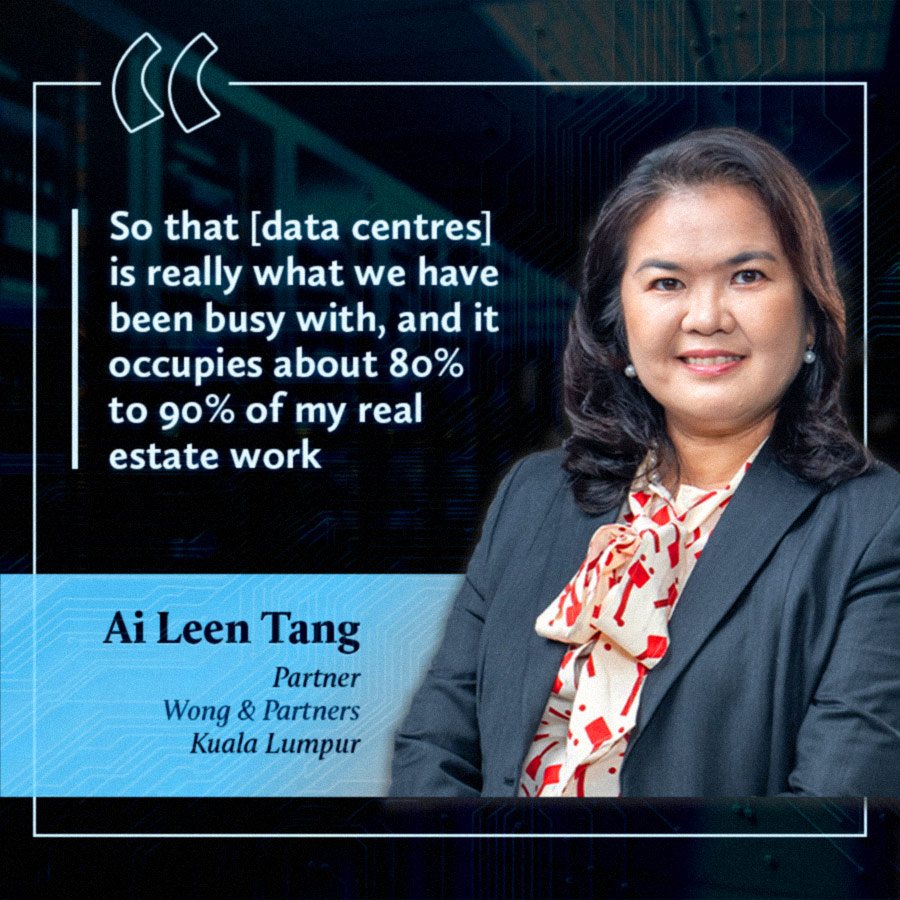
“So that [data centres] is really what we have been busy with, and it occupies about 80% to 90% of my real estate work,” says Tang. “Specifically, there has been strong investor focus on Johor, and it has very much been a spotlight, where it has become a hub for data centre investment.”
Tang says that data centre developments have led to the introduction of new regulations and guidelines, which have created new challenges, as much development is still greenfield. With data centres generally consuming a significant amount of electricity and water, the sustainability of these resources has also been a concern.
To manage these concerns, Tang says that the Malaysian government – both at federal and certain state levels – has introduced new requirements, and specific approvals need to be obtained for planning and developing data centres.
“Typically, we advise our clients as part of their due diligence to ensure sufficient water and electricity to the development site for the operations of their data centres,” says Tang. “For example, in Johor, there is the Johor Data Centre Development Co-ordination Committee, from which developers are required to obtain initial approval before they can proceed with their land acquisition and data centre developments.”
In Thailand, where data centres are also now an active sector, interest in data centre land acquisitions has increased significantly since last year, with a notable rise in enquiries, according to Chaiwat Keratisuthisathorn, a partner in Tilleke & Gibbins’ corporate and commercial group and head of the firm’s real estate practice in Bangkok.
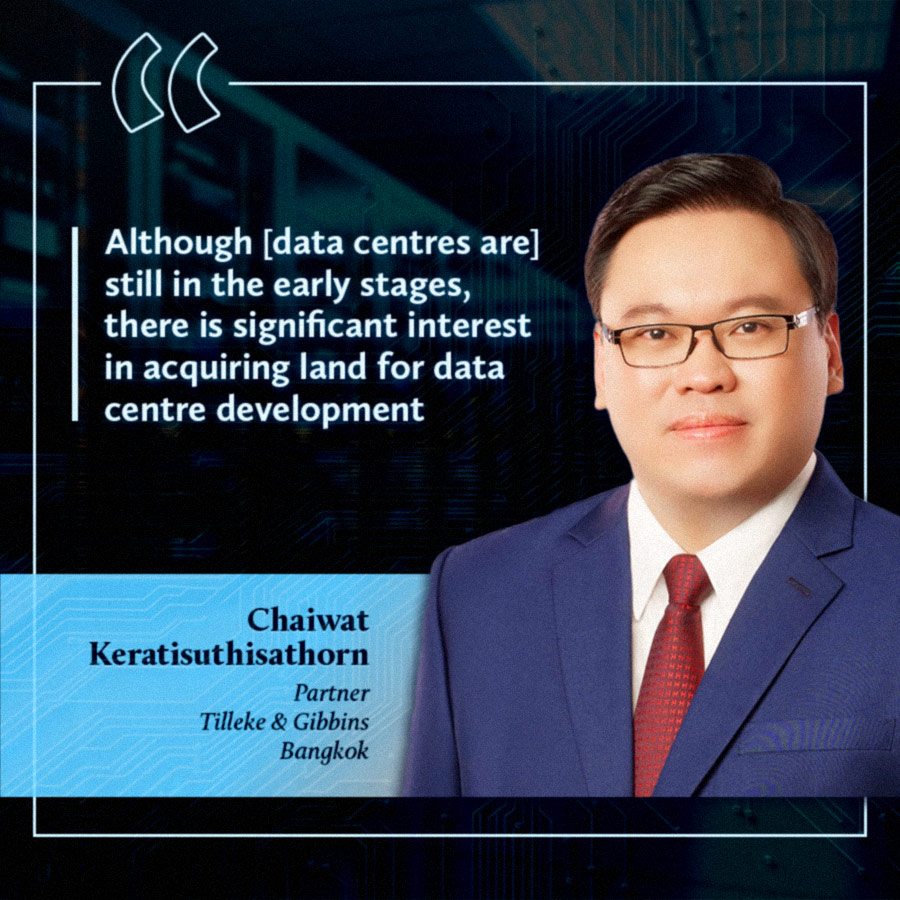
“Although [data centres are] still in the early stages, there is significant interest in acquiring land for data centre development, followed by applications for the necessary telecommunications or related licences,” says Keratisuthisathorn. “Our real estate practice is currently very busy with these transactions.”
As a data centre hub in the region, Singapore currently hosts 99 of them with 548 service providers, according to Cloudscene, a global independent directory of high-speed internet, data centres and cloud services based in Australia.
In a 16 July report titled “Navigating Data Centre Opportunities Across APAC-Singapore”, King & Wood Mallesons, which operates in Singapore, refers to the city-state’s strong submarine cable infrastructure, with full foreign ownership permitted and targeted tax incentives for hyperscalers and enterprise operators serving Asia.
Rajah & Tann Singapore’s Ho tells ABLJ that many of the data centres in Singapore sit on land owned by the Jurong Town Corporation (JTC), a government agency that manages industrial land.
“If you want to invest and develop data centres, you will have to get approval from the JTC [which] will also look at the supply of industrial land in an area, or designate an area for data centre development,” says Ho. “This means that you cannot develop data centres anywhere you want.”
Ho adds that, for data centre matters his firm has advised on, the primary focus has been on local land issues including securing capacity, land rights, and regulatory consent in respect of the specific operations. This also involves securing utilities and advising on more specific data centre-related issues, particularly in relation to capacity allocation and development periods.
Singapore’s Asean neighbour, Vietnam, has been singled out by Savills for its solid performance in the industrial and residential sectors, as well as steady demand for logistics assets. The fast-growing economy is also rapidly emerging as a data centre investment destination in Asia, with a yield-on-cost second only to Singapore, according to US-based global commercial real estate services firm Cushman & Wakefield in a report published in July this year.
Tran Thai Binh, the partner in charge of LNT & Partners’ real estate and infrastructure practice group in Ho Chi Minh City, says his firm recognises that one of the main challenges for investors in the data centre sector is compliance with the country’s new Personal Data Protection Law (PDPL), passed in June this year.
“This legislation presents several uncertainties in terms of interpretation and implementation,” says Tran. “For instance, certain prohibitions, such as the collection or use of personal data in ways deemed to be against the Vietnamese government, national security or defence, or the lawful interests of organisations and individuals in Vietnam, require further clarification and official guidance.”
Source of investment
To a large extent, the data centre frenzy that has swept across different parts of Asia, and the wider intra-regional real estate investment flow, has been driven by regional and global institutional investors from and through Singapore, several senior real estate lawyers in the region tell ABLJ.
Greenberg’s Rothstein, whose firm operates in Tokyo, Seoul, Singapore and Shanghai, says that Asia and internationally based private equity funds and asset managers base their Asia operations in Singapore, using its holding company structures that take advantage of tax treaties and incentives.
With Singapore’s relatively small domestic market, he adds that there is a need for investors to search for options and opportunities beyond its borders.
With operations on the ground, Rothstein also observes that Singapore has several categories of deep-pocketed investors all in one country that are actively interested in and focused on real estate investment, including Singapore-based sovereign wealth funds, real estate developers, real estate investment trusts (REITs), and family offices.
“In some countries, REITs are restricted from investing beyond their country of formation, but this restriction does not apply in Singapore,” says Rothstein. “In the category of family offices, Asia-based high net worth individuals are increasingly managing their funds out of Singapore, with real estate becoming a favourite alternative asset class.”
Rajah & Tann Singapore’s Ho, whose firm operates a regional network of offices covering 10 jurisdictions, says that very often foreign investors establish a special purpose vehicle in Singapore for investing in real estate assets in the Asean region because it is more convenient administratively.
“We have acted for clients who used Singapore as a base, establishing a joint venture agreement in Singapore, but with the venture itself being in other countries such as Vietnam and Malaysia,” says Ho.
“They use us in Singapore to work out the framework agreement to co-ordinate and work with our regional offices for their regional investments.”
He adds that many such clients, including regional and international companies, have their Asia-Pacific head offices in Singapore and use the country as their business platform for their real estate and M&A transactions in the region. For the regional companies, Ho points out that their home headquarters are largely in mainland China, Hong Kong and Singapore.
In Thailand, Tilleke & Gibbins’ Keratisuthisathorn has also seen Chinese investors being very active in data centre investment. He notes that China-headquartered investors normally invest through a holding company in Singapore or Hong Kong due to many reasons, especially restrictions on overseas investment and foreign exchange regulations in China.
“In addition, we were informed by some clients that Singapore and Hong Kong are in Asia and also use Chinese language, and that makes such countries more attractive to Chinese investors,” says Keratisuthisathorn.
Singapore-headquartered companies are also very active in data centre investment in Thailand, Keratisuthisathorn adds.