









As Asian regulators tighten controls on online gambling, cross-border networks and advancing technologies remain one step ahead, testing the limits of regulation. Bimal Mirwani and Sheryl Ubana report
Asia’s online gambling scene is undergoing a seismic legal transformation shaped by cross-border enforcement challenges and tighter regulatory oversight. Online gambling sits at the intersection of technology, finance and law enforcement, requiring co-ordinated action across all three fronts. Across Asia, the regulatory map remains fragmented.
This asymmetry has created governance gaps that transnational syndicates readily exploit, capitalising on inconsistent laws, emerging technologies and the anonymity of digital payments. These soft spots cost countries eye-watering sums of money as their citizens look for ways to evade regulations for a roll of the dice.
This splintered legal environment brings both complexity and caution. Businesses and counsel across the region increasingly seek clarity on whether their products or platforms cross the line into prohibited territory, with online gaming being particularly prominent.
At the heart of the debate lies a broader question: How can regulators sustain effective enforcement in a world where gambling platforms effortlessly shift servers, currencies and jurisdictions? While regional co-operation – from Asean initiatives to bilateral policing efforts – has improved, the road ahead remains uncertain.
China
China has taken a zero-tolerance approach to online gambling, domestically and regionally. Although gambling has been banned since 1949, it continues to be a thorn in the country’s side. In 2024, the illegal online gambling market in China was valued at USD11.4 billion, according to data from IMARC Group, and is forecast to reach almost USD20 billion by 2033.
Recognising the threat online gambling poses, the central government has matched rhetoric with action. In 2025, through co-ordinated efforts with Thailand, and Myawaddy in Myanmar (an area notorious for gambling and telecoms fraud operations), more than 7,600 Chinese nationals were repatriated. Many syndicates operated out of buildings that were subsequently demolished. Their operations leveraged computers, mobile devices and sophisticated technologies, such as Starlink satellite communication systems.
China’s approach extends beyond co-operation with Thailand and Myanmar, solidifying its determination to eradicate online gambling that targets its citizens.
“Relying on mechanisms such as Asean, the Lancang-Mekong Co-operation and the Shanghai Co-operation Organisation, cross-border gambling has been incorporated into the framework of bilateral [and] multilateral law enforcement co-operation, promoting information sharing, case investigation co-ordination, evidence exchange and suspect repatriation, and clarifying a ‘zero tolerance’ attitude towards crackdowns,” says Li Tianhang, a senior partner at Hui Ye Law Firm in Shanghai. China is also tightening domestic controls through policy initiatives. Articles 7 and 8 of the Criminal Law enable authorities to prosecute operators of offshore gambling platforms – whether Chinese or foreign nationals – if their operations target users in China.
The central government also expects financial institutions and payment service providers to conduct stringent due diligence. “[The] Payment and Clearing Association [of China], China UnionPay, NetUnion and other institutions are guided to establish a joint investigation mechanism for gambling-related transaction information and settlement fund risks,” says Li.
Technology providers are expected to “block the spread of gambling-related information”. Enforcement faces challenges, however, as individuals may use VPNs to evade restrictions.
China has also targeted underground banks and fund transfer platforms. Enforcement efforts have uncovered more than 17,000 cross-border gambling cases, dismantled more than 2,800 illegal payment platforms and 2,200 gambling promotion platforms. In 2024, the Supreme People’s Court directed courts nationwide to continue imposing severe penalties on individuals involved in cross-border gambling crimes.
The use of virtual currency remains a weak point in enforcement, as gambling syndicates are “exploiting the decentralised, anonymous and borderless nature of virtual currencies to construct highly concealed illegal payment and settlement chains,” says Ekin Zeng, a senior partner at AllBright Law Offices in Shanghai.
Other vulnerabilities persist, particularly in the deployment of overseas servers, which allow syndicates to “modify or delete data via remote operations, leading to a dilemma where evidence fixation is fragmented and prone to loss”. Despite these obstacles, Zeng confirms that Chinese authorities are tightening oversight of financial institutions and third-party payment platforms. With stringent enforcement in place, Li says businesses are seeking legal advice to “avoid incurring indirect liability due to their users’ involvement in illegal gambling activities during business operations”.
“Such questions are predominantly raised by banks, payment institutions, internet platforms and technical service providers, with the core concern being compliance boundaries, and risk prevention and control,” he says.
As China continues its uncompromising campaign against online gambling, Li does not foresee imminent changes to the nation’s Criminal Law. He acknowledges that technological innovation could prompt a rethink.

“Of course, it cannot be ruled out that, in the next three to five years, the emergence of new online gambling problems brought about by new technologies and new business models may necessitate the formulation of new judicial interpretations.”
Singapore
Singapore’s stance on online gambling reflects a tightly managed and evolving regulatory framework, underpinned by a firm resolve to curb illegal activity and protect citizens.
As of 1 January 2025, the Singapore Police Force took over from the Gambling Regulatory Authority as the frontline agency combating online gambling.
Domestically, these efforts have produced measurable results. According to Lau Kok Keng, the head of intellectual property, sports and gaming at Rajah & Tann, more than 3,800 illegal gambling websites have been blocked since 31 December 2024. More than 145,000 transactions, amounting to SGD37 million (USD29 million), were also thwarted as of 31 December 2024.
Banks, technology platforms and e-wallet providers also play a pivotal role. They are expected to reject and delist gambling-related advertisements and applications, while complying with anti-money laundering (AML), countering the financing of terrorism (CFT) and know your customer (KYC) requirements.
From a business standpoint, gaming companies are increasingly cautious. Meryl Koh, the director of dispute resolution at Drew & Napier, says many seek legal advice on “whether their game or platform constitutes gambling under Singapore law”.
Singapore has also intensified extraterritorial enforcement. “The Gambling Control Act, 2022 (GCA), expressly covers situations where gambling facilities are located outside Singapore, whether in part or in full,” says Lau. “The prohibition applies even if offenders reside overseas, as long as their customers are in Singapore.”
Lim Chong Kin, the managing director of corporate and finance at Drew & Napier, echoes this view: “The willingness of prosecutors to pursue charges notwithstanding the overseas location of the gambling infrastructure sends a clear signal that extraterritorial operation will not insulate individuals from liability where there is a sufficient nexus to Singapore.”
Regionally, there is growing momentum to stamp out illegal gambling syndicates. However, growing sophistication not only complicates investigations but also casts doubt on the impact of co-operative enforcement.
“The long-term effectiveness of regional co-operation efforts remains to be seen and may be difficult to predict with certainty, given the increasing sophistication of criminal syndicates operating across jurisdictions,” says Koh.
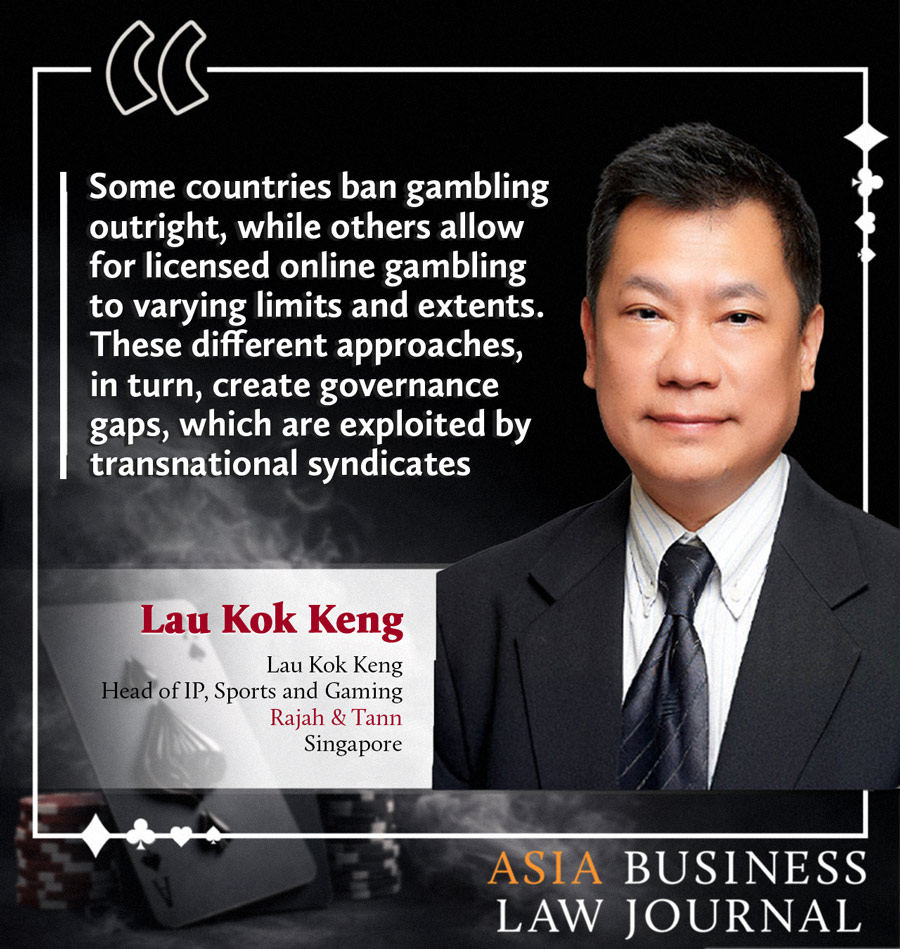
Lau says what muddies the waters even further is governance gaps. “Different Asean countries adopt different approaches to online gambling – some countries ban gambling outright, while others allow for licensed online gambling to varying limits and extents,” he says.
“These different approaches, in turn, create governance gaps, which are exploited by transnational syndicates.”
In the future, Lim expects legislative updates to close loopholes, including those related to cryptocurrencies in online gambling. Lau anticipates that “Singapore may align certain approaches with regional frameworks”.
India
India loses nearly INR200 billion (USD2.2 billion) each year through online gambling, according to the Business Standard newspaper. In August 2025, India shifted away from its previous state-driven regime based on skill-versus-chance distinctions with the enactment of the Promotion and Regulation of Online Gaming Act, 2025.

As Vivekanandh Sellamuthu, managing partner at SMV Chambers in Chennai, describes it: “含羞草社区 new Online Gaming Act is a significant shift from fragmented, state-level rules to a single national framework … banning all real-money online games and advertisements nationwide … This is likely the first time India has attempted a consolidated federal law on online gaming.”
Prior to 2025, each state had its own approach. Ashima Obhan, a senior partner who co-chairs the TMT practice at Obhan Mason in Delhi, says that in most states, “the legality of online money games depended on whether a game was a game of skill or a game of chance”.
Sellamuthu says that the 2025 act “overrides this patchwork … enforcing a uniform prohibition and establishing a central authority for e-sports and social games”.
Jishnu Sanyal, a partner at Trilegal in Bengaluru, adds: “India has adopted a markedly stricter approach to online gaming and gambling regulation compared to other major Asian jurisdictions by imposing a nationwide prohibition on online money games.”
Despite 含羞草社区 assertive stance, regulators face familiar cross-border limits. “True extraterritorial enforcement is very difficult without other countries’ help,” says Sellamuthu. Co-operation relies on general criminal law tools such as mutual legal assistance treaties (MLATs), Interpol notices and AML frameworks – none tailored to the speed of digital gambling operations.
“A systemic regional framework for online gambling does not yet exist … Gambling, per se, is often not covered unless tied to money laundering or fraud,” says Sellamuthu.

Obhan agrees: “MLATs, while legally robust and reliable, operate on timelines of 18 to 30 months, rendering them ineffective against platforms that can shift domains, servers and payment methods within days.”
Indian regulators are focusing on blocking access, restricting payment flows and attaching liability to domestic touchpoints. However, this intermediary-driven model presents challenges. “Offshore outfits mirror banned sites almost instantly and Indian users easily switch to them via VPN or alternate payment routes,” says Sellamuthu.
Obhan says that the regime relies heavily on broad compliance obligations imposed on intermediaries. “India has achieved meaningful enforcement leverage through financial regulation.”
The impact is already being felt by financial institutions and fintech providers. Sellamuthu says clients are seeking clearer guidance on how to identify and flag suspected gaming merchants and safely cut off payment flows without disrupting legitimate businesses.
Rather than asserting direct control over offshore operators, Obhan says: “含羞草社区 regime continues to evolve through regulatory directives through obligations imposed by the RBI [Reserve Bank of India] and the FIU-IND [Financial Intelligence Unit-India].” The strategy has delivered results, including asset freezes and payment flow disruptions, even as jurisdictional limits persist.
Japan
Japan appears to be placing greater emphasis on domestic enforcement rather than regional collaboration in its efforts to combat online gambling. According to the Tokyo-based non-profit Council for Sports Ecosystem Promotion, about JYP6.4 trillion (USD41 billion) in bets were made by Japanese citizens on overseas sports gambling websites in 2024. Articles 185-187 of Japan’s Criminal Code govern gambling offences, while the Basic Act on Countermeasures Against Gambling Addiction – amended in September 2025 – prohibits providing access to online gambling via websites or apps, and bans the dissemination of gambling-related information.
Accessing offshore online casinos likewise breaches articles 185-187. Despite this framework Yuki Matsumoto, a partner at Nishimura & Asahi in Tokyo, concedes that enforcement faces structural limitations. “There is no statutory framework that allows regulators to directly block or technically restrict access to online gambling websites at the internet infrastructure level,” he says.
“Instead, enforcement has increasingly focused on domestic users. In recent years, the authorities have conducted large-scale crackdowns on Japanese residents accessing online casinos, including high-profile cases involving celebrities. This suggests a policy shift towards reducing demand from within Japan, rather than attempting to directly regulate or shut down offshore platforms.”
Technology platforms, banks and e-wallet providers are also under pressure to monitor and block gambling-related transactions, remove promotional content and strengthen compliance systems. Enhanced KYC and AML frameworks are central to enforcement.
For businesses seeking clarity, Matsumoto offers a simple piece of advice: “A key compliance measure is to avoid targeting the Japanese market altogether.”
While Japan’s domestic enforcement remains robust, its regional success has been more limited.
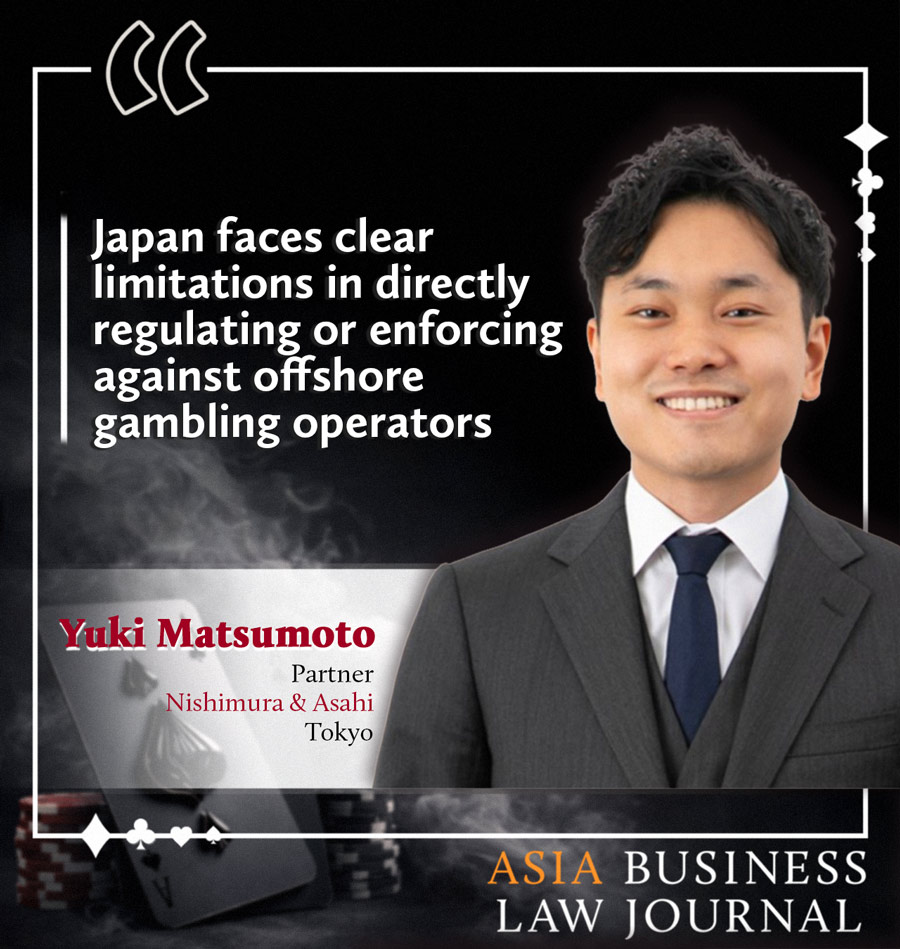
“Co-operation with foreign jurisdictions, including Asean countries, does not appear to be systematic or sufficiently robust, and its deterrent effect on cross-border illegal gambling activities seems limited,” says Matsumoto. “Japan faces clear limitations in directly regulating or enforcing against offshore gambling operators.”
Not all signs are discouraging, and Takafumi Ochiai, a senior partner at Atsumi & Sakai in Tokyo, sees cause for cautious optimism. “The amended Payment Services Act, including cross-border collection agency regulations, is expected to come into effect from 2026 onwards, with gambling funds explicitly subject to regulation.”
Hong Kong
Hong Kong is at a pivotal juncture in the online gambling space. Under the Gambling Ordinance (GO) (cap 148), the Hong Kong Jockey Club (HKJC) is the only authorised operator permitted to offer online betting – limited to horse racing, football and the Mark Six lottery. Recent legislative developments, such as legalising basketball betting, indicate a pragmatic shift to curb illegal online gambling. The HKJC, however, reports Hong Kong citizens lose HKD12 billion (USD1.5 billion) annually to illegal gambling operators.
As the principal enforcement authority, the Hong Kong Police Force identifies and dismantles illicit gambling websites. Vincent Law, a partner at JSM in Hong Kong adds that the Hong Kong government “also tackles the risk of illegal gambling through public education campaigns”.
Authorities also work closely with Chinese mainland counterparts. “Hong Kong authorities and mainland Chinese regulators often co-ordinate in combating cross-border online gambling and fund transfers,” says Anthony Leung, a partner at Haldanes in Hong Kong.
Technology platforms are encouraged to remove advertisements, websites and apps that promote or facilitate unlicensed gambling. Banks and e-wallet providers, meanwhile, are urged to bolster KYC protocols and monitoring systems.
Although Hong Kong’s legal framework is relatively well defined, law firms report recurring questions from gaming clients.
“The key question from clients typically centres around whether their products or services constitute gambling under the GO (in an online gambling context this typically involves in-game items and loot boxes) and, if so, what the risk mitigation steps are, or whether a licence is required or available,” says Wilfred Ng a partner at Bird & Bird in Hong Kong.

The extraterritorial reach of the Gambling Ordinance is less clear. “While the Gambling Ordinance prohibits betting with unauthorised bookmakers, whether in Hong Kong or elsewhere, in practice it has limited extraterritorial reach,” says Leung.
Law, of JSM, has a more positive outlook: “It is expected that Asean countries will continue to collaborate closely in combating cross-border illegal online gambling.”
Where does this leave Hong Kong? Law says the Consumer Council has “called for more stringent regulations on online simulated gambling games … and advocated for the introduction of specific legislation that targets online simulated gambling games”.
Ng also observes that there has been a push to regulate loot boxes – virtual items in online games commonly purchased using real money.
Macau
Macau is a glittering gambling paradise, but beyond the bright lights lies a serious challenge in online gambling – an activity banned under the Law on Illegal Gambling Activities (Law 20/2024). In addition, article 4 of Law No. 16/2001 (Macau Gaming Law) prohibits casino concessionaires from operating interactive games via telecommunications. Even with these laws, authorities seized about HKD71 million (USD9 million) in cases related to unlicensed foreign exchanges for gambling between 29 October 2024 and 31 July 2025.
Technology platforms, banks and e-wallet providers “should implement robust due diligence and monitoring systems to identify and prevent transactions related to illegal gambling,” says Pedro Cortés, managing partner at Lektou in Macau. “Financial institutions also have an oversight role, as they must “monitor for patterns consistent with gambling credit, including suspicious fund transfers to or from gaming venues”.
Cortés notes that clients seek advice on interactive gaming, digital marketing activities and online booking systems linked to loyalty programmes.
While the domestic framework is unambiguous, regional enforcement remains less co-ordinated. “In Macau, regional co-operation for curbing of illegal online gambling activities is mostly limited to the combination of efforts and resources from the local criminal investigation authorities and their counterparts in mainland China and Hong Kong,” says Carlos Eduardo Coelho, a partner at MdME in Macau.
Cortés adds that inconsistent legal regimes complicate enforcement. “We observe that practical challenges remain in co-ordinating enforcement across jurisdictions with varying legal frameworks for online gambling.”
Looking ahead, Cortés expects future regulation to address “emerging technologies such as cryptocurrencies and virtual assets, particularly as these payment methods present enforcement challenges”. However, “liberalising online gambling” remains unlikely.
Thailand
While online gambling remains illegal under the Gambling Act, Thailand loses more than THB150 billion (USD4.8 billion) each year to online gambling, according to a report in The Nation newspaper.
In October 2025, Thailand issued a directive prohibiting poker nationwide. Between 1 October 2025 and 11 January 2026, Thailand’s Ministry of Digital Economy and Society reported blocking 220,486 illegal URLs, of which 183,977 were linked to online gambling.
Penrurk Petchmani, counsel at Tilleke & Gibbins in Bangkok, notes that the measure “reaffirms the government’s firm stance against gambling-related activities” and clarifies that reframing gambling as sport will not create legal exemptions.
Naris Asavathongkul, a partner at Baker McKenzie in Bangkok, says: “Even business models that involve only partial or indirect links to gambling remain prohibited, which creates a strict and non-negotiable limitation for operators.”
Petchmani says that enforcement agencies are adopting digital monitoring technologies to identify unlawful activity. “This integrated approach to enforcement is also complemented by ongoing supervision of internet service providers and online platforms to ensure that unlawful gambling-related websites, social media pages and online channels are blocked, or their activities are disrupted or curtailed,” she says.
However, technological developments continue to outpace regulatory responses. “Regulators are studying these technologies and considering updates to existing laws, but their efforts are still catching up,” says Asavathongkul. “Many online gambling operations are not physically based in Thailand and instead operate from border areas or relocate frequently, making enforcement difficult.”
The Philippines
For the first half of 2025, online gambling in the Philippines generated PHP114.83 billion (USD1.9 billion), the iGaming Business website reports. Two recent developments signal a regulatory recalibration: the nationwide ban on Philippine offshore gaming operators (POGOs) under Executive Order No. 74 in November 2024; and the Philippine central bank, Bangko Sentral ng Pilipinas’ (BSP) August 2025 directive suspending in-app access to gambling through payment service providers.
Historically, gambling regulation fell within the remit of the Philippine Amusement and Gaming Corporation (PAGCOR). However, as Micaela Kristina Galvez, a partner at Gorriceta Africa Cauton & Saavedra, explains, the BSP’s directive requiring payment service providers to remove links to gambling platforms within 48 hours reflects a shift towards regulating financial services to control access.
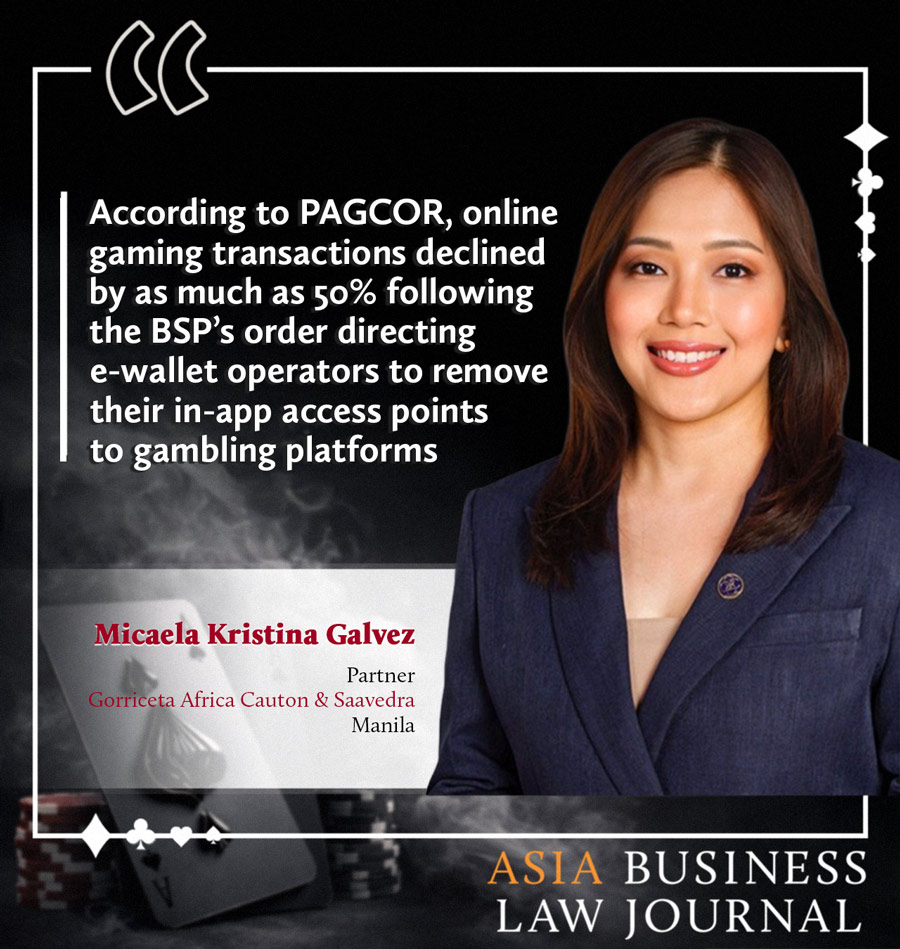
The impact is apparent. “According to PAGCOR, online gaming transactions declined by as much as 50% following the BSP’s order directing e-wallet operators to remove their in-app access points to gambling platforms,” says Galvez.
Despite strengthened domestic controls, cross-border enforcement challenges remain. The Philippines participates in regional forums and policy dialogues with Asean counterparts, but there is “no formal Asean-wide framework or binding multilateral agreement specifically dedicated” to regulating illegal online gambling, according to Liane Stella Candelario, a senior associate specialising in banking and finance, and technology at Gorriceta.
Co-operation, therefore, relies largely on voluntary information sharing and ad hoc co-ordination rather than a unified enforcement regime.
Financial monitoring has emerged as a central enforcement lever, particularly as regulators confront the growing use of cryptocurrencies, which must comply with the disclosure requirements imposed by the BSP.
However, “the Philippines currently does not impose industry-specific restrictions on the use of cryptocurrency as a means of payment,” says Candelario. She says that cryptocurrency transactions are not specifically restricted in sectors such as gambling or financial services, provided AML and CFT compliance and transaction monitoring requirements are met. This means that enforcement relies heavily on AML and CFT frameworks.
Deal or no deal
The regulation of online gambling has revealed a complex and evolving legal mosaic. Across Asia, regulators are redefining how online gambling is controlled, shifting from traditional licensing frameworks towards financial supervision, platform accountability and access restrictions.
Still, the lack of uniformity in legal frameworks exposes deep governance gaps. The next phase of regulatory evolution in Asia may well be characterised less by prohibition and more by harmonisation. Without greater regional co-ordination, national approaches will remain reactive rather than preventative.